Proposal: method neutral regulations (request for STM as the official WCA metric)

Beginner LBL method has pretty much no chance to win FMC. No fair! Not method neutral! We should introduce method handicaps. So that people aren't disadvantaged just because they use beginner LBL.

Overall I think this standpoint is a remnant of when cubes were so stiff you really couldn't independently turn an inner slice
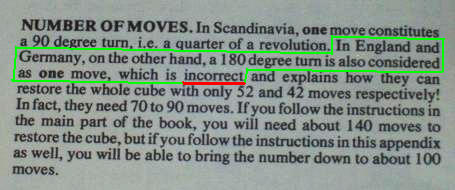
When was that? I'm pretty sure slice moves have been possible since the 1970s.

Btw, good time to re-post one of my favorite quotes from a cube book:

incorrect.jpg
 
Last edited:
The opposition: Because CFOP users sometimes 'abuse' the +2 penalty by simply not finishing their solves, other users (Roux, mainly) want the ability to have failed to execute the final turn of the solve as well (which is more likely to be an M or M'), and still only be penalized +2 instead of DNF. If CFOP users can benefit from this, why can't Roux users do so more easily?

Abusing the regulations by simply not finishing their solves and getting a +2 instead of simply finishing the last turn... How long exactly does a single turn take?

It would definitely make some methods more viable, but whereas you see those methods as inherently inferior, I see them as merely stifled by unfair regulations. Why are corner insertions inherently better than edge insertions?

I fail to see how this legitimately makes any method more viable. I don't honestly believe that any method has been "Stifled by unfair regulations towards them". Well actually, now that I think about it, lots of slower methods have be unfairly stifled because they are slower than others. I suggest we give a 10 second handicap to anyone who decides to use a beginner LBL method in competition.
 
My thoughts are that adding M turns in FMC would change the event completely. But having a M off by 90 degrees being a +2would mean changing it for FMC as well for the sake of consistency.


Edit: also if they were to add M as one move. In FMC you'd have to treat it like a new event. Since having M turn count as one is an advantage.
 
Last edited:
Okay? So? FMC is changed FOR THE BETTER so people can get better results. This is a bad thing, how? Because old results are less efficient? So...? If someone can get a 20 with HTM, then I'm sure they can get better than that with STM. It really isnt that big of a deal to change something.
I also support removing of +2s altogether.
 
And yet only one is official. One option would be to make STM FMC and Classic FMC, but people always say "there's no time" when people want to add a new event, so I'm not seriously lobbying for that. If only one can be official, people will obviously want HTM because they're already good at it, but I still say it's the less logical option and hinders some methods that are only being held back by tradition in spite of logic.

What logic?

I think you're still missing the idea that the M is completely arbitrary. It doesn't really matter what M is. People built the methods based on the M. If the method works better with HTM than STM, than it's a better method for the current definition of M. If it were changed to HTM, the methods would change. If people are using a method that takes advantage of STM rather than HTM, than they are studying a method that won't help them with the current definition of FMC. Changing the definition only helps people that are using currently inferior methods. It's like saying measuring speed solving in seconds hinders people that use slow methods. It doesn't really make any sense.


Okay? So? FMC is changed FOR THE BETTER so people can get better results. This is a bad thing, how? Because old results are less efficient? So...? If someone can get a 20 with HTM, then I'm sure they can get better than that with STM. It really isnt that big of a deal to change something.
I also support removing of +2s altogether.

Changing HTM to STM will lower the number, but a lower number doesn't mean "better". The "M" in FMC is similar to the seconds in speed solving. The lower the M the better, the lower the seconds the better. Changing the definition of M in order to allow people to get lower scores would be the equivalent of changing the definition of seconds to allow people to get lower scores. If we measured times in minutes instead of seconds, Mats Valk's 5.55 solve would instantly drop to .0925, but it's not really better, you've just changed the definition.

 
Changing HTM to STM will lower the number, but a lower number doesn't mean "better". The "M" in FMC is similar to the seconds in speed solving. The lower the M the better, the lower the seconds the better. Changing the definition of M in order to allow people to get lower scores would be the equivalent of changing the definition of seconds to allow people to get lower scores. If we measured times in minutes instead of seconds, Mats Valk's 5.55 solve would instantly drop to .0925, but it's not really better, you've just changed the definition.

one reason it's not fair to just change the definition of "M" is because all the old FMC solutions are written for HTM. I'm sure a bunch of people have solves with " U D' " somewhere in the middle of their solutions. But there's no way to go back and subtract a move from all these solves at this point. and it's unfair to rank new solves against the old ones if the regulations are changed.

there is no good way to change the regulations without changing the event (like how they changed from the old multi-blind format to the new one).

the WCA was just dumb when they wrote the rules in the first place. no surprise there.

giphy.gif
 
The choice of metric is really just an arbitrary choice -- any arguments people have had for one metric over another are completely subjective.. HTM was commonly known and understood. STM is also a valid metric. But why make an arbitrary change to STM that would both completely change how people approach the event and make previous records inconsistent?

the WCA was just dumb when they wrote the rules in the first place. no surprise there.

Do you only post things to bait people into dumb arguments?
 
Do you only post things to bait people into dumb arguments?

no. but it's been a decade since they arbitrarily chose that metric.

i thought by now you'd come up with some justification besides "HTM was a commonly understood metric." personally, i can't think of a dumber reason that doesn't involve extraterrestrials or dowsing rods.
 
no. but it's been a decade since they arbitrarily chose that metric.

i thought by now you'd come up with some justification besides "HTM was a commonly understood metric." personally, i can't think of a dumber reason that doesn't involve extraterrestrials or dowsing rods.
Do you have a better (not subjective) reason to suggest some other metric then? If you do I will gladly listen. Btw "byhyy rouxers can get more dnfs" or "I think M is 1 move" are not good reasons. I can just as well think that U D is 1 move or that U2 is 2 moves as discussed earlier at this topic
 
Do you have a better (not subjective) reason to suggest some other metric then? If you do I will gladly listen. Btw "byhyy rouxers can get more dnfs" or "I think M is 1 move" are not good reasons. I can just as well think that U D is 1 move or that U2 is 2 moves as discussed earlier at this topic

yes.

the reason you can count moves in a speedsolve or efficiency solve is because they occur one after another.

for example, sune has 7 moves because the moves must be executed in this order: " R U R' U' R U2 R' ." you can't combine or switch around any of these moves. the order is defined because the axes involved intersect at every move

however, when executing slice moves, or other moves about the same axis, the moves can occur at the same time. because of the way the FMC solve-sheet is set up, we have to arbitrarily assign an order to these moves, "U D2" or "D2 U," when in reality an optimal solver, or a cuber, or a cubing robot would execute these moves in the same moment, and the state of the cube can be immediately changed from "F2 B" to "F' b' B2" without any defined intermediate position. (edit: IN OTHER WORDS. R U R' must pass through 4 different states [initial, and the 3 following moves], and each state should require a representative move, but L2 M R only requires 2 states to represent it completely [initial and final])

therefore, in my opinion ATM is the best metric for measuring "efficiency." you can read Snyder's justification here.

you could apply a similar argument to QTM, arguing that every possible, intermediate position must be directly passed through (IE. U2=U U passes through U state of the cube before moving to the U U state), which only requires QTM to satisfy 100% of the time.


however, i cant justify HTM, FTM, or OBTM, or what have you. any ideas?
 
Last edited:
I believe three things:

1) There is no truly method-neutral metric.
2) The choice of official metric is arbitrary, and the best is just to pick one and stick with it.

The efficiency of each method depends a bit on the metric – and even then, it depends on your specific approach and your algs.
You want Roux to be given a boost, but I don't think you've made (or can make) the argument that moving to STM is truly neutral over all possible methods.

FMC has always used OBTM (even when it was described as HTM, which is less specific).
Alignment penalties have been restricted to at most a single misaligned slice, since 2008 (read the change for 10e here).

This has been clear to competitors, and they had the choice to take it into account any time they learned new techniques.
By now, competitors have also presumably optimized their techniques for OBTM, and it would be unfair to change it on them without a really good reason.

So I remember when there was a proposal about fixed orientation for blind and people rejected it in part because it wasn't method neutral.

This thread?
It wasn't really about method neutrality. Practical fairness is a much bigger issue.

Back to the matter at hand: essentially this a question of which metric makes more sense. You say HTM, I say STM.

And someone says QTM and someone says ATM.

because it logically makes sense

Here, I made up an explanation that OBTM is logical: You have two hands. Take one hand, and hold one section of the puzzle. Take the other hand and use it to move the other section as one piece. That counts as a move, and anything else has to be broken down into these moves.

Several metrics are "logical" and "natural", and we really just have to pick one. I think that the general consensus in this thread is that OBTM is at least as logical as any other choice.

(I personally think OBTM is a bit more natural. But I think that's less important than a consistent choice, and OBTM has worked well enough.)

SWhen a CFOPer fails to AUF properly there is a +2 penalty. However, if a Rouxer is off by an M2 the solve if DNF'

I said I had three beliefs. The last one is actually an opinion, and the controversial one:

3) All misalignments that are currently +2 penalties should be DNFs.

Allowing one plane of misalignment is already confusing enough.

If you allow two or more, it gets confusing: more confusing to write clear Regulations, more confusing to understand, more confusing to judge. Try to come up with a definition, push it to the edge, and see if 1) everyone is still able to apply it unambiguously, and 2) is still comfortable with the resulting judgments.

We're still stuck with dated rules that people don't change simply because they don't want change. They don't want to have to relearn something they're already good at, and it just seems stupid that some methods will never be as viable as they logically should be (based on what a move logically is) because of tradition.

Please don't call us stuck in the past or stupid just because you don't like a policy.

We do make big changes sometimes. Whenever someone wants to propose a change like this one, I want to separate the issue into parts:

1) Is the proposal better than what we currently have?
2) Is it worth the trouble of switching?

In this case, 1) is "not really" (about equally good), and 2) is "not really".
 
Here, I made up an explanation that OBTM is logical: You have two hands. Take one hand, and hold one section of the puzzle. Take the other hand and use it to move the other section as one piece. That counts as a move, and anything else has to be broken down into these moves.

[video]www.youtube.com/watch?v=yeUtFwNsqYI[/video]
 
yes.

the reason you can count moves in a speedsolve or efficiency solve is because they occur one after another.

for example, sune has 7 moves because the moves must be executed in this order: " R U R' U' R U2 R' ." you can't combine or switch around any of these moves. the order is defined because the axes involved intersect at every move

however, when executing slice moves, or other moves about the same axis, the moves can occur at the same time. because of the way the FMC solve-sheet is set up, we have to arbitrarily assign an order to these moves, "U D2" or "D2 U," when in reality an optimal solver, or a cuber, or a cubing robot would execute these moves in the same moment, and the state of the cube can be immediately changed from "F2 B" to "F' b' B2" without any defined intermediate position. (edit: IN OTHER WORDS. R U R' must pass through 4 different states [initial, and the 3 following moves], and each state should require a representative move, but L2 M R only requires 2 states to represent it completely [initial and final])

therefore, in my opinion ATM is the best metric for measuring "efficiency." you can read Snyder's justification here.

you could apply a similar argument to QTM, arguing that every possible, intermediate position must be directly passed through (IE. U2=U U passes through U state of the cube before moving to the U U state), which only requires QTM to satisfy 100% of the time.


however, i cant justify HTM, FTM, or OBTM, or what have you. any ideas?

This is an amazing post, and convinced me of the value of ATM/QTM as opposed to STM/HTM. I wish you could post this stuff without...

personally, i can't think of a dumber reason that doesn't involve extraterrestrials or dowsing rods.

...this stuff.

You are very smart and articulate. I don't know why you have to resort to insults and hyperbole so much. It puts people's defenses up and takes a lot away from the good stuff you offer.
 
you could apply a similar argument to QTM, arguing that every possible, intermediate position must be directly passed through (IE. U2=U U passes through U state of the cube before moving to the U U state), which only requires QTM to satisfy 100% of the time.

nice explanations, i never really understood why ATM was ever even considered but now i do. for M2 moves in QTM, how many moves would/should it be considered. because there are so many ways to do M2, it can go through many different cube states. M'M',MM,RRLL,R'R'L'L',etc.
 
This is an amazing post, and convinced me of the value of ATM/QTM as opposed to STM/HTM. I wish you could post this stuff without...


...this stuff.

You are very smart and articulate. I don't know why you have to resort to insults and hyperbole so much. It puts people's defenses up and takes a lot away from the good stuff you offer.

Don't say that! That was the only part worth reading imo.
 
nice explanations, i never really understood why ATM was ever even considered but now i do. for M2 moves in QTM, how many moves would/should it be considered. because there are so many ways to do M2, it can go through many different cube states. M'M',MM,RRLL,R'R'L'L',etc.

In QTM M2 is 4moves (RR LL) In SQTM 2moves (MM) in HTMandOBTM 2moves (R2L2) in STMandATM 1move
 
Back
Top