
OtaMota
Legend
1/2000Maybe someone already asked this, IDK
but what is the probability of getting a 4 mover on 2x2?

Follow along with the video below to see how to install our site as a web app on your home screen.
Note: This feature may not be available in some browsers.

1/2000Maybe someone already asked this, IDK
but what is the probability of getting a 4 mover on 2x2?


1/62208 I think since LL skip is 1/15552 and each parity is 1/2. Shame about the OLL parityNot sure if it's been posted here before, but I just got my first LL skip; and it was on a 4x4 of all cubes. What's the probability of a 4x4 LL skip? (LL skip happened with OLL parity).
 (was it still a good time?)

Thanks!1/62208 I think since LL skip is 1/15552 and each parity is 1/2.
It was 'ok' for me (51.17), would have defiantly been PB or one of my best times without the parity. Kind of a normal solve, nothing special except for the LL skip.Shame about the OLL parity
Unless you solve OLL parity before last layer, that doesn't really count as an LL skip.(LL skip happened with OLL parity).
This isn't correct, because if you get OLL parity, you're not going to do the OLL parity alg from a random angle to get a random even-flipped-edge LL case afterwards; you're going to do it from an angle that'll solve EO if possible.1/62208 I think since LL skip is 1/15552 and each parity is 1/2. Shame about the OLL parity

I've gotten that at least twice before, guess I'm just luckyNot sure if it's been posted here before, but I just got my first LL skip; and it was on a 4x4 of all cubes. What's the probability of a 4x4 LL skip? (LL skip happened with OLL parity).
This is the way I have always understood it, but I don't know if it is correct. I just did some checks and suddenly I'm not sure if it is the right explanation.How do you account for symmetries and duplicate cases when calculating probabilities or positions on cubes? For example, if you account for AUF, and parity it seems like there are 72 pll cases, but there's actually only 22 distinct ones (including pll skip). Why is this? How do people find these numbers from scratch? Is it just pure probability theory, or casework with trial and error?

We’ve taken the general pattern of each PLL and defined it as one pattern. Even though there’s like 4 Tperms you can get for LL on white cross (24 depending if you use full CN) we’ve learned to see each case as different bars, checkers, and headlights to recognize and execute each case.This is the way I have always understood it, but I don't know if it is correct. I just did some checks and suddenly I'm not sure if it is the right explanation.
So don't rely on this, but I'll do my best and hopefully if it is correct you'll know.
Take the T-perm. There are 4 different ways to get a T-perm(white cross)- The case with a blue bar, green bar, red bar and orange bar. This means that the chance of a T-perm is 4/72 or 1/18.
Now take the Z-perm. There are 2 different ways to get a Z-perm- Orange/green swapped and red/blue swapped or red/green swapped and orange/blue swapped. This means that the chance of a Z perm is 2/72 or 1/36.
And I think you can do this in some form for all PLLs.
I'm not sure if this is the correct explanation as I'm no expert, but hopefully it helps.
OHHH, I think I understand now. The specific color patterns of each case also matters! I was previously thinking only in terms of auf of a single case when actually (for example T-perm) it applies to multiple cases that just seem the same from a color-neutral perspective.This is the way I have always understood it, but I don't know if it is correct. I just did some checks and suddenly I'm not sure if it is the right explanation.
So don't rely on this, but I'll do my best and hopefully if it is correct you'll know.
Take the T-perm. There are 4 different ways to get a T-perm(white cross)- The case with a blue bar, green bar, red bar and orange bar. This means that the chance of a T-perm is 4/72 or 1/18.
Now take the Z-perm. There are 2 different ways to get a Z-perm- Orange/green swapped and red/blue swapped or red/green swapped and orange/blue swapped. This means that the chance of a Z perm is 2/72 or 1/36.
And I think you can do this in some form for all PLLs.
I'm not sure if this is the correct explanation as I'm no expert, but hopefully it helps.

Hope I did my math right. I think it’s 1/972, but depending on if my assumption on the number of permutations is correct or not, it may be 1/1944. I know OLL skip is 1/81*, and then you would times by chance of PLL skip, which are either 1/12** (for the 1/972) or 1/24 (for the 1/1944)what are the odds of a kilo LL Skip no auf
Correct, and it would be 1/4860 as a 2-swap is indeed not possible. See this post: https://www.speedsolving.com/threads/help-thread-hugebld-discussion.93969/post-1637388Hope I did my math right. I think it’s 1/972, but depending on if my assumption on the number of permutations is correct or not, it may be 1/1944. I know OLL skip is 1/81*, and then you would times by chance of PLL skip, which are either 1/12** (for the 1/972) or 1/24 (for the 1/1944)
* 3^4 for each of the corners orientation, one stays oriented so even tho there are 5 corners, you would only do 3^4
** 5!And then divide by 5 (for AUF)rereading OPs question, don’t do the crossed out part. After that, you possibly divide by 2, depending on whether or not a swap of only 2 corners is possible (I don’t think it’s possible, but I might be wrong)
Edit: just saw the no AUF part, so times 5 more rare. 1/4860 or 1/9720

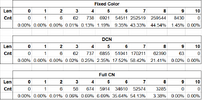
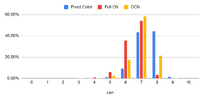
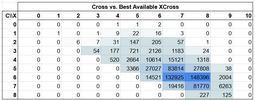
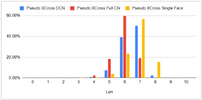
I analyzed the same dataset for Pseudo XCross. When looking at a Pseudo XCross you have to understand that it adds a move later in the solution, so its not 1:1 comparison to XCross, but I think we can agree a 6 move solution with an AUD later (assuming fluency in Pseudo F2L) is going to be easier than a 7 move XCross. I was expecting the Pseudo XCross to be shifted down by at least a full move, so these findings are rather interesting. It only saves slightly more than a half move on average. That said, it increases the number of "findable" cases for any depth, so it would probably be worthwhile being comfortable with Pseudo F2L and XCross and utilizing option select. (Means are shown on the bottom right of the tables)I wrote a program that calculates the shortest XCross solution for a scramble and ran it on ~100k scrambles. This is what i got:
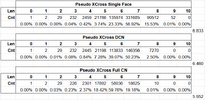
Great info ! I am curious about comparing movecount of EOCross to a standard CFOP cross + 1st pair. Would you be able to calculate?I analyzed the same dataset for Pseudo XCross. When looking at a Pseudo XCross you have to understand that it adds a move later in the solution, so its not 1:1 comparison to XCross, but I think we can agree a 6 move solution with an AUD later (assuming fluency in Pseudo F2L) is going to be easier than a 7 move XCross. I was expecting the Pseudo XCross to be shifted down by at least a full move, so these findings are rather interesting. It only saves slightly more than a half move on average. That said, it increases the number of "findable" cases for any depth, so it would probably be worthwhile being comfortable with Pseudo F2L and XCross and utilizing option select. (Means are shown on the bottom right of the tables)
Note: The way I defined Pseudo XCross actually includes the trivial case as well, in the event it is the shortest solution for its depth.
Update: ran the sim for an additional 100k solves (2.4 million states) and the distributions all hold within a 0.25%
Here are the stats for EOCross over the same dataset.Great info ! I am curious about comparing movecount of EOCross to a standard CFOP cross + 1st pair. Would you be able to calculate?
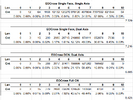
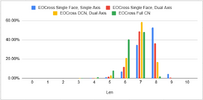
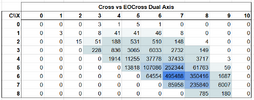
Thanks for running this analysis! Roughly speaking the EOcross is a bit less than 1 full move more than CFOP cross on a single axis. For a human solver I would expect a bit more than that, perhaps a good EOcross solver would be in the 8 to 9 move range.Here are the stats for EOCross over the same dataset.
It appears that CN EOCross has a comparable movecount to CN XCross and DCN Axis Neutral EOCross is slightly better (but not much) than DCN XCross based on the ~300k states analyzed here.
I am going to make a thread for all this once I comb through all the data and make a more rigid study/report framework. Probably will do RouxFB, EOLine, 2x2x2, 2x2x3, and XXCross as well.


