Older cubers discussions

Came back from a couple of weeks off and annihilated all 3x3 PBs except single. Gotta take more breaks :) 5/12/50/100 = 15.65/16.79/17.47/17.93. Man it felt good to check my times at the end and see that sub-18 ao100! :cool:

That is amazing Mark! I am too adicted to quite for a while. LOL... My times are picking up a bit but are no-where near yours.. Most of my Ao50's are between 19.40 and 19.90.. Sub 20 is rare..

Just filmed this 5 minutes ago and is uploading..

73. 19.05 L2 D2 B2 D B2 L2 D R2 B2 R2 D2 F U L U' R' D' B' F' D L U'
74. 19.07 U' B2 L2 B2 L2 U' F2 D' B2 D' L2 B' D2 L B' U' R' D2 F' U L' D
75. 18.29 R2 D2 B2 L2 D' B2 L2 U F2 D' F2 R D' L F' R' B' F' U F L' U2
76. DNF could not decide on cross color D B2 L2 U' R2 D' B2 D B2 U R' F' D B' D2 L' B' U' R' L2 B' L'
77. 14.55 U' L2 B2 U' F2 D2 R2 F2 U B2 U2 R' D2 B' F' U L2 F R' D F'
78. 18.43 L2 D' F2 D2 F2 U L2 D' F2 R2 U' F D' U' L' U B F2 R' D' U
79. 17.54 R2 F2 R2 B2 L2 U F2 D2 B2 U' B2 R' U' L2 B' L D2 F' L' U L2 D'
 
Last edited:
That is amazing Mark! I am too adicted to quite for a while. LOL... My times are picking up a bit but are no-where near yours.. Most of my Ao50's are between 19.40 and 19.90.. Sub 20 is rare..

Well done. You seem to have been improving very nicely these past few months.

Well, I had one session on fire, and it will be hard to beat. I spent a long time at a plateau around 20-21 then something clicked (lookahead?) and I dropped to 18-19 quite quickly. Improvement seems to come in bursts.
 
Some observations regarding plateaus: I keep an Excel sheet of my progress including a plot of my progress as averages against date, but it occurred to me that perhaps the fact I take so many breaks may be obscuring some interesting trend. So I plotted averages versus cumulative number of solves, instead. Surprisingly, when plotted this way it shows my progress has been remarkably steady, with no obvious plateaus.

So why do I feel like I get stuck on plateaus? Perhaps it's just because PBs represent the most downward spikes in the graph, and because averages jump around a lot in the short term, not only can PBs persist for a long time but it can feel like I'm not improving even though the overall trend is still downward.

See the attached graph. Main plot shows best ao50 of each average >50, plotted against cumulative number of solves - the horizontal axis doesn't get populated for some reason, but spans about 9000 solves, and the vertical axis is seconds minus 15. The trend shows exponential convergence on 15 seconds. The orange lines mark PBs that persisted for a while and may have felt like plateaus at the time (if you look at the second plateau, for example, you can clearly see why I might have felt stuck, as the short-term trend was reversed, but in the bigger picture it's nothing).

attachment.php
 

Attachments

  • progress20150601.png
    progress20150601.png
    36.8 KB · Views: 52
That is really cool. I wish I had entered more data in a sheet for reference. I too feel a lot like I have big plateau's. Especially the one I am now. But when I look in my averages document I see I have an Ao100 PB of 23 secs a little over a year ago.. So the last year I have been going from 23 to 20 which is still progress.. The 32 to 23 took 6 months so it just feels like a plateau. But in fact it is not. I was actually feeling a bit bored with not gaining any speed lately but your progress has made me want to some practice again. I just wait and see what my speed is in about 6 months :)
 
So the last year I have been going from 23 to 20 which is still progress.. The 32 to 23 took 6 months so it just feels like a plateau. But in fact it is not.
I always expected that progress would slow down, that's kinda obvious, and is why I guess at an exponential convergence on some minimum achievable time. However, when I got around low 20s, I formed the opinion that the process of improvement is very different at that speed. Above say 25, it's all about gaining competence, not speed. Around sub-25 you have good competence but now you have to go faster. It's interesting to see this on the graph. I don't have data before this, but you can see a steep drop to around 25 and that's where the steady declining trend kicks in.

I was actually feeling a bit bored with not gaining any speed lately but your progress has made me want to some practice again. I just wait and see what my speed is in about 6 months :)
Bored with cubing...? No!! :D. On my plot against time it looks like I could be sub-17 by end of this year, so that's my target, but I now know I have to average 100 solves/week to achieve that. Actually doesn't sound like much.
 
It looks like I have suitable data going back to 45s averages. Prior to that I only did a dozen timed solves at a time. I'll see what the graph looks like later this week.

I stopped maintaining my progress graph last year but it was based on session averages each month. This always showed steady improvement since it was at a monthly level and avoided the plateaus which PB tracking can exhibit.
 
Above say 25, it's all about gaining competence, not speed. Around sub-25 you have good competence but now you have to go faster.

I think I still have a lot to learn. Just the other day on a Facebook group I posted a reconstruction and Brest PM-ed me about one of the F2L's. I did a 12 - 14 move solution (I will look it up tonight and post here) where Brest had a 8 move solution. :) My movecount is a bit on the high end for being super cool..

Bored with cubing...? No!! :D. On my plot against time it looks like I could be sub-17 by end of this year, so that's my target, but I now know I have to average 100 solves/week to achieve that. Actually doesn't sound like much.

I try to do at least 50 per day (timed). I feel like sub 18 is an easy goal. I have big sessions with getting six 17.xx's in a row without problems.. But in the end the Ao100 is barely sub 20.. :(

It looks like I have suitable data going back to 45s averages. Prior to that I only did a dozen timed solves at a time. I'll see what the graph looks like later this week.

I stopped maintaining my progress graph last year but it was based on session averages each month. This always showed steady improvement since it was at a monthly level and avoided the plateaus which PB tracking can exhibit.

A shame you do not have data up untill today :)
 
A shame you do not have data up untill today :)

I still record my individual sessions, I just don't produce the graph of monthly averages.

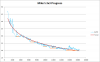
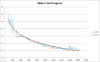
Here's a chart that I just produced which is very similar to Mark's one showing plateaus.

mikesplateus20150601_updated.png

Notes:

- Almost all of my solves are timed but the general shape is still pretty similar, just showing more solves in total.
- The slower times from 16,000 to 18,000 show my return to 3x3 after a two month abstinence.

I haven't cubed for the past fortnight so I need to get back to it before that happens again!
 

Attachments

  • mikesplateus20150601.png
    mikesplateus20150601.png
    25.2 KB · Views: 5
Last edited:
Cool.. the blue line is going up in the end.. That's something to worry about.. LOL

Yup... :)

- The slower times from 16,000 to 18,000 show my return to 3x3 after a two month abstinence.

Fortunately 16,000 onwards is still showing a downward trend.

Edit: Granted, the last data point was not a great session. ;)
 
Just the other day on a Facebook group I posted a reconstruction and Brest PM-ed me about one of the F2L's. I did a 12 - 14 move solution (I will look it up tonight and post here) where Brest had a 8 move solution.

Set up: R U' R' U R U2 R'


Mine: U' R U' R' U2 R U2 R' U R U' (Well, less than 12 moves but I have been doing that for 3 years now :) )


Brest: R U2 R' U' R U R'

Still so much stuff to learn..
 
- Almost all of my solves are timed but the general shape is still pretty similar, just showing more solves in total.
- The slower times from 16,000 to 18,000 show my return to 3x3 after a two month abstinence.
2000 solves seems a long recovery from a break. Apart from that it's similar shape indeed. Have you estimated what potential time your trend is converging on?

In my graph I used an exponential best fit converging on 15 secs because at the time, I couldn't see myself progressing beyond that. Just out of curiosity, I just tried other trendlines with different target times, to see which gives the best fit (highest R^2)... and guess what? 7 seconds! Watch out Feliks :D

Still so much stuff to learn..
Dude, you should be embarrassed by that one ;).

It's a good example though. You're fast enough that you should know that one, but when we're slower, much of our improvement comes from learning solutions like this, becoming more efficient, learning more algs to reduce move count and recognition cost, getting both hands comfortable with solving, spending less time hunting all over the cube, and generally getting familiar with how the cube works. At 25 seconds we might typically do 60 moves at 3 tps plus 5 seconds total pauses. That really doesn't require speed - it's just competent solving - but it's about as fast as you can get with just competent, comfortable solving, IMHO. To progress much beyond that, we need to start pushing beyond our comfortable tps, looking ahead, staying composed at faster speed, etc. - generally focusing more on speed than just competent solving.

There's no abrupt cut-off of course and there's always more to learn, but for me, I feel like since low/mid-20s my solutions are now pretty decent and won't improve greatly between now and sub-10 - instead it's all down to technique and speed. A few months ago, the difference between a good and bad solve would be whether I had to use 2-look OLL, couldn't find my F2L pairs, or lost a piece during cross; now, the difference between a good and bad solve is whether I find a finger-trickable cross solution, fumble some awkward rotations or regrips, stay composed and accurate or get catches during algs, lose concentration on my lookahead, etc.

---

Changing subject, I've been doing PLL recognition practice this week and found it good fun. See what you think. What I do is this: generate and apply a PLL scramble but do not allow myself to see more than two sides. Inspect those two sides then close eyes and solve (untimed). Cube should be fully solved afterwards, no further AUF required. Some of them are ridiculously easy of course, but for some it's quite a challenge to recognise the case, and recognise how to AUF to line it up for the alg, and then figure out how the alg will leave it and what AUF will be needed at the end.
 
Dude, you should be embarrassed by that one ;).

LOL, I know.. But I am about most of my solves.. ha ha ha..


Changing subject, I've been doing PLL recognition practice this week and found it good fun. See what you think. What I do is this: generate and apply a PLL scramble but do not allow myself to see more than two sides. Inspect those two sides then close eyes and solve (untimed). Cube should be fully solved afterwards, no further AUF required. Some of them are ridiculously easy of course, but for some it's quite a challenge to recognise the case, and recognise how to AUF to line it up for the alg, and then figure out how the alg will leave it and what AUF will be needed at the end.

That's pretty cool practice. If you look at Feliks' solves he needs no AUF time but just looks at the cube before PLL does PLL and drops the cube.. I really should learn that. That would shave off 2 seconds of my global average easily. That is without a doubt my weakest point.
 
2000 solves seems a long recovery from a break. Apart from that it's similar shape indeed. Have you estimated what potential time your trend is converging on?

I neglected to say that it was also the time when I was learning the remainder of OLL; 15/57 cases. The time off added about 1.5-2.0 seconds to my global average but I started learning the remaining OLLs as soon as I came back. Taken in isolation, I think the trend from 16K-18K looks reasonably healthy considering I was regaining my previous level of competency and integrating new OLL algs.

I've not done any precise estimations but 15 seconds seems doable long term, I have lots of obvious areas for improvement.

Dude, you should be embarrassed by that one ;).

I didn't want to say it myself. :)

Changing subject, I've been doing PLL recognition practice this week and found it good fun.

That's one of the many areas that I have recognised needs improvement in my solves. It's automatic for some cases but I should go through every case methodically to ensure I know them all properly.
 
If you look at Feliks' solves he needs no AUF time but just looks at the cube before PLL does PLL and drops the cube.. I really should learn that. That would shave off 2 seconds of my global average easily. That is without a doubt my weakest point.
The way I've started to learn this is by looking at certain stickers before the PLL that tell me the front colour afterwards. For example, for Ra, after pre-AUF I would look at the FUR sticker (and the front centre) and that would tell me what post-AUF to do. So no need to recognise after the alg. After a while it feels like the post-AUF becomes an integral, seamless part of each alg, with no delay at all.

For two-sided recognition I am learning two stickers per case, on opposite sides (where possible). It's harder than it sounds, to recognise these before pre-AUF.

Which stickers to look at depends on your algs of course.

Edit:-
I neglected to say that it was also the time when I was learning the remainder of OLL; 15/57 cases.
I have to admit I sometimes "cheated" when learning new algs. If a case came up that I had just learned, and I got messed up or slowed down by the new alg, I would delete the time. The reason I started doing that is because I found that when under time pressure, rather than hesitate and try the new alg, I would often resort to two-look, and those new algs therefore weren't getting practiced. So I decided to take the time pressure off and allow myself to revert those solves to untimed practice solves whenever particular new cases came up.
 
Last edited:
I have been doing my daily 50 timed solves and I feel it is going in a good direction. Last few Ao100's (weekly) where sub 20. Most of my Ao12 are low 19. I feel like sube 19 is very close now.

Ao5 after one warm up solve:
Time List:
1. 18.65 R2 D U2 F2 D' U2 L2 F2 U' R2 F2 B' R2 D' B' R' B L' B' D R
2. 19.86 D' L B2 L B2 R2 D2 B2 R F2 U2 L' D L' B D' U L2 U2 R B'
3. 18.05 F2 L U2 F2 R' D2 F2 R' B2 D2 B2 D' L2 B2 F D L B2 U L B2
4. 23.65 R2 U F2 L2 B2 F2 R2 U' L2 R2 B2 R' B' D' B' F2 D' L2 U B' D'
5. 17.75 F2 U R2 D' B2 D' R2 U2 B2 F' R' D2 L2 R2 D F' R2 D2 F'

Cube: Congs design MeiYing
 
Last edited by a moderator:
Back
Top