I can't find it right now, but from memory I think it showed that a sequence of random moves needs to be at least 40 long before the distribution of good/bad edges converges on what you would get with random state scrambles.
Convergence is a process, so technically it starts converging on the very first move, but the convergence is kinda slow. (And just like every statement qualified with "technically", that means "this is true but maybe not in a useful way"…)
Stefan Pochmann showed, back in the day, that with 25-move scrambles (the standard scramble length then), it was about three times as likely to get all 12 good edges as to get all 12 bad edges, even though these should have the same probability with random-state scrambles. The gap between the two probabilities decreases exponentially as the number of moves increases. At 30 moves, the probability of getting 0 bad edges is still 46% higher than expected; at 40 moves it's 4% higher; at 50 moves it's 0.4% higher; et cetera. It never ever reaches 0, although you can get as close as you want by increasing the scramble length.
(source)
Is 4% an acceptable deviation? Maybe if you use a method that doesn't involve EO at the start, i.e. pretty much anything other than ZZ and 3OP. However, it's fairly easy to get random-state scrambles these days, so I don't think it's fair to count anything but solves done in "ideal" scrambling conditions.
(Also singles are pretty dumb and IMO they're just for fun, so however seriously you want to treat them is really up to you. Handscrambles all the way? Sure, whatever. Only random-state scrambles with cube cover and stackmat and all that stuff? That's cool too! The above paragraph mostly applies only if you want to measure how fast you
really are.)
My question is whether or not the Magentic version is worth the cost?
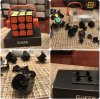
This isn't quite answering your question, but I have the Galaxy v2 M and I quite like it. My initial impression of the puzzle was lukewarm at best, but it's really all around better than the Galaxy v1. Is it worth it over the nonmagnetic Galaxy v2? Hard to answer, I don't have both.

Some people (including myself) have mentioned that the magnetic "click" is fairly pronounced in this puzzle, so that's something to take into account.



 (There might be some words exchanged, but certainly no physical attacks, anyway.)


 . BTW, once after doing a lot of timed solves on my phone I sat down with the Stackmat, did inspection, set the cube down, and touched the LCD with one finger. True story.