

speedsolvetheory
Regular
This is my first real post on this platform, my apologies if it is in the wrong format or discussion or if I am violating etiquette rules.
I don't know if I'm the first one to come up with this idea for the curvy copter puzzle, but my idea is that, by learning the U-set of 1LL4C, you can save moves by using a trick I came up with.
MUoN (Misoriented Up-Face Negation)
This technique is used when arriving at L4C. If you get a bad OL4C, like H or Pi, or generally get a case you don't like, you can convert it into a simpler case by making one move. The cube will become slightly unsolved, but this is fixed in the end.
Step 1: Misorient Up-Face
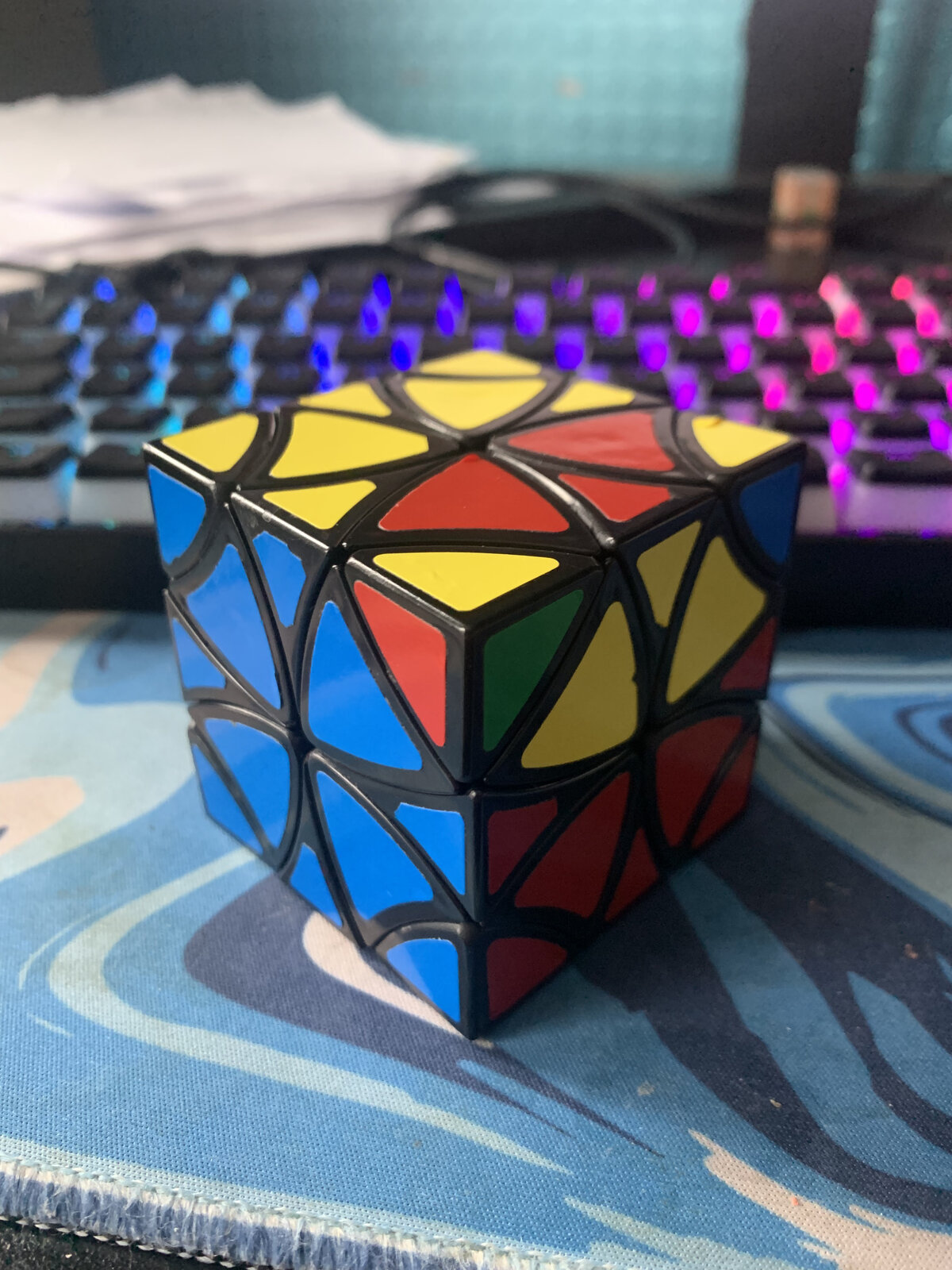
The "Pure" Case, which is (F) (M B M F)2 in my abridged last-layer notation. Just keep turning the front, left and right, back, left and right until it is solved for this case.
The following cases can be "converted" into an alternate using this method as follows: (you can find the exact move by just generating the case and then experiment)
From here, do the normal OL4C ignoring the messy T4T.
Step 2: Misoriented Up-Face Negation (MUoN)
This is the namesake step of the method. It is the U-L4C with one move taken to make all four corners "oriented" on top. This will create an unusual corner permutation, however it is functionally the same as U-L4C, with slight modifications. See an example pictured.
Pros and Cons:
MUoN's approach is directly inferior to the 2LL4C method due to its unfamiliarity and weird recognition. It is inferior to 1LL4C due to it being less efficient and being two look.
Standard 2-look requires 11 algorithms, although most can be replicated using other algorithms. MUoN requires 15 algorithms, most of which are permutations, which is not an improvement. I believe it may be slightly more efficient than 2LL4C but I have not done enough research in order to prove that is the case. It does provide an alternative method to the standard way of solving, which may be of use to some intermediate solvers.
TL;DR:
This is my first real post. It's about a new L4C method for the Curvy Copter. You can avoid bad OL4C in exchange for learning more cases of the second step by misorienting a turn of the T4T as pictured. It's not very good, and I'm not sure it's even original.
I don't know if I'm the first one to come up with this idea for the curvy copter puzzle, but my idea is that, by learning the U-set of 1LL4C, you can save moves by using a trick I came up with.
MUoN (Misoriented Up-Face Negation)
This technique is used when arriving at L4C. If you get a bad OL4C, like H or Pi, or generally get a case you don't like, you can convert it into a simpler case by making one move. The cube will become slightly unsolved, but this is fixed in the end.
Step 1: Misorient Up-Face
The "Pure" Case, which is (F) (M B M F)2 in my abridged last-layer notation. Just keep turning the front, left and right, back, left and right until it is solved for this case.
The following cases can be "converted" into an alternate using this method as follows: (you can find the exact move by just generating the case and then experiment)
| Normal Case | MUoN Alternate |
| U | Solved |
| T | T |
| Sune | T |
| Antisune | T |
| L | L (inverse of U) |
| H | U |
| Pi | T |
Step 2: Misoriented Up-Face Negation (MUoN)
This is the namesake step of the method. It is the U-L4C with one move taken to make all four corners "oriented" on top. This will create an unusual corner permutation, however it is functionally the same as U-L4C, with slight modifications. See an example pictured.
Pros and Cons:
MUoN's approach is directly inferior to the 2LL4C method due to its unfamiliarity and weird recognition. It is inferior to 1LL4C due to it being less efficient and being two look.
Standard 2-look requires 11 algorithms, although most can be replicated using other algorithms. MUoN requires 15 algorithms, most of which are permutations, which is not an improvement. I believe it may be slightly more efficient than 2LL4C but I have not done enough research in order to prove that is the case. It does provide an alternative method to the standard way of solving, which may be of use to some intermediate solvers.
TL;DR:
This is my first real post. It's about a new L4C method for the Curvy Copter. You can avoid bad OL4C in exchange for learning more cases of the second step by misorienting a turn of the T4T as pictured. It's not very good, and I'm not sure it's even original.


