

SkewbDiamond
Member
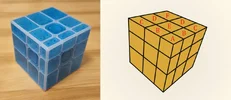
On the left side of the image, I have the normal mirror cube. On the right side, I have a weird variation of the mirror cube that I found from this website where the mirror cube is modeled incorrectly. Normally, the pieces (or "cubies" as you would call them) are all different on the mirror cube. However, on the right side cube, some cubies are identical. I marked some of them with letters so you get a better idea, pieces which are identical being marked with the same letters.
Basically you could think of the right side cube like this. Take the normal Rubik's cube and draw a diagonal of the cube (line that connects two opposite vertices). Then shift the central mechanism of the cube together with the cut lines a little bit along that diagonal. By doing this you don't end up with a true mirror cube but you get this weird cousin of the mirror cube instead. Another difference is that none of the corner pieces on the mirror cube are perfect cubes, however the small corner piece (A) on the right side cube is a perfect cube.
I have a few questions about this mirror cube's cousin:
1) Has this puzzle ever been made by anyone?
2) How would the solving be different compared to solving the normal mirror/Rubik's cube?
3) What about the number of combinations? The normal mirror cube has the exact same number of combinations as the Rubik's cube. I suppose this right side cube has fewer (for example, doing U' or R' would result in two different combinations on the normal mirror cube but on the right side they both result in the same combination because of the symmetry). But the question is: how much fewer? And how would you calculate that?
Basically you could think of the right side cube like this. Take the normal Rubik's cube and draw a diagonal of the cube (line that connects two opposite vertices). Then shift the central mechanism of the cube together with the cut lines a little bit along that diagonal. By doing this you don't end up with a true mirror cube but you get this weird cousin of the mirror cube instead. Another difference is that none of the corner pieces on the mirror cube are perfect cubes, however the small corner piece (A) on the right side cube is a perfect cube.
I have a few questions about this mirror cube's cousin:
1) Has this puzzle ever been made by anyone?
2) How would the solving be different compared to solving the normal mirror/Rubik's cube?
3) What about the number of combinations? The normal mirror cube has the exact same number of combinations as the Rubik's cube. I suppose this right side cube has fewer (for example, doing U' or R' would result in two different combinations on the normal mirror cube but on the right side they both result in the same combination because of the symmetry). But the question is: how much fewer? And how would you calculate that?


