geocine
Regular
Hi I am not sure where to post this so I am posting it here. Do we have a list of 3x3x3 (programming) Algorithms. I explicitly cited 'Programming' because this could be easily misunderstood as a collection of 3x3x3 move notations.
For example, sorting has different algorithms. We do have bubble sort, insertion sort, shell sort, radix sort (the list goes on).
I am not a math wizard but I do understand math and I could implement (programming) algorithms as how they are explained using my programming language of choice. I believe having a list of these will help us (non math wiz) programmers to implement these (programming) algorithms, discover , simulate and generate (notation) algorithms or use them as we wish.
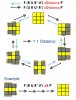
Has anyone written a library to compute/generate CFOP algorithms from a given case. What I would like to accomplish is to create an OLL tree / PLL tree with the use of programming.
Example:
OLL 1 + OLL 2 = OLL 3
This means executing OLL 1 followed by OLL 2 is equivalent to executing OLL 3 and so on. If you have idea how to do this please direct me to a resource.