


dudefaceguy
Member
- Joined
- Feb 17, 2019
- Messages
- 260
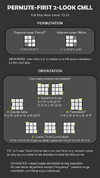
This is how I do 2-look CMLL in Roux. I prefer intuitive solving, so I've never done a CFOP solve, and I don't have any preference for orientation before permutation. I think permutation first is easier and more intuitive, and it also has a much lower move count.
Advantages:
Significantly lower move count: full-step is 13-23 versus 19-29 for orient-first
All of these algs are used in full CMLL, just as with orient-first, so progression is easy.
2-corner cases all become a single case with easy recognition and execution.
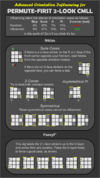
Good cases exist in the second look. A first look with only 2 algs makes influencing easier, further reducing average move count. Using influencing, there is an overall 64% chance for 15 moves or less and a 90% chance for 19 moves or less, the same as the best full-step case in orient-first.
Inspecting edge orientation during corner orientation is easy, helping lookahead.
Disadvantages:
Corner twist commutator is long, somewhat awkward, and very common (44%).
Nobody else does this so maybe it is bad for some reason I haven't thought of??
EDIT: Slow recognition is the reason.
Why use this method?
The main reason is because it is easy to learn and it has a low move count.
The purpose of 2-look CMLL vs full CMLL is not speed, but rather ease of memorization, recognition, and execution. So of course, a cuber should just use what they prefer. I like this method because algs are short, intuitive, and easy to learn, avoiding the long permutation algs used in orient-first. And I enjoy influencing the second look.
Easy lookahead to edge orientation is also very helpful. All but one orientation algorithm preserves edge orientation, so it's very easy to inspect the edges while executing the orientation algorithm. The 2-corner commutator doesn't even permute edges - although it is the longest algorithm, you can fully inspect and plan your EO while executing it.
Of course full CMLL will be faster, but I don't want to learn full CMLL because I don't find it fun to learn algorithms. For me, this method is much faster and easier than orient-first, and of course it has more potential because of the significantly reduced move count. I think others might benefit from the lower move count and easy lookahead, so I made this guide.
Nasty Corner Twists
The biggest problem is the 2-corner cases in the orientation step. By random chance, 44% of orientation cases will be bad 2-corner cases. Although they are easy to recognize and the commutator is simple, it is somewhat more awkward to execute compared to the other cases, and has a comparatively long move count. (Of course, the move count is only 1 move longer than the best second-look case in orient-first.)
You could learn 3 specialized algs for the 3 corner twist cases to save a few moves, but there is really no good way to solve a 2-corner twist: all of the algs are either long or awkward to execute.
I avoid these bad cases by influencing the orientation step during the permutation algorithms, using a few simple rules to force good cases. This doesn't require learning more algs - you just adjust the U layer before starting the permutation algs, as the guide explains.
I don't believe it's possible to influence the permutation step in the orient-first method in the same way, since almost all of the orientation algs must be executed from a single direction. And you would only reduce the second-look move count from 17 to 13, saving 4 moves, so it's unlikely to be worth it.
In this method, the best benefit you can get from influencing is converting a 15-move 2-corner case to a 7-move Sune case, which saves 8 moves and is much easier to execute. I think that's worth it, even if it slows recognition slightly. And I think it's fun, which is the most important thing. Obviously if you really want to be fast, just learn full CMLL.
Math
I calculated probabilities based on the 162 possible corner cases. For the chart in the influencing guide, I removed the 27 permutation skip cases, and calculated only the orientation cases that could come after a permutation algorithm, since those are the only cases that you can influence. The chart approximately matches my observed cases.
So the percentage chart in the influencing guide doesn't include step-one permutation skips. If you include permutation skips and influencing, this method has a 24% chance to skip either step. Based on randomness, the chance of a skip should be about 20%, since there is always a 17% random chance of a permutation skip and a 3% chance of an orientation skip. The orient-first method should therefore have a 20% chance to skip either step.
The overall 64% chance for 15 moves or less and 90% chance for 19 moves or less includes skips, since this is an overall comparison to orient-first. Orient-first only has a 20% chance to have fewer than 19 moves, since this requires a skip.
Have Fun
I hope that some people find this alternative 2-look CMLL method useful. If you do about 4 TPS during your CMLL execution, it should save 1-3 seconds compared to orient-first (edit: not counting recognition time!). At the very least, I think it is a lot of fun.
Last edited:


