Border-Case Puzzle Brainstorming

Once a decision is made, I think it might be helpful to have a page which has a concise list images of relevant allowed/borderline/banned puzzles to serve as an easy reference for a competitor to check the legality of a particular puzzle. Probably something similar to the list developing in this thread.
 
But it has more than six faces, so it's allowed to have more than six colors. I guess it depends on how you define face.

Yeah maybe it does depend on the definition. However, this in my opinion is one of those cases where it is not really necessary to go into lawyer-level discussions. If you really want to argue "creatively" like this, there are a lot of things you can do that are unwanted with current regulations. Sure, maybe the wording is not 100% perfect, but its very clear what is meant. I have heard several board members use this way of using the regulations. And hey, even if you really want to argue like this and even if the proposal would allow this (which is at most sketchy*), nobody will use this "mod" anyway.

*There are a few things going on here at this example. A pieces which normally have 2 or 3 sides, are now divided into more sides and with extra stickers. You can of course also argue that those extra stickers are not functioning as stickers or tiles and are thus, part of the base of the cube, which 3d4 says only can have one colour. Another way to prevent something like this is describing that a cube has 6 sides (which may be rounded, but not divided into more faces) and may have at most 6 sticker/tile/whatever colours and one base colour. But then again, this would make the regs. more unreadable for no reason.

As a side note: I just summed up the puzzles which I think would be illegal to use using the current proposal, if other cubers interpret it differently (deliberately or not), maybe it is an indication the proposal is too unclear. But also, maybe it is just nitpicking :)
 
Last edited:
Yeah maybe it does depend on the definition.

A rhombic triacontahedron has 30 faces. I challenge you to find a definition that disagrees (a serious already published one, doesn't count if you make one up now :)). So if it has 30 colors, I think it does comply with that regulation.

Though I agree that nobody would want to use it, as clearly a normal 3x3x3 is much more convenient to hold/turn. But maybe there's a way to turn an inconvenient shape (skewb, pyraminx?) into a legal more convenient shape? Or equally convenient to hold/turn, but more information visible at once?
 
Last edited:
Yeah maybe it does depend on the definition. However, this in my opinion is one of those cases where it is not really necessary to go into lawyer-level discussions. If you really want to argue "creatively" like this, there are a lot of things you can do that are unwanted with current regulations. Sure, maybe the wording is not 100% perfect, but its very clear what is meant. I have heard several board members use this way of using the regulations. And hey, even if you really want to argue like this and even if the proposal would allow this (which is at most sketchy*), nobody will use this "mod" anyway.

I don't think we can depend on "nobody will do X" if we try to say we have an anything-goes policy.

In any case, some people think the Skewb with extra sides is okay (Exhibit 12); I don't see an intrinsic problem with allowing it under "anything goes". Arguably, the rhombic triacontahedron isn't much different.

In any case, the point here isn't to try to come up with rules to be as pedantic as possible.
The point is to judge whether a given proposal *would already handle them* by virtue of being well-written.

This could possibly be solved by replacing "basic concept" with some better description of the official puzzles (which Dene is discussing in the Delegate list).
 
A rhombic triacontahedron has 30 faces. I challenge you to find a definition that disagrees (a serious already published one, doesn't count if you make one up now :)). So if it has 30 colors, I think it does comply with that regulation.

Though I agree that nobody would want to use it, as clearly a normal 3x3x3 is much more convenient to hold/turn. But maybe there's a way to turn an inconvenient shape (skewb, pyraminx?) into a legal more convenient shape? Or equally convenient to hold/turn, but more information visible at once?

*There are a few things going on here at this example. A pieces which normally have 2 or 3 sides, are now divided into more sides and with extra stickers. You can of course also argue that those extra stickers are not functioning as stickers or tiles and are thus, part of the base of the cube, which 3d4 says only can have one colour. Another way to prevent something like this is describing that a cube has 6 sides (which may be rounded, but not divided into more faces) and may have at most 6 sticker/tile/whatever colours and one base colour. But then again, this would make the regs. more unreadable for no reason.

I basically described a reasoning to still not allow this puzzle using the current proposal. Yes the definition might be a bit vague like I also already said, do you have a proposal to make it clearer?

I don't think we can depend on "nobody will do X" if we try to say we have an anything-goes policy.

In any case, some people think the Skewb with extra sides is okay (Exhibit 12); I don't see an intrinsic problem with allowing it under "anything goes". Arguably, the rhombic triacontahedron isn't much different.

In any case, the point here isn't to try to come up with rules to be as pedantic as possible.
The point is to judge whether a given proposal *would already handle them* by virtue of being well-written.

This could possibly be solved by replacing "basic concept" with some better description of the official puzzles (which Dene is discussing in the Delegate list).

Nobody will do X will always be a factor, no matter what regulations you have. If you truly want to have an anything-goes policy there is no need to ban anything as long as a puzzle is still a Rubik's cube (which then depends on the famous 'basic concept').

About the Skewb: I thought you just wanted to discuss wording here and the implication of using the proposal at hand. Not discussing what we think is ok and what is not. Personally I don't like extra stickers or the creation of extra faces since they suggest the puzzle is not actually a 3x3 (in the same way this is in fact a 2x2 http://upload.wikimedia.org/wikipedia/commons/thumb/c/c5/Pyramorphix.jpg/200px-Pyramorphix.jpg) and this is in fact a 3x3, (http://twistypuzzles.com/museum/large/00642-01.jpg) just like this is practically a 3x3 as well (http://www.twistypuzzles.com/museum/large/02686-01.jpg) Determining a cube has to have 6 sides (which may be rounded) and 6 solid colours is not that complicated...
 
New suggestion for an exhibit.
A cube that is not proportional. Like the M slices are 2 times thicker than the outer.
Or the M slices are thinner.
 
k cool I'ma bring in my self-solving cube next time. Here I come WR.

How does it go against that?


I'll beat it with my single-colored cube.

tbf my original wording did allow a single coloured cube, sorry about that, I edited my post.

as for your suggestion dene, I suppose another line is necessary to stop that kinda thing, not that it exists anyway - have fun wording that restriction.
 
About the Skewb: I thought you just wanted to discuss wording here and the implication of using the proposal at hand. Not discussing what we think is ok and what is not. Personally I don't like extra stickers or the creation of extra faces since they suggest the puzzle is not actually a 3x3 (in the same way this is in fact a 2x2 http://upload.wikimedia.org/wikipedia/commons/thumb/c/c5/Pyramorphix.jpg/200px-Pyramorphix.jpg) and this is in fact a 3x3, (http://twistypuzzles.com/museum/large/00642-01.jpg) just like this is practically a 3x3 as well (http://www.twistypuzzles.com/museum/large/02686-01.jpg)

I'd say Pyramorphix is no 2x2, as half the pieces have no orientation and thus the set of states differs. Similarly, I'd say your third example isn't a 3x3.
 
I'd say Pyramorphix is no 2x2, as half the pieces have no orientation and thus the set of states differs. Similarly, I'd say your third example isn't a 3x3.

I think the idea is quite clear... Did you think about a way to improve the proposal? I am genuinly very interested in your opinion, but I only see you correcting people or coming up with weird puzzle examples which we will never have to deal with.
 
I think the idea is quite clear... Did you think about a way to improve the proposal? I am genuinly very interested in your opinion, but I only see you correcting people or coming up with weird puzzle examples which we will never have to deal with.

That *is* the point of this thread. ;-)

(Seriously, it is. This is about examples we'll hopefully never have to deal with. *Preferably* because we'll be prepared to judge them without any special cases.)
 
If you want to discuss cases we might not forsee, but are unwanted then I understand und and fully agree with investigating this and I will be happy to help like I did in my previous posts. Some of the examples Stefan and others posted are leaning towards ridiculousness though. I really don't see the point in discussing wether examples like #30 are legal with the current proposal or not. If anyone honestly thinks the current proposal is not not clear enough about cases like this, then please also come up with an improvement proposal instead of pointlessly argue.

Some people have already proposed good ideas like to include the extra '6 colours', '6 sides', 'same texture' etc. so let's try to work out the solution :)
 
Size matters to scramblers, so there should be some size limitation (or at least something like "If your puzzle is bigger than [insert size here], then the delegate can make you not use it"). Magic the Gathering has the following rule: "There is no maximum deck size; however, you must be able to shuffle your deck with no assistance." (source)
Maybe we could do something similar?

EDIT: It's also harder to scramble the cube without it being seen and keep it hidden from other competitors until inspection starts.
 
Last edited:
Size matters to scramblers, so there should be some size limitation (or at least something like "If your puzzle is bigger than [insert size here], then the delegate can make you not use it"). Magic the Gathering has the following rule: "There is no maximum deck size; however, you must be able to shuffle your deck with no assistance." (source)
Maybe we could do something similar?

EDIT: It's also harder to scramble the cube without it being seen and keep it hidden from other competitors until inspection starts.

I wouldn't mind this, myself. Although there's no advantage for using an enormous puzzle. It does get rather tiring seeing someone bring up a crazy foot cube during OH as a joke for the fifth time.

I think that the size of a typical cube cover (Guessing maybe 12-15 cm each dimension?) would be a reasonable limit on size.
 
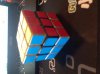
Kinda like case 1 but with multiple layers
image.jpg
Changes the way to recognize the pieces defiantly
 
Exhibit 41: 3x3x3 with protruding centers, possibly combined with thicker inner than outer layers. So that you can for example press down the cube onto the floor with the left foot and move F, R and B freely with your right foot.
 
Not really a border-case, but based on a suggestion by a friend:

Exhibit 42: A puzzle with magnets that can help with alignment, and might possibly give away information based on how/when pieces connect to each other.
 
Back
Top