Border-Case Puzzle Brainstorming

Lucas Garron

Premium Member
Joined
Jul 6, 2007
Messages
3,757
Location
California
WCA ID
2006GARR01
YouTube
Visit Channel
There's currently a discussion about more generous rules for allowed puzzles, but there are still some uncertainties about where to "draw the line".

I'd like to see what crazy things we can up with, to see if they break any given proposal because the wording allows it (but perhaps we would not like to allow them).
A good proposal should be absolutely clear about whether any of these puzzles are allowed, without an additional reference/"Delegate discretion".

Exhibit 0: Normal Cube
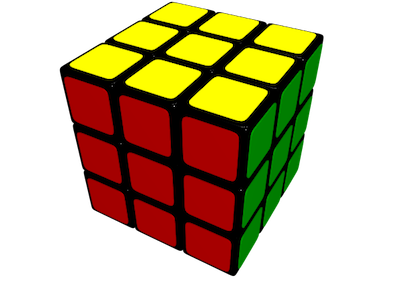
normal.png


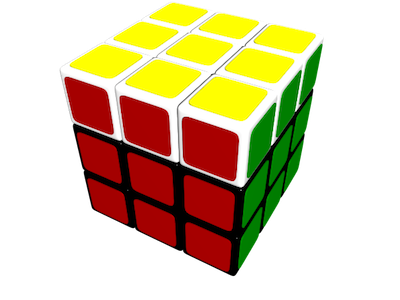
Exhibit 1: White LL plastic
white_LL.png


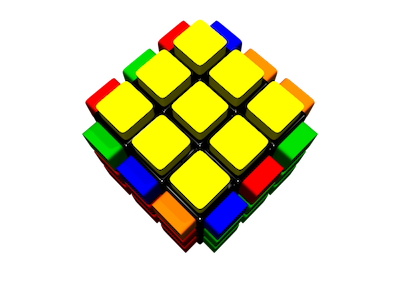
Exhibit 2: Excessively thick tiles
thick.png


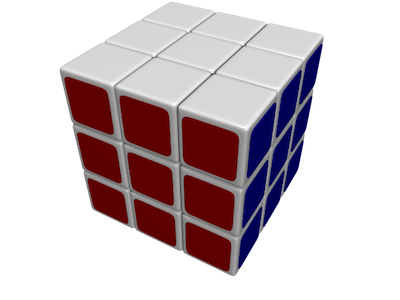
Exhibit 3: Different center plastic color:
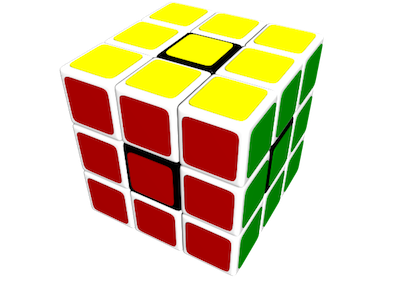
black_centers.png


Exhibit 4: FangShi with two-color plastic
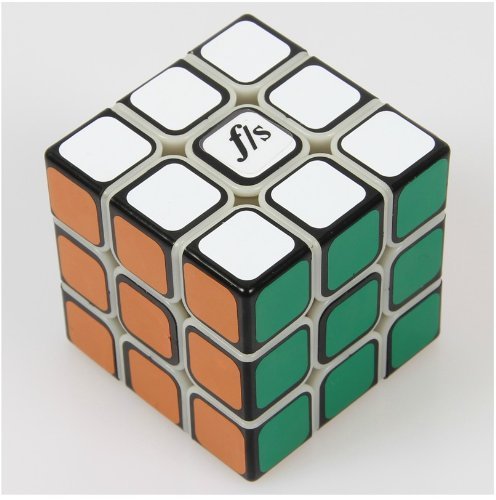
fangshi.jpg


Exhibit 5: Stickerless Ridged Megaminx
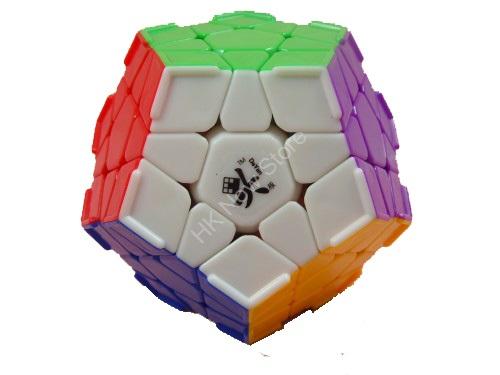
stickerless_ridged_megaminx.jpg


Exhibit 6: Stickerless top face only
top_stickerless.png


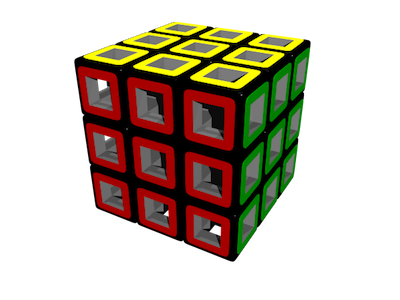
Exhibit 7: Holes
holes.png


Exhibit 8: Transparent cube (suggested by Kit Clement); digital cube provided as an example.
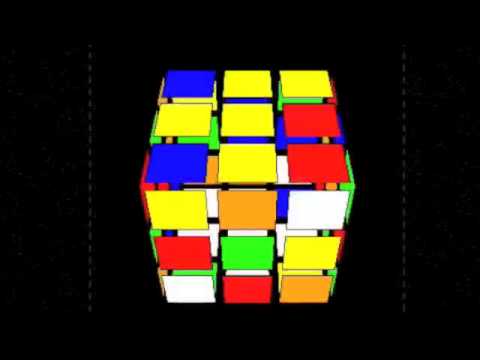
transparent_heise.jpg


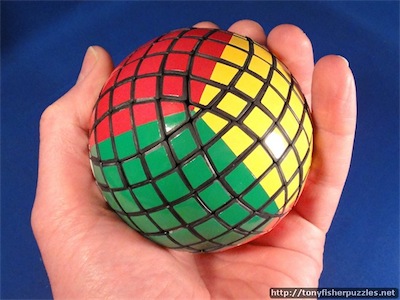
Exhibit 9: Tony Fisher's 7x7x7 Ball
tony_fisher_7x7x7_ball.jpg


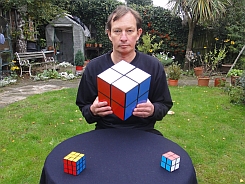
Exhibit 10: Tony Fisher's huge 2x2x2
tony_fisher_huge_2x2x2.jpg


Exhibit 11: Tony Fisher's huge 3x3x3/Pyraminx
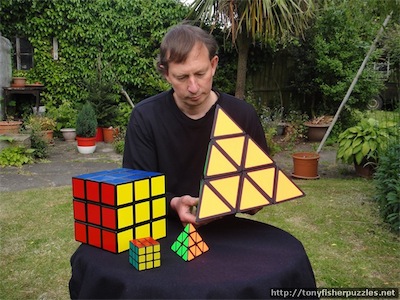
tony_fisher_giant_pyraminx_333.jpg


Exhibit 12: Tony Fisher's X-Factor/Skewb Extreme
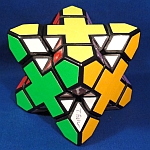
tony_fisher_x_factor_skewb_extreme.jpg


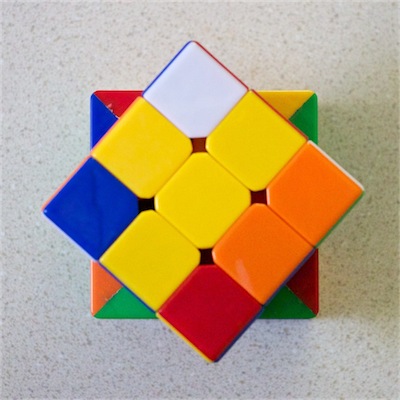
Exhibit 13: Dave Litwin's inverted 2x2x2
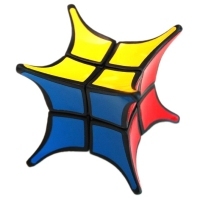
dlitwin_inverted_222.jpg


Exhibit 14: Dave Litwin's inverted 3x3x3
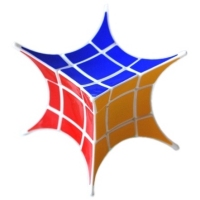
dlitwin_inverted_333.jpg


Exhibit 15: 3x3x3 Supercube (sugested by Ron)
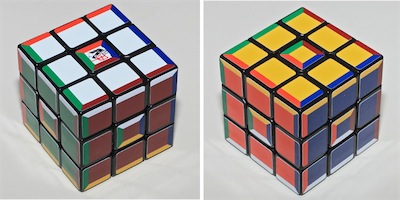
supercube_333.jpg


Exhibit 16: 4x4x4 Supercube (can be used to make 4x4x4 BLD center memo deterministic)
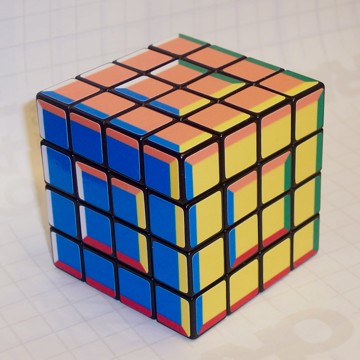
supercube_444.jpg


Some I don't have pictures for (yet):

  • Exhibit 17: A 3x3x3 ball (has been mass-produced; I own one)
  • Exhibit 18: A bandaged 4x4x4 used as a 2x2x2
  • Exhibit 19: 3x3x3 with ridges
  • Exhibit 20: A colored-plastic stickerless cube, with stickers on top that match the plastic color
  • Exhibit 21: A colored-plastic stickerless cube, with a black sticker on every face
  • Exhibit 22: A cube with star-shaped stickers
  • Exhibit 23: A void cube with some fixed parts on the interior of each center that indicate color.
  • Exhibit 24: A 7x7x7 with every 3rd-slice-from-the-outside in black plastic, and the rest in white plastic.
  • Exhibit 25: A 3x3x3 with axial spikes coming out of the centers to aid with turning (suggested by Vincent Sheu).


The simplest rule I can think of that separates these into natural groups is "allow only mass-produced puzzles". However, such a rule change would almost certainly result in new puzzles being mass-produced, especially if they provide a nice advantage. In addition, this requires us to specify how much modification is allowed, which I think is uncomfortable and difficult.

Anyone got some other crazy ideas?
(Try to continue the numbering if possible.)
 
Last edited:
You bring up some good points. I wish that pillowed and stickerless cubes were legal...but the rules can't just be changed to any cube. Pillowed and stickerless cubes provide ABSOLUTELY NO advantage, right?
 
Pillowed and stickerless cubes provide ABSOLUTELY NO advantage, right?

False.
This is an important point: there is a clear advantage in being able to "see around" the puzzle. I always use this image to show how you can look at all F2L edges simultaneously:
stickerless_400px.jpg


Our concern is if the advantage is significant enough to prohibit them.

(The strongest arguments in favor of allowing them are that it hasn't been proven that someone can use this advantage to get a significantly faster time, and that puzzles with such advantages would be available to anyone.)
 
Last edited:
I have to admit, this post is a LITTLE worrying, which is why in the thread I half agreed/half disagreed. Something like different coloured pieces for LL/F2L actually does offer a huge advantage. It'd only be useful for PURELY one colour, non-CN users, who generally aren't world class, but the ability to tell that red+x piece in UB is red+yellow or a red+F2L piece is a huge advantage. Likewise, completely transparent cubes offer the same, there's a reason sim cubes have the ability to see-through, it offers an advantage.

Another concern would be for Roux users, the UL/UR pieces are important. For those with x axis neutrality, or no neutrality, they could get a different coloued piece for UL and UR pieces allowing them to quickly tell where both are, without seeing nearly all the stickers you would normally need.

I think a lot of the list you've added just as examples, and wouldn't offer an advantage (pillowed cubes generally aren't as easy to manipulate as cubic puzzles, so unless a large lookahead advantage is given, most would stick with the cubic puzzles)

I see no reason for the giant 2x2/Pyraminxes to give an advantage, nor why they're in your list other than a way of categorizing different puzzles. I see no reason they should be banned, nor why anyone would want to use them. Large cubes offer no advantage, smaller cubes however allow you to see 4 sides at once from above, but they're currently legal and would need banning, not legalizing if they were deemed problematic.


Overall my personal opinion is that this opposite backwards stance is unnecessary. I think Megaminxes should be allowd 1.5mm tiles as they have been all this time. I don't see real need to legalize stickerless/pillowed puzzles. I do not think stickerless cubes offer an advantage, even though it is POSSIBLE to do so, in an actual speedsolving, they offer no advantage. However I do not think pillowed cubes should be legalized, and I think transparent cubes should NOT be legalized.

One tiny advantage stickerless cubes could offer, is the ability to see the B sticker on the UB piece in Roux L6E, if the layers are slightly misaligned from prior M slice movement. However, I don't think it gives an advantage to experienced Roux users, as they already know what that piece is during CLL.
 
Here is what I think.

OK:
0: obvious
2: the only non-arbitrary limits on tile thickness are "no limit" or "flush with cube surface"
3: each piece type looks the same except for stickers
4: each piece type looks the same except for stickers
5: acceptable for same reason as stickerless 3x3x3, and shape of pieces is irrelevant
8: I don't personally see a problem with having more stickers visible
9: piece shape shouldn't matter, and pieces of the same type are only distinguishable by sticker colors
10 and 11: puzzle size shouldn't matter
12: the extra stickers do not provide any additional information
13, 14: piece shape shouldn't matter
15: there is actually no additional info here, and pieces are no more visible than on a cube with thick tiles or transparent plastic
17: shape doesn't matter
19: shape doesn't matter
20: every face is the same
21: (assuming you mean 54 black stickers) every face is the same
22: every face is the same
23: centers are not distinguishable from each other and each face is still marked with the same color on each sticker; also this is really just a shape mod of a 3x3x3, and shape shouldn't matter
24: pieces of each type look the same
25: shape doesn't matter

not OK:
1: you can distinguish one piece from another of the same type (e.g. FRU from FRD) using something other than the stickers.
16: there IS additional info here, the colors on the centers let you distinguish between them which you couldn't before, so it could provide an advantage

conditional:
6: OK iff the stickerless face can't be distinguished from the other faces by feel
7: OK as long as holes are the same size/shape/feel everywhere
18: OK if there is no position where you can make turns of the "outer" faces (i.e. it's properly bandaged)
 
(I've deleted a few posts above to keep this on topic. Right now, we don't need people "voting" or providing their 2 cents. Use the other thread if you'd like to provide more than 2 cents and actually come up with a solution. I'd like this thread to focus on exploring puzzle designs that we can use to judge a proposed change to the current puzzle Regulations.)
 
Last edited:
  • Exhibit 26: Stickers only on the inside (of a transparent/holey puzzle). Would get around an "only one one-sided sticker" rule.
  • Exhibit 27: Stickerless 5x5 with the udlrfb pieces removed/cut as much as possible so it's equivalent to a 3x3 but you can see through the huge gaps.
  • Exhibit 28: Different layer thicknesses (like mirror cube but with colors).
  • Exhibit 29: An "equivalent" puzzle with the same states/transitions but totally different, e.g. a 2-dimensional representation of a 3x3x3.
  • Exhibit 30: 3X3X3 rhombic triacontahedron, equivalent to a 3x3x3 and only has one color per side.
  • Exhibit 31: Computer cubes like twisty.js (also equivalent, in the sense of same states/transitions).
  • Exhibit 32: With colored lights, so you can see the back colors by reflection from the hand.
  • Exhibit 33: Material with certain properties that let's you distinguish pieces when you wear the according special glasses.
  • Exhibit 34: Pieces of same color/texture, but different material (e.g., metal feels colder than plastic).
  • Exhibit 35: Pieces of same color/texture/material, but different weights.
  • Exhibit 36: Self-solving cube. Correctly by physically turning the layers (maybe when thrown in the air), or in case of "LED stickers" by resetting to solved when pressing a button, or by gradually changing the LED sticker colors during the secret cheat alg so it could go unnoticed if there's no video.
  • Exhibit 37: 6x6/7x7 obliques with two different piece colors, one for each orbit.
  • Exhibit 38: Clicking mechanism for more puzzles, maybe just between certain pieces, giving information by sound (in addition to by feel).

TwistyPuzzles lets you search by mechanism, maybe more interesting ones can be found that way. Here's 3x3x3 mechanism:
http://www.twistypuzzles.com/cgi-bi...all=&phr=&any=&non=&sec=&mec=4&inv=&pro=&dat=
 
I don't know, if this should be discussed now, but for me it would be very important to differentiate the puzzles for "speedsolving" and "bld". E.g it is way easier to know which pieces you see when you have different plastic colours for the different layers. In my eyes this would be a huge advantage
 
15 - the centres give extra states for the puzzle. Without them included, I would probably use this scheme if it was legal (I'm not really ok with that).
16 - centres are obviously a problem
 
Exhibit 16 (4x4 BLD with a supercube 4x4): I am by no means competitive compared to the current experts, but I've always found supercube BLD to be more challenging than regular BLD. If you gave me a supercube 4x4x4 during an official attempt in 4BLD I would certainly not memo it supercube style. I'm even trying to think of a hybrid method where you memo mostly supercube style, but somewhat regular style in order to avoid cycles with an even number of pieces. I cannot think of a way to memo a super4x4x4 in a 4x4x4BLD event that would actually make you faster than memorizing/solving a regular 4x4x4. Perhaps there is something obvious I am missing, but I cannot see any practical advantage that this theoretical advantage would give during a solve.

--edit--
If you memo the centers first, and you are actively trying to keep track of the overall parity of the center permutation on your supercube 4x4, then you would know the parity of the corner permutation before you began memorizing it. This may be able to influence how you memo corners such as to more easily solve corner parity.

I still think that the speed advantage gained by knowing the corner parity before starting corner memo, which is probably negligible, would definitely be lost by the disadvantage of memo'ing the centers supercube style. For those who think memo'ing centers supercube style could be easier, try a super4x4BLD solve where you have memo'd 20 center pieces, none are solved, and the last four centers are in two 2-cycles ;)
 
Last edited:
1: No, reasons for this should be clear.
2: I don't like it, being able to recognize a PLL fully from one angle seems somewhat over the top. But I wouldn't be too upset if we allowed this.
3/4: Yes, this is okay, no clear advantage is given.
5: Yes, assuming we allow stickerless puzzles and allow ridged puzzles, I see no issue.
6: No, especially not for blind. Identifying a certain side by feel shouldn't be allowed.
7: Reminds me of the Holey Skewb. I'd lean towards the side of no, just for the difficulty in making sure that holes are all the same size/feel. But I see no visual advantage gained here, maybe a better grip.
8: No, too much additional visual information is possible.
9/17: Yes, if we allow pillowing, we shouldn't limit the amount that a cube should be pillowed.
10/11: Yes, size does not matter.
12: No, additional colors are used in the cutouts that could provide more information than a normal skewb might have already.
13/14: Yes, no additional visual information.
15/16: No, I'd like to stay to the one uniform color per side rule.
18: Yes, this is fine. But I'm not heartbroken if it's simpler for regulations to not allow it.
19: Yes, I see this as a less extreme case of 13/14.
20: No, one side is identifiable by feel.
21: I'm okay with it, but I don't think we should go out of our way to make this legal. By that, I mean that we will likely require puzzles to be stickered OR colored plastic (stickerless), with no combination of the two. I don't see a problem with this puzzle, but I wouldn't break the simplicity of this regulation just to allow this.
22: No, pieces are now not rotationally symmetric about 90/180 degrees, and orientations are more easily identified.
23: Yes, this is okay. But I'm not heartbroken if it's simpler for regulations to not allow it.
24: Yes, all similar pieces are of the same color.
25: I'm not sure I understand what this puzzle would be, but the way I imagine it, I'd say no. It seems to provide too much assistance in turning the puzzle.

Will do Stefan's cases later.
 
Just to get an overview. The following examples are illegal according to the current proposal:

#1 #3 and #4, #7, #12 #32 #37, because of 3d4) The body of a puzzle having coloured stickers, coloured tiles or painted colours to define the colours of its faces is required to have a uniform colour. I assume that the plastic underneath the stickers is to be considered to be the body of the puzzle in this case. Maybe 'body' could be described a bit clearer. I consider #12 to be illegal because there is now more than one colour on the base of the cube: black plastic, and white stickers. #3 also goes against 3d4++, though I think it's rather superfluous.

#15 #16 #20 #26 #28 #30 goes against 3d2: 3d2) The colours of puzzles must be solid, with uniform texture and one uniform colour per face. Each colour on the puzzle must be clearly distinct from the other colours. Exception: a logo (see [Regulation 3l](regulations:regulation:3l)). #26 depends on how you see a 'face'. #28 because you could argue that texture refers to 'feeling a difference' which would be possible here. If you want to enforce 'no feeling' I suggest adding the words 'size and shape' and also 'a uniform colour and feel' or something like that to a few of the regulations.

#33 #36 goes against A5b: while inspecting or solving the puzzle, the competitor must not receive assistance from anyone or any object other than the surface (also see regulation 2i). Penalty: disqualification of the attempt (DNF).
Though I still think A5b is too vague. It's unclear what assistance is. Bringing your own chair, listening to music, using noise cancellation, using glasses, etc.
#36 is also against 3h++ and a general attempt of cheating

all in all a few notes about the way I interpret the proposal:
- distinguishing by touch is not clearly forbidden
- you could argue the stickerless cubes are forbidden since the 'body' of the puzzle has different colours ('body' is unclear)
- transparent cube are not clearly forbidden

some personal thoughts:
- mass-produced is a bad way to go, since then puzzle-manufacturing companies are deciding what is legal and not, also 'mass-produced' is unclear. If I 3D print 300 cubes myself and sell them, is it mass-produced?

- decisions need to be made to the topics of transpareny and touch. Personally I don't have anything against touch or transparency, yes they might provide an actual advantage but to me a transparent cube is still a Rubik's cube. The amount of visible pieces is quite irrelevant I think. As quite a few cubers here stated they think the opinion of non-cubers is important as well: most non-cubers think of a stickerless cube to be a "professional" cube, but still a Rubik's cube. It's like a high tech, aerodynamic bicycle, car or swimsuit. The same goes for transparent ones. They see that the puzzle, the challenge and the way to solve it is still the same.

- thinking about and designing regulations against extreme puzzles we might find is over-estimated. When a puzzle comes out which would provide an unwanted advantage we don't know of, it's as quick as making an announcement to ban it until the necessary regulation changes have been made.

- Slightly off-topic, but since we are discussing something like this I'd like to address it again: I think it is not a good development that we almost need a lawyer to help us make or understand the regulations.
 
I overall support the idea of allowing as much cubes as possible, yet it is impossible to summarize it all with only one or two rules imo. Either we continue the way we do now, or a new "set" of rules has to be introduced. My opinions on the specific exhibits are as follows:

1,3,4,20,21,24,37: A rule like "a stickered side of a puzzle must have a uniform colour directly underneath the stickers" would address most of these issues.
2: Tiles are indeed difficult to categorize, an arbitrary value should be developed based on input from the community and the measurement of todays generally available tiles.
5: I don't see a difference to any of the other stickerless puzzles.
6: I'm fine with that for sighted, as I don't see any conspicious advantage here. For BLD however, this kind of puzzle should definitely be forbidden, be it 3x3, 4x4 or 5x5.
7,8: Variants that allow seeing the interior of the puzzle while in solved state should not be allowed.
9,17: These are like "extremely pillowed", so by allowing pillowed cubes you also allow these.
10,11: Are there any size limitations in the current regulations? If so, I'm not aware of them...
13,14: Those are OK I think
15,16: Not for BLD. People already knowing how to bigBLD won't draw an advantage from supercubes, but imagine that you learn how to bigBLD with supercubes right from the start: No parity!
18: OK.
19: OK as long as the ridges only cover one piece per ridge.
22: OK as long as the colours match the plastic underneath.
23: This Void cube acts like a normal 3x3 then, with the only disadvantage being the Void mechanism. I don't see why people would use this for SPEEDcubing.
25: What? Picture or sketch or further explanation please.
26: Stickers are only permitted on the outside.
27: Pieces visible from the outside have to be directly touching each other.
28: Sighted: OK, BLD: Nope.
29: As far as I'm concerned, we live in a three-dimensional universe, based on the way gas expands. So I'd love to see a two-dimensional cube.
30: Limit the number of outside faces for all WCA cubes.
31: I wouldn't put my laptop or smartphone on a scoresheet being called out in a competiton event.
32,36: No electric features.
33,34,35,38: The same material has to be used throughout the entire puzzle.

Puzzles I can come up with:
Exhibit 39: 4x4+ with supercube-like features, but mechanism-wise. What I mean by that is a cube that looks completely "standard" from the outside, but features a mechanism that locks up as soon as you were to put a piece in its wrong location.
Exhibit 40: Shapes like the "House Cube"
 
- thinking about and designing regulations against extreme puzzles we might find is over-estimated. When a puzzle comes out which would provide an unwanted advantage we don't know of, it's as quick as making an announcement to ban it until the necessary regulation changes have been made.

- Slightly off-topic, but since we are discussing something like this I'd like to address it again: I think it is not a good development that we almost need a lawyer to help us make or understand the regulations.

While I think these are good thoughts, I consider them to be at odds with each other. Irregular announcements/Guidelines/Regulation amendments are what make things complicated -- to the extent that you have to be a "lawyer" to find out what rulings currently apply.

For what it's worth, I think the current Regulations are pretty good at minimizing this "need to be a lawyer".
(Unless we really want "anything goes", I would actually prefer to require a single plastic color because it's not an unreasonable requirement and makes things simpler for everyone to understand/judge.)
 
Last edited:
I think there needs to be lines drawn for puzzles of course, and you certainly suggested some interesting examples.

In my opinion, the line that needs to be drawn is that the puzzle has the same set of states as a standard version of the puzzle, and the same number of faces and piece types etc (without getting too hung up on the definition of these terms). I feel that if we are going to be allowing puzzles that give "extra information" for example stickerless cubes, then an argument such as qqwref's

1: you can distinguish one piece from another of the same type (e.g. FRU from FRD) using something other than the stickers.

is not sufficient for the banning of a puzzle, since the means of getting this extra information on a stickerless cube is identical to the case outlined (namely, it is from the colour of the piece's plastic - it is NOT from the stickers for either). I think that the statement "getting extra information from [sight of] the stickers" is a contradiction in terms.

edit: removed some silly wording
 
Last edited:
I think there needs to be lines drawn for puzzles of course, and you certainly suggested some interesting examples.

In my opinion, the line that needs to be drawn is that there are new states that arise from the puzzles.

k cool I'ma bring in my self-solving cube next time. Here I come WR.
 
#30 goes against 3d2: 3d2) The colours of puzzles must be solid, with uniform texture and one uniform colour per face. Each colour on the puzzle must be clearly distinct from the other colours. Exception: a logo (see [Regulation 3l](regulations:regulation:3l)).

How does it go against that?

k cool I'ma bring in my self-solving cube next time. Here I come WR.

I'll beat it with my single-colored cube.
 
Back
Top