Understanding Parity.

  • Thread starter Thread starter andyt1992
  • Start date Start date
Chris' definition doesn't allow that abstraction, referring specifically to pieces.

I have no problem considering a dedge to be a piece.


I do, my problem is that it's two pieces.

if your saying pll parity is really two 2 cycles, then what do you call it when 2 adjacent / opposite edges are switched on a 4x4?


two 2 cycles (assuming you meant dedges and not edges, if you did mean edges (which I seriously doubt) I would simply call it a 2 cycle)

Wait...
Did you mean 2 2 cycles of single edges? Because I meant 1 2 cycle of dedges, like the UF dedge and the UB dedge switch.

If not i still dont really understand you, but I dont mean im right and your wrong im just not understanding what you mean completely.

2 2 cycles is not parity
and
1 2 cycle is right?

I have a question:
Do you use K4?
Because if you do your probably right since I know nothing about it (I use reduction)
 
Last edited:
it's universally referred to as "PLL Parity"

Is it? Do *you* refer to it as that? Or is it just universally referred to that in the pseudo-3x3x3 context? There I think it's alright.


I usually refer to it as PLL Parity in real life for clarity. To be honest, I never really discuss it enough to have the opportunity to call it anything else. I think you'll be hard pressed to find many that don't call it "PLL Parity". It's a reducer's world out there.

You do however make a valid point.

Yeah, I was hoping to :). What one considers a piece depends on the purpose and usage.


Yeah, but does it not feel odd to you to change what is defined as a piece depending on the stage of the method you are on?

It seems silly to me to think of it as a single piece when they weren't always a single one in the solve, and can return to being two.

Good point, though if you insist that it shouldn't be called piece, you're just as stubborn as people who insist it should be. Like you said, matter of perspective. And neither is wrong except for calling the other wrong.


Indeed. I think not calling it a piece is more valid (without context), but I don't think calling it a piece is incorrect (with context).
 
I think you'll be hard pressed to find many that don't call it "PLL Parity". It's a reducer's world out there.

Well... http://www.worldcubeassociation.org...gionId=&years=&show=100+Persons&single=Single :D

does it not feel odd to you to change what is defined as a piece depending on the stage of the method you are on?

Not at all.

Again the analogy: When assembling a DIY 3x3x3, one might count maybe not the stickers but at least the centers/core and perhaps the screws/caps/etc as pieces. Once the cube is assembled and we solve it as such, we usually mean just the edges and corners when we say pieces. What's done is done, no need to look back and think in obsolete terms. Unless we have stickered wrongly and need to go back to stickers to fix it, or have reduced wrongly and need to go back to 4x4x4 edges to fix it.

I think not calling it a piece is more valid (without context)

Agree.
 
If I have the parity pattern on the up and bottom face of my SQ-1, is it possible to solve it WITHOUT the parity alg? Does it have to be a parity if it's on both sides?
 
If I have the parity pattern on the up and bottom face of my SQ-1, is it possible to solve it WITHOUT the parity alg? Does it have to be a parity if it's on both sides?
That's not a parity... Do a 4 cycle ((1,0) / (0,3) / (-1,-1) / (1,-2) / (-1,0)) and you'll end up with two 3 cycle-able cases on the top and the bottom.
 
Last edited:
I think you'll be hard pressed to find many that don't call it "PLL Parity". It's a reducer's world out there.

Well... http://www.worldcubeassociation.org...gionId=&years=&show=100+Persons&single=Single :D


Haha, you have me there.

does it not feel odd to you to change what is defined as a piece depending on the stage of the method you are on?

Not at all.

Again the analogy: When assembling a DIY 3x3x3, one might count maybe not the stickers but at least the centers/core and perhaps the screws/caps/etc as pieces. Once the cube is assembled and we solve it as such, we usually mean just the edges and corners when we say pieces. What's done is done, no need to look back and think in obsolete terms. Unless we have stickered wrongly and need to go back to stickers to fix it, or have reduced wrongly and need to go back to 4x4x4 edges to fix it..


So upon discovering parity in the reduced group, you are again seeing dedges as two pieces until you have finished executing the algorithm. So while the case is correctly labeled, does this mean the algorithm is incorrectly labeled as it is executed in the non-reduced state? I never considered that until parities are fixed, the cube isn't truly reduced.

However, I understand that "PLL Parity" when referring to the algorithm really means "PLL Parity Fix" so I'm willing to let that slide ;)


EDIT;

if your saying pll parity is really two 2 cycles, then what do you call it when 2 adjacent / opposite edges are switched on a 4x4?
two 2 cycles (assuming you meant dedges and not edges, if you did mean edges (which I seriously doubt) I would simply call it a 2 cycle)

Wait...
Did you mean 2 2 cycles of single edges? Because I meant 1 2 cycle of dedges, like the UF dedge and the UB dedge switch.


A 2 cycle of dedges is a 2x2 cycle of edges.

2 2 cycles is not parity
and
1 2 cycle is right?


Depends how you look at the 2x2 cycle. Your question provides no context.

I have a question:
Do you use K4?


lol.
 
Last edited:
I personally still don't get how sq-1 parity works, and I'll let you search around for the bigcube edge parity.

This may not technically be correct, but I like to think of it this way:

Each of the 8 corners is really two 30 degree edge pieces bandaged together. This means that there are actually 24 "edge" pieces to the Square-1 and the concept of corner is really only that each one is two bandaged edges taken together.

Whenever you do a 30 degree turn you are actually performing a 12 cycle of "edges" (some of which may or may not be bandaged together). Regardless though this is still a 12 cycle of pieces, and this toggles the parity of the "edge" permutation (remember that corners do not exist per se).

Here is the part where I haven't analyzed this fully, when the puzzle is no longer in cube shape you always interchange 6 "edges" from the top with 6 "edges" from the bottom on each twist (verify?). If you break this down into "edge" cycle notation (remember, corners are still only bandaged edges) this is like doing 6 double swaps, which is an even permutation.

So the parity toggling manipulation on square-1 is a 30 degree turn of either layer. Can someone either discount or verify this analysis?

Chris
 
If I have the parity pattern on the up and bottom face of my SQ-1, is it possible to solve it WITHOUT the parity alg? Does it have to be a parity if it's on both sides?
That's not a parity... Do a 4 cycle ((1,0) / (0,3) / (-1,-1) / (1,-2) / (-1,0)) and you'll end up with two 3 cycle-able cases on the top and the bottom.

Or you can do (-2,0)/(3,0)/(-1,-1)/(-2,1)/(2,0) [adj-adj]
Or (1,0)/(-1,-1)/(6,0)/(1,1)/(5,0) [opp-opp]
 
A 2 cycle of dedges is a 2x2 cycle of edges.

A twisted 2-cycle of dedges is a 4-cycle of edges.

Whenever you do a 30 degree turn you are actually performing a 12 cycle of "edges"

Seems rather contrary to what we usually consider parity. You'd call (1,0) at cube shape a parity changer and you wouldn't call a 6-corners-cycle a parity changer. Do you find that perspective useful?
 
if your saying pll parity is really two 2 cycles, then what do you call it when 2 adjacent / opposite edges are switched on a 4x4?
two 2 cycles (assuming you meant dedges and not edges, if you did mean edges (which I seriously doubt) I would simply call it a 2 cycle)

Wait...
Did you mean 2 2 cycles of single edges? Because I meant 1 2 cycle of dedges, like the UF dedge and the UB dedge switch.


A 2 cycle of dedges is a 2x2 cycle of edges.

2 2 cycles is not parity
and
1 2 cycle is right?


Depends how you look at the 2x2 cycle. Your question provides no context.

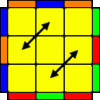
I consider 2 2 cycles like a Z or H Perm
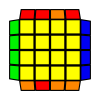
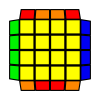
and 1 2 cycle (dedges) like the second image
and the first image a 2 cycle of singel edges
 

Attachments

  • 2 cycle.png
    2 cycle.png
    5.2 KB · Views: 6
  • 2 cycle 2.png
    2 cycle 2.png
    5.2 KB · Views: 6
  • Z perm.gif
    Z perm.gif
    1.9 KB · Views: 7
Whenever you do a 30 degree turn you are actually performing a 12 cycle of "edges"

Seems rather contrary to what we usually consider parity. You'd call (1,0) at cube shape a parity changer and you wouldn't call a 6-corners-cycle a parity changer. Do you find that perspective useful?

Yes true, I would consider a 6 cycle of corners to be an even permutation on a square-1 (with bandaged edges in place of corners). However, this would be "parity" in the same sense that 4x4x4 PLL parity is with bandaged dedges.

From a pure puzzle standpoint a 6 corner cycle is even in my view, but it counts as a 3x3x3 reduction "parity error" when solving. Just like PLL parity is a "parity error" when reducing a 4x4x4.

Chris

P.S. "Oooooh Parity!!!! Oooooh Parity!!!! Oh how you haunt my speeeedsooooooolves!!" ;)

I agree
 
A 2 cycle of dedges is a 2x2 cycle of edges.

A twisted 2-cycle of dedges is a 4-cycle of edges.


I assume he didn't mean double parity, but yeah, that's how I labeled it.

I consider 2 2 cycles like a Z or H Perm
and 1 2 cycle (dedges) like the second image
and the first image a 2 cycle of singel edges


Anyway, the second image is somewhat ambiguous. Since you referred to the pieces as dedges though, I'll assume it'd be after attempting to reduce the cube to a 3x3x3 and this would be a parity case.

However, if the cube is directly solved, it would not be a parity.

It all depends on context. At the moment, it's more like schrodinger's parity.
 
Fisher Cube doesn't have parity, it only has rotated centers like a picture cube would have.

That is parity?? Also that isnt a problem i can solve it and understand what i need to do to always avoid it.
BUT what about on the LL where one of the pieces is pointing up and all the others are solved??
 
Back
Top