Getting stuck on second layer

darthdustin

Member
Joined
Dec 20, 2009
Messages
4
I've gotten to a point where the first layer is cake. Then I flip the cube over so the solved side is down and, following Dan Brown's video, I use:

down-right: U R Ui Ri Ui Fi U F
down-left: Ui Li U L U F Ui Fi

...to solve the second layer, but that assumes that all of the pieces for the second layer are on top so you can move them down and over. Sometimes they're already on the second layer, but they are either in the wrong place or they're flipped the wrong way. Dan doesn't address this. I would appreciate some suggestions. I'm a noob so please keep it simple if you can.

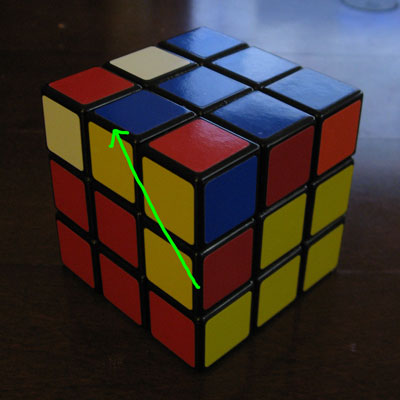
Here's an example where I needed to move a cublet up and over so I could employ one of the two algorithms I listed above to get it back where it needs to be. Would I just do the "right" algorithm backwards?
attachment.php
 

Attachments

  • rubiks01.jpg
    rubiks01.jpg
    27.9 KB · Views: 123
Then I flip the cube over so the solved side is down and, following Dan Brown's video, I use:[/B]


Stop what you are doing, right now.
The wiki is your friend.

It will be harder to switch to a faster method once you learn this one.
But, if you don't care that much about getting fast, just do the algorithm for right-edge replacement, position it correctly, and do whichever algorithm you would end up needing (right or left.)
 
Last edited:
No1: Use ' instead of i to notate inverse moves. (they are also called Prime moves)

No2: What you should do is remove it with one of your algorithms and replace correctly again. So with the situation on the picture (with red on front) you would use Right down (U2) right down.
 
Your Welcome.
What about his welcome? :)

Anyhow, the advice is correct and that's what counts!

Yes, the technique you are using: what does it do exactly? It swaps an edge piece from the top layer with one in the middle layer.

So if you need to remove an edge from the middle layer, just use your technique to swap it with an arbitrary piece in the top layer. Simple, no?
 
Or:

R2U2FR2F'U2R'UR' for an edge flipped wrong.

And:

R2U2R2U2R2 for one that's on the opposite side it's supposed to be.
 
Well, the above techniques all work.

However, I support switching to the video Carson posted if you think you'd be interesting in solving the cube faster once you know how to do it in the first place. It took me 3 months to be able to transition to basic CFOP (fridrich, a really fast method) because I used that vid.

It's your choice though. If you don't plan on getting fast, I'd stick to that vid.
 
Most of the advice is good, and all the techniques work, but two things.

1) It's important that you learn not to rely so much on step by step instructions and understand what you're doing rather than robotically repeating algorithms. So, the piece you want to insert is already in the place you want it, but oriented incorrectly. You know how to put a piece in there, but what happens to the piece that was already there before you put a new one? It moves somewhere else. It doesn't move into the bottom or middle layer, so that just leaves the top layer, where you can use what you know to put it where it needs to be. You should start thinking about what the steps are doing and, more importantly, understanding how the algorithms work and what the side effects of them are.

2) I love badmephisto's videos and, yes, I agree that the one Carson posted is a better beginners method than Dan's *if* you're hoping to transition into faster CFOP. However, whatever LBL beginner method you're using doesn't preclude the situation from happening. If you're using edge keyhole or corner keyhole, you can still end up with the situation where you have the final slot just like this, by accident. Newer cubers come here (just like I did) asking if ZB or MGLS or some of the other advanced CFOP hybrid methods can keep them from having to learn OLL. Well the answer is No. For example, here is Chris Hardwick's page on ZBF2L case 3: http://www.speedcubing.com/chris/zbf2l2-3.html You can't do ZBF2L without OLL and the entirety of OLL is encompassed in that one little frame. Just like you can't do any LBL method without knowing what to do when you last slot is in place but oriented wrong. MOST of these beginner methods that build to CFOP are additive, and there's just no skipping the basics.
 
2) I love badmephisto's videos and, yes, I agree that the one Carson posted is a better beginners method than Dan's *if* you're hoping to transition into faster CFOP. However, whatever LBL beginner method you're using doesn't preclude the situation from happening. If you're using edge keyhole or corner keyhole, you can still end up with the situation where you have the final slot just like this, by accident. Newer cubers come here (just like I did) asking if ZB or MGLS or some of the other advanced CFOP hybrid methods can keep them from having to learn OLL. Well the answer is No. For example, here is Chris Hardwick's page on ZBF2L case 3: http://www.speedcubing.com/chris/zbf2l2-3.html You can't do ZBF2L without OLL and the entirety of OLL is encompassed in that one little frame. Just like you can't do any LBL method without knowing what to do when you last slot is in place but oriented wrong. MOST of these beginner methods that build to CFOP are additive, and there's just no skipping the basics.
I just wanted to point out a couple things since he is new.

LBL = Layer by Layer
LL = Last Layer
Keyhole = A technique for placing pieces
ZB & MGLS = Solving Methods
F2L = First 2 Layers
ZBF2L = First 2 Layers of the ZB Method
OLL = "Orient" last layer (turn the pieces so the correct stickers are facing up)
PLL = "Permute" last layer (Move the pieces around the last layer so they are in the correct places)
CFOP = Also known as the Fridrich Method (although some others methods would technically fall in this category as well) It stands for CROSS,F2L,OLL,PLL.

It is easy to forget that new cubers have no idea what the multitude of abbreviations we use mean.

BTW, here is a list of all of the abbreviations and terminology.
http://www.speedsolving.com/wiki/index.php/Cubing_Terminology
 
Thanks, guys, for your time and all the helpful links. I really appreciate it. Dan's videos are what I cut my teeth on, and I obviously don't relish the idea of starting from scratch, but if it's going to be beneficial in the long run I'm willing to make the effort. Thanks again.
 
I highly recommend you abandon that video and use this one instead.

even if your not planning on getting faster watch the vid, Badmephisto explains it eleventy billion times better than Dan Brown does.

I dunno.. I learned from Dan and got it in a matter of hours, but I learned before badmephisto's improved tutorial came out.

I'd imagine it to be better, but I've never watched it through. Both of them are good tutorials IMO, if you don't take into account the actual method. Still, most people like to get fast, and badmephisto's is faster than pogobat's and allows for a faster and easier transition to other methods.
 
Last edited by a moderator:
Back
Top