RotoSphere -- This time for real

Pawel

Regular
Joined
Jun 17, 2020
Messages
61
For the last half a year, I've been developing RotoSphere(TM) -- this time no longer as a conceptual mobile/browser game, but a real-world twisty puzzle. Now, after the patent and trademark filings, RotoSphere officially has the "Patents Pending" status, and I can move to the next stage...

When I say "RotoSphere" I don't mean the original geometry in the initial discussion about the mobile game. I have made quite a few prototypes and also have discovered a lot of things about this puzzle. It has similarities to cubes but also differences. The biggest difference perhaps is that there is not a single "goal" setting -- instead, there are many patterns to be solved. Some patterns are easier -- like the half and half settings where you only need to move each color to a separate side of the sphere, while others require you to find a precise location for each piece.

The other difference (perhaps) is the creativity side -- RotoSphere is much more free-flowing, its logarithms do not always require to follow each other in a linear fashion...

There will be more on the subject... with videos.
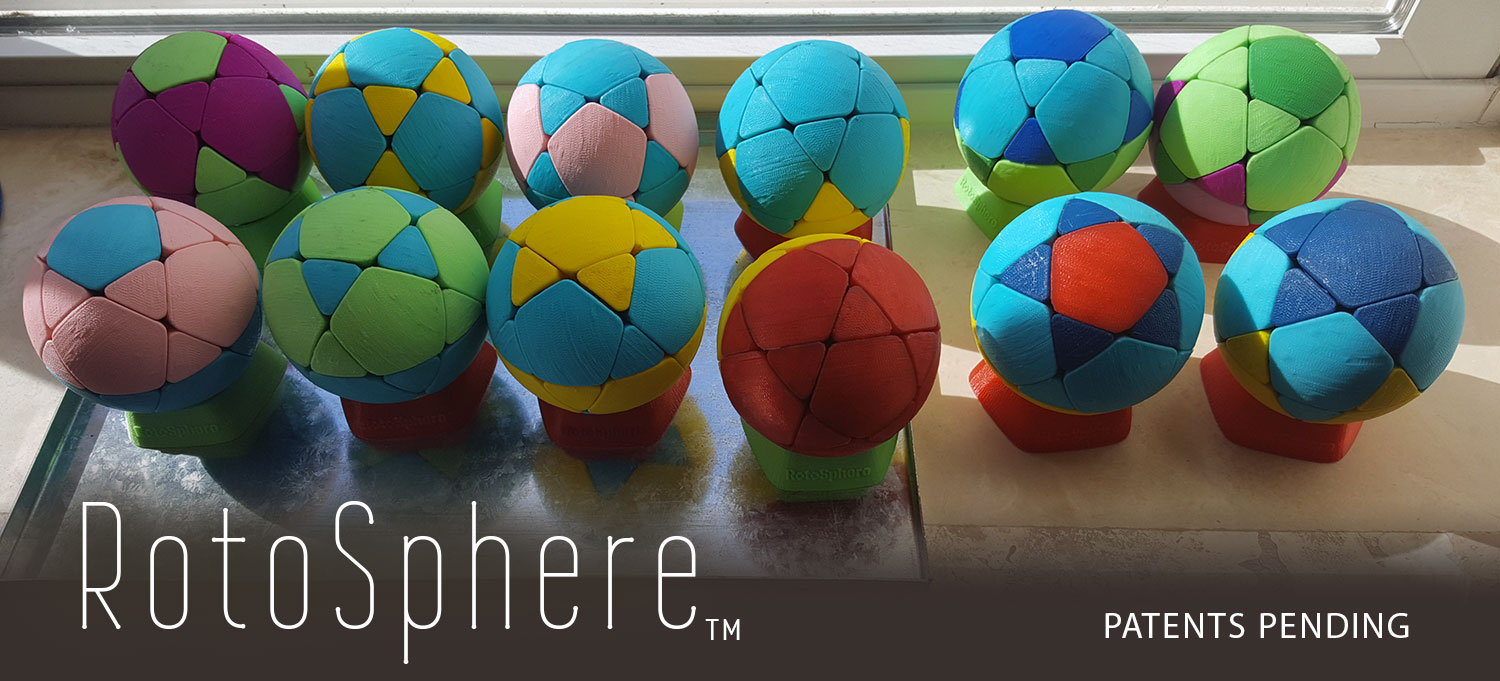
rotosphere-linup.jpg
rotosphere-rendering.jpg
 
Last edited:
For the last half a year, I've been developing RotoSphere(TM) -- this time no longer as a conceptual mobile/browser game, but a real-world twisty puzzle. Now, after the patent and trademark filings, RotoSphere officially has the "Patents Pending" status, and I can move to the next stage...

When I say "RotoSphere" I don't mean the original geometry in the initial discussion about the mobile game. I have made quite a few prototypes and also have discovered a lot of things about this puzzle. It has similarities to cubes but also differences. The biggest difference perhaps is that there is not a single "goal" setting -- instead, there are many patterns to be solved. Some patterns are easier -- like the half and half settings where you only need to move each color to a separate side of the sphere, while others require you to find a precise location for each piece.

The other difference (perhaps) is the creativity side -- RotoSphere is much more free-flowing, its logarithms do not always require to follow each other in a linear fashion...

There will be more on the subject... with videos.

View attachment 14415View attachment 14416

That’s really cool, I am surprised I hadn’t heard of this, but nice job! Seems like you put a lot of work into it
 
For the last half a year, I've been developing RotoSphere(TM) -- this time no longer as a conceptual mobile/browser game, but a real-world twisty puzzle. Now, after the patent and trademark filings, RotoSphere officially has the "Patents Pending" status, and I can move to the next stage...

When I say "RotoSphere" I don't mean the original geometry in the initial discussion about the mobile game. I have made quite a few prototypes and also have discovered a lot of things about this puzzle. It has similarities to cubes but also differences. The biggest difference perhaps is that there is not a single "goal" setting -- instead, there are many patterns to be solved. Some patterns are easier -- like the half and half settings where you only need to move each color to a separate side of the sphere, while others require you to find a precise location for each piece.

The other difference (perhaps) is the creativity side -- RotoSphere is much more free-flowing, its logarithms do not always require to follow each other in a linear fashion...

There will be more on the subject... with videos.

View attachment 14415View attachment 14416
That is so cool! I remember playing the prototype game you made and giving feedback, and everyone trying to get a faster time. I never imagined it would become a physical puzzle!
 
Awesome! It would be cool to see you get your product to cubing retailers!

I have a plan to bring it to life -- Either I license it to big guys and let them manufacture and market, or I will manufacture it and market myself.

I will give it half a year to see if the elephants are interested in partnering with an ant. If not (or they attempt to squash the ant) I will build an ant hill...
I would totally buy the rotospheres if they came out on cube stores!
 
For the last half a year, I've been developing RotoSphere(TM) -- this time no longer as a conceptual mobile/browser game, but a real-world twisty puzzle. Now, after the patent and trademark filings, RotoSphere officially has the "Patents Pending" status, and I can move to the next stage...

When I say "RotoSphere" I don't mean the original geometry in the initial discussion about the mobile game. I have made quite a few prototypes and also have discovered a lot of things about this puzzle. It has similarities to cubes but also differences. The biggest difference perhaps is that there is not a single "goal" setting -- instead, there are many patterns to be solved. Some patterns are easier -- like the half and half settings where you only need to move each color to a separate side of the sphere, while others require you to find a precise location for each piece.

The other difference (perhaps) is the creativity side -- RotoSphere is much more free-flowing, its logarithms do not always require to follow each other in a linear fashion...

There will be more on the subject... with videos.

View attachment 14415View attachment 14416
Wow that is so cool! I would recommend adding some form of ridges and/or indentations similar to how they do it on Megaminxes in order to have a place to grip onto while turning.
 
Wow that is so cool! I would recommend adding some form of ridges and/or indentations similar to how they do it on Megaminxes in order to have a place to grip onto while turning.

It is possible... However, solving RotoSphere is quite a different experience than cubes or even megamix -- you always rotate half of the puzzle -- not 1/3rd of a cube or 1/6th of the megamix. Honestly, I do not know how speed-solving would work with RotoSphere and if you even could use individual fingers like I see you guys doing with cubes...

This prototype presentation is just the beginning of a journey and the production puzzles should run much smoother than my prototypes (which I am still fine-tuning). My understanding is that Erno Rubik's prototypes were held with rubber bands -- I am sure you could not speed solve those with today's results... RotoSphere physically has a different set of challenges to overcome, so the final results may differ from cubes you are playing with. One of the fundamental differences is that not a single tile/piece stays in place -- there are no middles that stay fixed in relation to each -- every tile moves.
 
Back
Top