[Member Intro] Solving LL efficiently - my discoveries and questions

Pätçhw0rK

Member
Joined
Apr 30, 2017
Messages
4
Hi guys !

So I have a few questions, but I thought maybe it’d be nice to share my « cubing story » and how I came to ask these questions. It could serve as an introduction as well :)
I highlighted my questions with bulletpoints and my most important points in bold font. Also, I'm french, so excusez mon anglais ;)

I started cubing in september, out of boredom, and from the beginning what interested me was not speedcubing at all, but FMC. So I really wanted to be able to solve the cube intuitively, which I eventually managed using Friedrich for the F2L and commutators fot the LL. Then I learned Petrus, Heise and ZZ, which is now my main method. Also, I really hate learning algs, my goal is to understand everything I do on the cube.

Last month, I got the Calvin’s ultimate contrained cube, which F2L I managed to solve using a modified version of ZZ. But I got stucked at the LL : none of the algs and commutators that I knew about worked… So I took out pen and paper and started inventing my own.
I found an alg that can cycle three edges, but cycles and twists the corners as well… Then I learned that this algorith is actually called Sune ! I also found an algorithm that cycle three corners, but twists them as well (the Niklas commutator) ! So with both Sune and Niklas, I was able to permute the LL, but all the corners were misoriented. I could then orient them using a commutator, and the constrained cube was solved !

So, I ended up solving the cube in the following way :
  1. F2L and EO : ZZ
  2. Permute edges : Sune RUR'URU2R'
  3. Permute corners : Niklas [R,U'L'U]
  4. Orient corners: commutator or the form [R'DRD'R'DR,U]
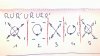
I know Sune is usually used to orient the corners, but it also permutes them as well as the edges. The edge permutation given by the Sune alg is what interested me there. At this point, we don't care about the corner permutation and orientation, since we solve them right after. I attached a little note I made about how SUne affects the top layer depending on the number of time we repeat it. The notation is quite straightforward I'm sure you'll understand! If not please ask me :)

The main thing that I changed from a « normal » LL method was that I permuted the LL before orienting it, and I realized that this way of doing the LL has a lot of advantages.

The good thing about both Sune and Niklas is that they are only 8 move long algs ! I know (may be wrong though, I’m more an FMC guy than a speedcuber) that the algs used by speedcubers are usually around 13 moves long. So, by first permuting the last layer without caring about the orientation of the corners, we save 5 moves per permutation alg (which is great) ! Finally orienting the corners is a piece of cake, and if we use ZZ we don’t even need to orient the edges. So we save time, moves, and also brain space (Sune+Niklas=2 algs only) !
  • I’ve never heard about solving the LL this way. Are there any issues with this « LL method » ? Is this something that is popular among speedcubers but I just didn’t know about ?
I realize that I probably just « reinvented » something that already exists since the beginning of cubing, and that leads to my questions :
  • Sune is able to do a U perm, but is there an alg of this type (that is short and does not care about the orientation of the corners) that allows to do an H perm ? And one do that allows a Z perm ?
  • Similarly, does someone know of an alg of this type that allows an E perm for the corners ?
Sorry for the long post, but I felt like it was kind of needed to explain correctly the whole thing !

Have a nice day !
 

Attachments

  • WP_20170430_003.jpg
    WP_20170430_003.jpg
    304.8 KB · Views: 6
Hi guys !

So I have a few questions, but I thought maybe it’d be nice to share my « cubing story » and how I came to ask these questions. It could serve as an introduction as well :)
I highlighted my questions with bulletpoints and my most important points in bold font. Also, I'm french, so excusez mon anglais ;)

I started cubing in september, out of boredom, and from the beginning what interested me was not speedcubing at all, but FMC. So I really wanted to be able to solve the cube intuitively, which I eventually managed using Friedrich for the F2L and commutators fot the LL. Then I learned Petrus, Heise and ZZ, which is now my main method. Also, I really hate learning algs, my goal is to understand everything I do on the cube.

Last month, I got the Calvin’s ultimate contrained cube, which F2L I managed to solve using a modified version of ZZ. But I got stucked at the LL : none of the algs and commutators that I knew about worked… So I took out pen and paper and started inventing my own.
I found an alg that can cycle three edges, but cycles and twists the corners as well… Then I learned that this algorith is actually called Sune ! I also found an algorithm that cycle three corners, but twists them as well (the Niklas commutator) ! So with both Sune and Niklas, I was able to permute the LL, but all the corners were misoriented. I could then orient them using a commutator, and the constrained cube was solved !

So, I ended up solving the cube in the following way :
  1. F2L and EO : ZZ
  2. Permute edges : Sune RUR'URU2R'
  3. Permute corners : Niklas [R,U'L'U]
  4. Orient corners: commutator or the form [R'DRD'R'DR,U]
I know Sune is usually used to orient the corners, but it also permutes them as well as the edges. The edge permutation given by the Sune alg is what interested me there. At this point, we don't care about the corner permutation and orientation, since we solve them right after. I attached a little note I made about how SUne affects the top layer depending on the number of time we repeat it. The notation is quite straightforward I'm sure you'll understand! If not please ask me :)

The main thing that I changed from a « normal » LL method was that I permuted the LL before orienting it, and I realized that this way of doing the LL has a lot of advantages.

The good thing about both Sune and Niklas is that they are only 8 move long algs ! I know (may be wrong though, I’m more an FMC guy than a speedcuber) that the algs used by speedcubers are usually around 13 moves long. So, by first permuting the last layer without caring about the orientation of the corners, we save 5 moves per permutation alg (which is great) ! Finally orienting the corners is a piece of cake, and if we use ZZ we don’t even need to orient the edges. So we save time, moves, and also brain space (Sune+Niklas=2 algs only) !
  • I’ve never heard about solving the LL this way. Are there any issues with this « LL method » ? Is this something that is popular among speedcubers but I just didn’t know about ?
I realize that I probably just « reinvented » something that already exists since the beginning of cubing, and that leads to my questions :
  • Sune is able to do a U perm, but is there an alg of this type (that is short and does not care about the orientation of the corners) that allows to do an H perm ? And one do that allows a Z perm ?
  • Similarly, does someone know of an alg of this type that allows an E perm for the corners ?
Sorry for the long post, but I felt like it was kind of needed to explain correctly the whole thing !

Have a nice day !
This is just beginner's LL
 
This is just beginner's LL

I don't think so, beginners LL orients before permuting LL. However this does not answer my questions:

  • If it is more efficient, why are people not using it?
  • Do you know how to do H, Z and E perms in the same way (low move count & not caring about the corner orientation)?
 
Last edited:
I don't think so, beginners LL orients before permuting LL. However this does not answer my questions:

  • If it is more efficient, why are people not using it?
  • Do you know how to do H, Z and E perms in the same way (low move count & not caring about the corner orientation)?
No, beginners permutes then orients the same way as that.

It is not more efficient.
The last step of orienting the corners the way you have it is not going to be efficient, as [R'DRD'R'DR,U] orients one piece, in 8 moves. Assuming you have the H OCLL, that is 24(?) moves to orient the LL, and you just used 16 to permute it (assuming you manage to do perfectly efficient 8 move comms to solve the edges and corners) so, 40 moves for the LL. ZZ's LL uses 7.93 moves on average to orient the corners, and then PLL, which is 11.8 Adding those is ~ 19 moves for the LL. Nearly 20 moves more efficient than what you proposed.

Okay, concerning the commutator, I'm sure it is far from being efficient (I'm just beginner so I stick with it for now). Also, I just looked it up, I reinvented the beginners method... nice hahaha
But it doesn't mean it is any bad, I don't mean to propose a new method, just to improve on top of what I found. And it seems that beginners LL with a bit of improvement would be very efficient!

Do you know the answer to my last questions?
An H perm that does not care about the corners would just be a U2, a Z would be R' F' U' F U R F U R U' R' F' and I was unable to find one for E.
 
  • Permute corners : Niklas [R,U'L'U]
  • Orient corners: commutator or the form [R'DRD'R'DR,U]

If you do the last four corners (L4C) with 3-cycle commutators instead of separating it into permutation and orientation, you get a relatively efficient beginner/intermediate method that doesn't require learning a lot of algs. Quickly recognising which commutator is the best for which cases is very difficult, however, and if you really want to get fast with this method, learning full L4C (~80 algs) is better in the long run.

But other than that, the conventional ways of doing the last layer in 3 looks (with edges oriented) are CO/CP/EP and CP/CO/EP. Doing EP first instead of last is not inherently bad, but recognising the edge permutation requires looking at three edges (versus only two when your corners are already solved); the worse recognition for EP combined with slower algs for the remaining CO and CP steps make EP/CP/CO a worse method overall.

EP/CO/CP is somewhat better if you learn a bunch of algs to do CO in one step every time instead of using your really long commutator, although still kind of bad compared to the conventional methods.

Similarly, does someone know of an alg of this type that allows an E perm for the corners ?

Shortest is 11 moves, iirc. [R' F2 R2 U2 R' : F2] is one of the 11-move cases, although there's a faster 14-move alg F (R U R' U')3 F' for that particular case. If you really don't want to learn new algs, double Niklas (14 moves) also works.
 
Last edited:
Back
Top