Older cubers discussions

I'm also practicing megaminx. After 100 measured times I'm 4:xx solver but today I've broken sub4 barrier with ao5 and ao12.

Nice to see the megaminx race is still going. Strange as I think it is having a positive effect on 3x3 too. Not used to holding a puzzle so easy to hold after the megaminx I guess :D

Had new PBs for all my averages except 5 today. Nice to see some quantifiable improvement.
41c2b2b6a1b6b38a6cf586111152ea68.jpg

Wow, so so close Jason. Hopfully teh next Ao100 and you will be there :)

Hey guys,

Please let me use your experience again :) As I said before, I'm currently learning the 21 pll algs (I have 13 down, 8 to go). But I have yet to see any increase in my averages : with 2look PLL, my session averages (any session with more than 10 solves) was between 40 and 43 sec.. and with half the PLL algs in the bank, I'm only down to 39-42 sec.

What was your experience while learning PLLs ? Did you improve your times right away or did it take time like it seems to be happening for me ?

As I side note, I learned the complicated F perm today and I'm quite proud to say that the only algs I still have to learn are the G, R, Y and V perms :)

I would just echo what the other have eloquently already said. Initially times will suffer, especially until you know them all as there s still the question of getting a PLL you dont know and having to two look it. Persevere and you will see improvement soon :)
 
Nice to see the megaminx race is still going. Strange as I think it is having a positive effect on 3x3 too. Not used to holding a puzzle so easy to hold after the megaminx I guess :D

Yes it has a possitive effect. Since I wrote it I got 3:01 pb and a lot of 3:xx solves.

Today I've set a lubed my Thunderclap v2. It seems working better.
 
omg guys : this is a hell of a day !

I just got a new Ao10+ PB... THREE times in the same evening.
Up to yesterday my PB was 38.47 sec. ( I think it was a series of 15)
And today...
At 5pm i did 37.57 sec for 13 solves.
At 9pm i did 37.28 sec for 14 solves.
At 2am i did 36.51 sec for 10 solves.

Beleive it or not, this hollywood sequel keeps going on :

At 4pm i did 34.81 sec for 10 solves.
 
I've just got my first Last Layer skip of the year, my last one was in February 2015. Needless to say I was doing slow untimed solves at the time, just like last time, so nothing exciting resulted from it. Oh well...
I was doing some full-speed OH first 2 layers practice earlier, and got one of those 'two for the price of one' F2L slots which usually surprise/confuse me.
With last layer on U face, do: R' U' R2 U R' U'
I didn't see the pair for the FR slot, but the BR slot was spotted and swiftly solved (with the reverse of the above) leaving me wondering what happened...it was a decent 15 seconds first two layers, with a 16 and a couple of 17's also in the session.
If only it was easy to manipulate slot-solving to affect the next slot (multi-slotting) - but you've only got to look at sites like Sebastien Felix' one (absolute mind) to realise it's fiendishly difficult. I can do a bit of it slowly for FMC purposes, but at speed???
http://absolutemind.pagesperso-orange.fr/ms-angl.html
 
@SenorJuan - Yes I got excited about multislotting when I first discovered it but it is indeed difficult. I went through all the cases and identified the ones with the greatest saving - that is, inserting pair A slightly differently than the obvious default way will convert pair B from a long-winded case into a formed pair ready to insert. There are only a handful of those. I did start learning them but forgot them a long time ago because my recognition is too slow. I can dig them out if anyone's interested.
 
In principle, for my favoured OH solving, tricks like multislotting should be more viable, due to the slower turning, but I guess the slower brain makes it un-viable. I remember when one of the Dzoan brothers (edit:Chris) set a OH record (about 12 sec) it was in part attributed to multislotting. But now, I think good use of empty slots is a much more realistic way to reduce move-count. If you're doing 'intuitive' solving, you can, and should consider empty slots as part of the learning process.
Though I haven't analysed it 'scientifically', I think my first two layers move-count is about 32 turns (htm), which is what is considered normal for this process, so I don't think I'm doing anything significantly wrong.
 
Last edited:
Doing Megaminx also here...
First real a12 with the Xman - 1:56.34, 2:01.61, 1:50.68, 1:51.94, 1:58.02, 1:49.08, 1:59.69, 1:54.93, (2:09.31), (1:48.67), 2:05.13, 1:51.99 = 1:55.94 :D

There were some 1L-PLLs also, like a J, an odd Y, an odd T & a Q2 EP (in all I know 43/151 PLLs).
 
Hey look at this ! At this rate, I'll be sub-20 before the end of september.

Kidding appart, I wonder what a realistic goal would be.

View attachment 6734

It's up what you mean "being sub-20". Most people mean global averages (ao100, mo100, ao1000, mo1000) but singles are also nice and they show your progress. I think you can got sub20 solve any day. I remember me getting sub20 solve when my global avg was around 35-40. On the other hand - when I was globaly sub25 I got sub20 solve once per 30-40 solves.
 
But now, I think good use of empty slots is a much more realistic way to reduce move-count. If you're doing 'intuitive' solving, you can, and should consider empty slots as part of the learning process.
Though I haven't analysed it 'scientifically', I think my first two layers move-count is about 32 turns (htm), which is what is considered normal for this process, so I don't think I'm doing anything significantly wrong.
Yeah absolutely. IMHO, proficient F2L (2H) requires the ability to solve to all four slots without bias to FR, including the use of empty slots either to avoid rotations or to make the setups easier/shorter. Multislotting is certainly more advanced than that, although some basic techniques like preserving pairs, splitting nasty cases or extracting stuck pieces is relatively easy and good to know.

For pure F2L (excluding cross) I think 28 HTM is a good move count. I did do a scientific analysis once :).
 
It's up what you mean "being sub-20". Most people mean global averages (ao100, mo100, ao1000, mo1000)
Yeah everyone seems to have their own definition so it's best to state what yours is rather than just say sub-20. For me, it's rolling ao1000, meaning average with best and worst 5% excluded. On a graph, I like to see my rolling ao100 line stay well below the ao1000 line. The delta between them is a kind of metric of improvement. If they converge too close, it shows I'm stagnating and should think about changing how I practise.

@h2f, I'm interested to know how you track BLD averages. The idea that a larger average doesn't count if it has more than one (or even 5%) DNFs is useless for performance tracking. I don't like to count sessions with poor accuracy because it favours spamming to get fast results, so I always throw away sessions with less than 50% accuracy. On the other hand, even with an accuracy target I have the temptation to DNF (or at least rush carelessly) poor solves in case I spoil my average and it seems wrong that there can be a benefit to bailing out of a solve. So what I started doing is deleting the worst 50% from each session, including DNFs and slowest times, and taking the average of what remains. That seems to give me a consistent measure of performance without penalising better accuracy. I try my best to complete every solve. If my accuracy ends up poor, the slower results drag my average down, but if I make up ground and achieve better accuracy I am rewarded by exclusion of some slower results. Thoughts?
 
@h2f, I'm interested to know how you track BLD averages. The idea that a larger average doesn't count if it has more than one (or even 5%) DNFs is useless for performance tracking. I don't like to count sessions with poor accuracy because it favours spamming to get fast results, so I always throw away sessions with less than 50% accuracy. On the other hand, even with an accuracy target I have the temptation to DNF (or at least rush carelessly) poor solves in case I spoil my average and it seems wrong that there can be a benefit to bailing out of a solve. So what I started doing is deleting the worst 50% from each session, including DNFs and slowest times, and taking the average of what remains. That seems to give me a consistent measure of performance without penalising better accuracy. I try my best to complete every solve. If my accuracy ends up poor, the slower results drag my average down, but if I make up ground and achieve better accuracy I am rewarded by exclusion of some slower results. Thoughts?

In fact I've stopped tracking it for the reasone I'm still not good in 3style and my accuracy is less than 40%. Last autumn Maskow sent me an excel sheet to track it. It counts few things but the idea is based on session mean which is count in this way: if your accuracy is over 50% than you delete the worst times (including DNFs) till you got 50% solves of the session. If your acc is lower of cours you must take lower mean of session times. But the most important thing - you must keep that ratio for whole time - in the sheet it was 14 days measured period. I think this is good idea and it goes on the line of your thoughts about it. Maskow wrote me that the reason is not to punish blinder for doing slow solves and take into account the best times. I hope you know what I mean.

I think I'm ready to back to measure it. I'll start today: 20 solves per day, 30%ratio.
 
@h2f, that is great to know, thanks! If Maskow does something similar then that's an endorsement. I will stick with 20 solves/day at 50% ratio. I will maybe lose a few sessions but I don't want to sacrifice my accuracy.
 
A while back I started modding cubes because I wanted to see if I could do it. Started off with a 2x2, 3x3, and 4x4 balls. So far of the 3 I have only finished the 4x4 ball. The 3x3 is close to being done, and the 2x2 I've written off as a failure.

Despite not finishing those I decided to start more :) So started on 3x3, 4x4, and 5x5 barrels. So far I have only just finished the 5x5 barrel. The 3x3 and 4x4 and close to being done, just need to sand each piece individually, paint, and sticker.
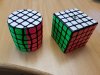
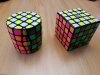
So here is my 5x5 barrel (made from a Cyclone Boys 5x5) which I finished off last night. The stickering is such a tedious job and proportionally takes quite a bit of time, so I was so happy to eventually get it done. I'm really happy with the end result and has made all the work worth while. Can't wait to finish off the 3x3 and 4x4 barrels now though. Just need to find the time.

As far as solving goes .... I must say this is the first time I have solved a 5x5 super cube and it does present some interesting things to look out for an be aware of. No simple center building and having to resort to 3 piece swaps to eventually get that done. You also need to watch out for center rotations ... after doing a G perm I had a "solved" barrel with 1 center rotated 90 degrees ... still need to figure that one out.

20160817_084934.jpg 20160817_085112.jpg 20160817_085618.jpg 20160817_085629.jpg

Edit:
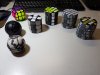
The collection I am currently modding .... most are more done than this photo but you get the idea
20160714_180330.jpg
 
Fine @mark49152 . He added also column with session mean (no matter accuracy). The second column is the one with 50%ratio (or 30% for me). Next avg's if you can do them. He said also that his acc. is around 60%. There's also column with best solve of the session.
 
Last edited:
Back
Top