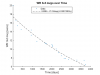
I recently began solving the Square-1. My first ao5 was 6 minutes. Only a few days later I was averaging 1 minute.
Last month on 4x4 I was averaging 1:45 and now I've only shaved 15 seconds off my times.
A non-cuber might think I'm absolutely awful at 4x4, given that I've improved by such a paltry amount compared to Square-1 even with a much longer timeframe.
A cuber sees this is probably due to the fact that I had already been speedsolving the 4x4 for quite some time, and in fact I have. This illustrates that improvement is fast in the beginning, and slower later. While some say the only set limit is sub-zero, I would propose that for any individual person using any set method, assuming they only practice that and don't learn anything new, we could use calculus to determine how fast they could get. This would require them to do an ao100 (at least) once a day for a long time (a year?). We could then plot their progress on a graph with x as the number of days since they began and y as their time in seconds and find the line of best fit (probably a logarithmic equation). Then we find the limit of x as x approaches infinity and voila, we've found their limit. Of course, If they learn something substantially new (A new alg set would be an example, but something like lookahead would not be, since it happens naturally) then they could decrease their times even more.
I would further propose that if we took a sufficiently large sample of all cubers and performed this experiment we could discover the limit of everyone's efforts put together. I'm not 100% sure the math would work and of course there would always be the possibility that the community would discover something new and substantially more effective at improving, but it would be interesting.
Another option would be to draw from only very fast cubers, as drawing from even amateurs and people who don't practice very much could skew the results.
I don't think this would be very practical because people are busy and don't practice very consistently most of the time, but it's still an interesting idea. What do you think? Is there a limit to cubing, or at least a limit for a particular person practicing a particular amount with a particular method? What do you think it is? Jessica Fridrich once said that because God's number is 20 and max tps is around 10, a normal human physically could not average below 2 seconds (even if they could see the entire optimal solution in 15 seconds!) But could anyone ever get that low? I've been plotting my progress, but I don't have a very large sample yet, only about 2 months worth of averages, and practical complications have gotten in the way of my consistency, so I don't know how useful the data are.