Where the puzzle was purchased: Aliexpress (attempt to purchase at a reputable European seller ended up in a post service black hole)
When the puzzle was purchased: August 2026
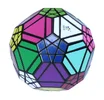
Thoughts on the puzzle: The puzzle is injection moulded, which is done quite well. It came stickered, with a few stickers not quite right, but nothing too serious. The turning faces are very shallow, just 5 mm, which is very unusual and it takes time to get used to it, but they turn very smoothly and with proper aligning they do not catch. It definitely feels better than Icosaminx, I'd say comparably to standard Rubik's cubes. Playing with the puzzle is a very pleasant experience. The makers wisely gave up on trying to come up with 32 different shades. Instead, the usual 20 shades for icosahedron were used for hexagonal faces, and some of them were recycled for the pentagonal faces (see the two white faces in the picture). Due to nature of pieces, no confusion arises from that.
I purchased this puzzle so that I do have something other than a Platonic solid to play with. The truncated icosahedron is a very nice and familiar shape that is easily available in two forms as a twisty puzzle. One is known as Soccer Megaminx and I thought it might be a bit boring as a shape mod of Megaminx. I therefore opted for the Soccer Cube (that some sellers also call Soccer Megaminx to confuse us) that is different from commonly known puzzles. There seem to be many pieces, but most do not contribute to complexity. Only the hexagonal faces can turn, by 120 degrees. Their huge triangular centers are connected with triangular pieces on the adjacent rims, so each little triangle in a pentagonal face can only go around its controlling hexagonal face and can be restored easily. Only the long edge pieces can really travel around the puzzle (and change orientation).
I actually found the puzzle challenging, because it takes ages to scramble properly. Once this is done, the rest is just fun. I go in the top down fashion and apart from the bottom face, all edge pieces are placed just like corner pieces in the top layer of Rubik's cube. The only complication is the frequent need to reorient the edge pieces before moving them in, and that can also be done intuitively. I found that I need only one algorithm worthy its name, a three-cycle applied to the last layer, where I use my usual three-cycle for edge pieces of Rubik's cube last layer. Placing all 30 edge pieces takes some time, but I find it enjoyable and overall I would see this puzzle as a nice intuitive holiday from more serious puzzle solving. Probably the most difficult part is that often I would turn a hexagonal face just by 60 degrees (which seems the natural thing to do) and then I have to correct myself and turn it a bit more. But this only adds to the "different" feel fo the puzzle. I definitely do not regret buying it.