The Naturally Desired Scramble State

Dane man

Veteran
Joined
Jul 9, 2010
Messages
262
Location
Earth
I think we all at one point or another have been messing around with the cube and been looking to scramble it in such a way that no single color is aligned with itself anywhere on the cube (without using algorithms). We turn and turn trying to break the pairs that continue to show up as we turn it, until eventually, in rare instances, we finally manage to scramble a cube in such a way as to separate all colors from their own kind. One example of this kind of scramble is known as the super flop. And I just achieved one recently, and it got me thinking...
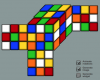
Screen Shot 2014-06-15 at 8.28.31 PM.png
What is the minimum number of moves required to achieve one? (Answered)
How many of these states exist on the 3x3?

This is either a mathematical problem or one that requires computer power to be thrown at it as well.

But what do you guys think? Can it be found?


Hey look, hundredth post.
 
Last edited:
But what do you guys think? Can it be found?

I think yes. If not for 3x3x3, then for puzzles which are nearly as complex. Very clever dynamic programming.
Maybe we can interest Tom in this. :-P

In any case, "naturally desired" isn't really a good term for this. If you want to discuss it a lot, I suggest something accurate and objective like "color-separating".

There goes the second question. How about the first one?

No, it doesn't? I don't see a proof in this thread that 5 moves are not enough.
 
Last edited by a moderator:
No, it doesn't? I don't see a proof in this thread that 5 moves are not enough.
On a solved cube, there are 72 adjacent pairs of like-colored stickers, 12 per side, each of which must be broken up. When you turn one outer layer, you're only cutting through 12 of these, and so one such move cannot break up more than 12. 72/12=6, ergo 6 turns is a lower bound. Since we already have an example of a 6-turn solution, 6 is also the upper bound. Ergo, the number is 6. Q.E.D.
 
I was wondering if it was possible to generate something that looks like a random scramble (and follows whatever rules are required for regulation scrambling), but ends up solving the cube (without just looking like half a scramble and then undoing it).
 
I was wondering if it was possible to generate something that looks like a random scramble (and follows whatever rules are required for regulation scrambling), but ends up solving the cube (without just looking like half a scramble and then undoing it).

There are no rules for what the scramble "looks like", only for what it does (produce a random state).

However, you can make it a goal to produce an identity alg that looks like the reversed output of a two-phase solver.
I don't know if anyone's done that, but I did something similar for an April Fools' prank back when the scramble was just random moves: R' U F R2 D B' R2 L2 F B2 D2 F' B R2 B L2 F' B U2 F R D' F' R2 U'
 
Last edited:
There are no rules for what the scramble "looks like", only for what it does (produce a random state).

However, you can make it a goal to produce an identity alg that looks like the reversed output of a two-phase solver.
I don't know if anyone's done that, but I did something similar for an April Fools' prank back when the scramble was just random moves: R' U F R2 D B' R2 L2 F B2 D2 F' B R2 B L2 F' B U2 F R D' F' R2 U'

Wow, yeah, that's what I was looking for. Actually, it would be funny if on Aprils Fool's, QQtimer was pumping out random scrambles that just solve the cube.

It seems like it would be a fun challenge to program something to generate random scrambles that just solve the cube.
 
Wow, yeah, that's what I was looking for. Actually, it would be funny if on Aprils Fool's, QQtimer was pumping out random scrambles that just solve the cube.

It seems like it would be a fun challenge to program something to generate random scrambles that just solve the cube.

cubeexplorer doesn't handle solved cubes well. It insists that 8 moves is 'optimal'...

EDIT:
F' U D' L2 U F2 R2 U' D B2 R2 U' F' (13f)

it's short but meh.
 
Last edited:
Wow, yeah, that's what I was looking for. Actually, it would be funny if on Aprils Fool's, QQtimer was pumping out random scrambles that just solve the cube.

It seems like it would be a fun challenge to program something to generate random scrambles that just solve the cube.
Yeah, but then there would be a ton of noobs going around being like: "One time, I got a complete whole cube skip, so my PB is 0" or something stupid like that :P
 
I wonder if there are any positions where no colours touch, even diagonally? I'd try to find out but I am tired and lazy.
 
I was wondering if it was possible to generate something that looks like a random scramble (and follows whatever rules are required for regulation scrambling), but ends up solving the cube (without just looking like half a scramble and then undoing it).
You could use cube explorer to generate two different solutions for a scramble, make the reverse of one of them, then put them together. (Ex: L' B2 R' B' U' D B' L' B2 R' L R B D' U B L R)

I wonder if there are any positions where no colours touch, even diagonally? I'd try to find out but I am tired and lazy.
See whauk's scramble.
 
Last edited:
Interesting challenge; I think it can be done as Lucas says with dynamic programming.
I'm not sure it can be done just with pencil and paper.

What if we extend it to colors not touching diagonally---even across a cube edge?
(So if the upper sticker on the up-front-right corner is yellow, the right sticker on
the up-right edge cannot be yellow either).
 
Back
Top