There's one very nice property of OBTM that STM/BTM doesn't have: there's a unique decomposition of moves on a single axis into outer block moves. Not so for block moves. Let's say we're looking at an n×n×n cube (n ≥ 2).
Assuming the cube's layers are only misaligned along the U-D axis, you can represent the rotation angle of each of the slices, relative to some independent reference, as some number from 0° to 360°. This gives a free module of rank n, (ℝ/(360°))^n. Since rotating the whole cube shouldn't affect the penalty, we can take the quotient by the rank-1 submodule corresponding to all whole-cube rotations along the U-D axis, leaving us with a rank-(n−1) module.
(N.b. if you don't know what a "free module" is, just think of it as a vector space, except that the coordinates are angles (and hence wrap around at 360°) rather than numbers you can freely multiply and do whatever with.)
With OBTM, we have the moves 1Uw, 2Uw, 3Uw, 4Uw, …, nUw, 1Dw, 2Dw, …, nDw. This is a set of 2n generators within (ℝ/(360°))^n, but if you quotient out by the submodule of whole-cube rotations, we get [nUw] = [nDw] = 0 and [kUw] = [(n−k)Dw] for all 1 ≤ k ≤ n−1, effectively leaving us with only n−1 generators. A set of (n−1) generators for rank-(n−1) ⇒ all of these are independent, and there is an essentially unique way of writing any misalignment in terms of (possibly-fractional) outer block turns. The only source of non-uniqueness comes from replacing, say, 2Uw with (n−2)Dw, but these are really the same move written in different ways anyway.
With BTM, we have the moves 1U, 2U, 3U, …, nU, 1-2u, 2-3u, 3-4u, …, (n−1)-nu, …, which is a much larger set of generators, with n(n+1)/2 elements; even if you quotient out by the whole-cube rotations, this leaves n(n−1)/2 generators. We get unique decomposition when this is equal to n−1, and the only way that can happen is if n = 2 (which makes sense, since that's where OBTM and BTM are truly equivalent). If n > 2, then n/2 > 1 and hence n(n−1)/2 > n−1, so there's definitely no way our generating set can be linearly independent, which also means the decomposition will fail to be unique.
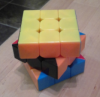
For a concrete example, let's look at a 3×3×3 and do an E move to a solved cube. Now, instead of using the "obvious" decomposition as 2U^−1, there are other possible decompositions, such as U^0.5 2U^−0.5 D^−0.5. With this choice of decomposition, we never need to do a move of more than 45° to fix the cube. In other words, no misalignment penalty!
With BTM, how should you choose which decomposition to use to judge for misalignments? It's already non-obvious for n=3, and it only gets worse as you increase n, where the system of equations gets increasingly underdetermined.




 ...