leeo
Regular
I was half-way into learning all of the 18 algs for TuRBo corners, when in rebellion, I stared searching for other commutators -- I found it difficult to warp my mind's eye to clockwise U-Face corner cycles after learning nine of the counter-clockwise U-Face corner cycles. A computer search reveled that learning the "opposite-direction" cycles only helps reduce the setup length in under 30% of all cases. After picking some random cycles to include and completing a computer search catalog, I stumbled into this method, which only requires *6* corner-cycle algs. This can be an entry-way into the BH method. I call this the Solid-Diagonal (SD) method.
The basic idea is that the target from the buffer is the solid-diagonal opposite cubie from the buffer. For example, a ULB buffer targets the FRD or RDF cubie. For a three-cycle method, the secondary, or helper, is on the same face as the target and diagonally opposite: in my case one of BLD, DBL or LDB. A computer search from these six algs shows the following properites: In all cases, only three or fewer setups are required. Additionally, all 378 of the setups can completed without disturbing the buffer. All of the algorighms have been verified not to twist the center face, and thus are "super-cube" safe.
In the chart below "(11f 3ff)" refers to the number of face turns "(11f)", and face double turns "(3ff)". The comment after "//" gives a short name for the algorithm based on Steven Arducci's facelet letter scheme in his video _How to Memorize for Blind Solving_. The short names for the algorithms are based on what a blind solver would read after the algorithm is turned onto a solved cube.
ULB -> DFR -> DBL : L B2 R' B' L2 B R B' L2 B' L' (11f 3ff) // _VY
ULB -> DFR -> LDB : x Uw' L' U2 L Uw B' U2 B x' (8f 2ff) // _RY
ULB -> DFR -> BLD : x' U R' U' L' U R U' L x (8f 0ff) // _OY
ULB -> RDF -> DBL : D L2 U R' U' L2 U R D' U' (10f 2ff) // _VJ
ULB -> RDF -> LDB : D2 L U L' D2 L U' L' (8f 2ff) // _RJ
ULB -> RDF -> BLD : L B' R2 B L' B' R2 B (8f 2ff) // _OJ
With the secondary facelet (DBL, LDB or BLD) diagonally opposite and on the same face as the target from the buffer (DFR or RDF), it is not necessary to learn the opposite or inverse algorithms. in two cases, a D2 setup move is enough to give the inverse. Note, in the second case listed it can be recognized that the D2 setup cancels the first D2 in the alg.
ULB -> DBL -> DFR == D2 {ULB -> DFR -> DBL} D2 // _YV == D2 {_VY} D2
ULB -> LDB -> RDF == D2 {ULB -> RDF -> LDB} D2 // _JR == D2 {_RJ} D2
in two cases, a D2 setup to another alg in the list generates an inverse.
ULB -> DBL -> RDF == D2 {ULB -> DFR -> LDB} D2 // _JV == D2 {_RY} D2
ULB -> LDB -> DFR == D2 {ULB -> DFR -> BLD} D2 // _YR == D2 {_OY} D2
Unlike in TuRBo, it is not necessary in SD to learn ULB -> FRD -> DBL, or other FRD target algorithms, because with the target from the buffer being as far removed from the buffer as possible, that facelet of the target cubie can be rotated into place with setup moves.
ULB -> FRD -> DBL == R F {ULB -> RDF -> DBL} F' R'
// _VG == R F {_VJ} F' R'
ULB -> FRD -> LDB == R F {ULB -> RDF -> LDB} F' R'
// _RG == R F {_RJ} F' R'
ULB -> FRD -> BLD == R F {ULB -> RDF -> BLD} F' R'
// _OG == R F {_OJ} F' R'
With this, as a D2 applied to two of the 6 algorighms gives a FRD target, but this can be modified with the target cubie rotation to give the inverse.
ULB -> DFR -> BLD == D2 R F {ULB -> RDF -> DBL} F' R' D2
// _YO == D2 R F {_VJ} F' R' D2
ULB -> RDF -> BLD == D2 R F {ULB -> RDF -> LDB} F' R' D2
// _JO == D2 R F {_RJ} F' R' D2
Knowing some of the TuRBo algs can be an aid by giving shorter sequences, saving up to six moves. However, this is not strictly required in SD. In fact, it can be illustrative to show how setup moves can give the same results as some of the TuRBo algorighms:
-- Example corner solve --
Scramble: B F' D U2 F2 U' R' F U2 F2 L' U2 B' D' U2 F2 D' U2 L' B F' L2 D2 B2 L'
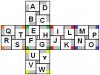
A BLD solver reading the corners with a lettering system will observe "_ADG_BURHK" or something similar depending on the letter assignments. In this system the ULB buffer is _A, and _ADG gives us the three-cycle ULB -> FRD -> UBR which with the setup moves D2 R2 gives us the cycle ULB -> DFR -> BLD (_OY). Executing this and then undoing the setup with R2 D2 will solve DFR and BLD.
A BLD solver if permitted, would then read "_BURHK", since the buffer is also solved at this point. Now we can break into the remaining cycle by executing "_ABURHKB" as three additional 3-cycles: "_ABU", "_ARH", "_AKB" which will then complete the solution of the corners.
"_ABU": ULB -> DLF -> UFL with setup moves D' F2
gives ULB -> DFR -> DBL (_VY). Then undo the setup: F2 D
"_ARH": ULB -> FUR -> LDB with setup moves F D2
gives ULB -> RDF -> BLD (_OJ). Then undo the setup: D2 F
"_AKB": ULB -> RBD -> UFL with setup moves F2 D2 F'
gives ULB -> DFR -> DBL (_VY). Then undo the setup: F D2 F2
-- -- --
To summarize, The goal of each setup is to always place the target from the buffer ULB to the solid-diagonally opposite cubie on the facelet DFR or RDF. At the same time, the next reading is placed on any facelet of the cubie in the same face diagonally across the target: DBL, BLD, or LDB. With a lettering scheme for each of the corner facelets, it may help to visualize the progression of the letter pair to solve into the target sequence with the setup moves. For instance, the final 3-cycle "_AKB" changes with the F2 move to "_AKY" which changes with the D2 move to "_ASV" which changes with the F' move to "_AYV". This is solvable with the (_VY) target sequence. Then as the setups are undone, the progression works back to "_AKB" similarly: F changes "_AYV" to "_ASV"; D2 changes "_ASV" to "_AKY"; and finally F2 changes "_AKY" back to"_AKB".
-- S. Lee Odegard, January 2015
The basic idea is that the target from the buffer is the solid-diagonal opposite cubie from the buffer. For example, a ULB buffer targets the FRD or RDF cubie. For a three-cycle method, the secondary, or helper, is on the same face as the target and diagonally opposite: in my case one of BLD, DBL or LDB. A computer search from these six algs shows the following properites: In all cases, only three or fewer setups are required. Additionally, all 378 of the setups can completed without disturbing the buffer. All of the algorighms have been verified not to twist the center face, and thus are "super-cube" safe.
In the chart below "(11f 3ff)" refers to the number of face turns "(11f)", and face double turns "(3ff)". The comment after "//" gives a short name for the algorithm based on Steven Arducci's facelet letter scheme in his video _How to Memorize for Blind Solving_. The short names for the algorithms are based on what a blind solver would read after the algorithm is turned onto a solved cube.
ULB -> DFR -> DBL : L B2 R' B' L2 B R B' L2 B' L' (11f 3ff) // _VY
ULB -> DFR -> LDB : x Uw' L' U2 L Uw B' U2 B x' (8f 2ff) // _RY
ULB -> DFR -> BLD : x' U R' U' L' U R U' L x (8f 0ff) // _OY
ULB -> RDF -> DBL : D L2 U R' U' L2 U R D' U' (10f 2ff) // _VJ
ULB -> RDF -> LDB : D2 L U L' D2 L U' L' (8f 2ff) // _RJ
ULB -> RDF -> BLD : L B' R2 B L' B' R2 B (8f 2ff) // _OJ
With the secondary facelet (DBL, LDB or BLD) diagonally opposite and on the same face as the target from the buffer (DFR or RDF), it is not necessary to learn the opposite or inverse algorithms. in two cases, a D2 setup move is enough to give the inverse. Note, in the second case listed it can be recognized that the D2 setup cancels the first D2 in the alg.
ULB -> DBL -> DFR == D2 {ULB -> DFR -> DBL} D2 // _YV == D2 {_VY} D2
ULB -> LDB -> RDF == D2 {ULB -> RDF -> LDB} D2 // _JR == D2 {_RJ} D2
in two cases, a D2 setup to another alg in the list generates an inverse.
ULB -> DBL -> RDF == D2 {ULB -> DFR -> LDB} D2 // _JV == D2 {_RY} D2
ULB -> LDB -> DFR == D2 {ULB -> DFR -> BLD} D2 // _YR == D2 {_OY} D2
Unlike in TuRBo, it is not necessary in SD to learn ULB -> FRD -> DBL, or other FRD target algorithms, because with the target from the buffer being as far removed from the buffer as possible, that facelet of the target cubie can be rotated into place with setup moves.
ULB -> FRD -> DBL == R F {ULB -> RDF -> DBL} F' R'
// _VG == R F {_VJ} F' R'
ULB -> FRD -> LDB == R F {ULB -> RDF -> LDB} F' R'
// _RG == R F {_RJ} F' R'
ULB -> FRD -> BLD == R F {ULB -> RDF -> BLD} F' R'
// _OG == R F {_OJ} F' R'
With this, as a D2 applied to two of the 6 algorighms gives a FRD target, but this can be modified with the target cubie rotation to give the inverse.
ULB -> DFR -> BLD == D2 R F {ULB -> RDF -> DBL} F' R' D2
// _YO == D2 R F {_VJ} F' R' D2
ULB -> RDF -> BLD == D2 R F {ULB -> RDF -> LDB} F' R' D2
// _JO == D2 R F {_RJ} F' R' D2
Knowing some of the TuRBo algs can be an aid by giving shorter sequences, saving up to six moves. However, this is not strictly required in SD. In fact, it can be illustrative to show how setup moves can give the same results as some of the TuRBo algorighms:
Code:
ULB -> UBR -> URF: "_ACD" with setup moves F2 R D
  gives
  ULB -> DFR -> LDB (_RY) then undo setup: D' R' F2


ULB -> URF -> UBR: "_ADC" with setup moves R' D2 R'
 gives
  ULB -> DFR -> BLD (_OY) then undo setup: R D2 R


ULB -> BRU -> RFU: "_AIM" with setup moves R D R2
  gives
  ULB -> RDF -> DBL (_JV) then undo setup: R2 D' R'


ULB -> RFU -> BRU: "_AMI" with setup moves R' D2 F
  gives
  ULB -> RDF -> LDB (_RJ) then undo setup: F' D2 R


ULB -> RUB -> FUR: "_AHL" with setup moves R D R2
  gives
  ULB -> DFR -> BLD (_OY) then undo setup: R2 D' R'


ULB -> FUR -> RUB: "_ALH" with setup moves F2 D' R2
  gives
  ULB -> RDF -> LDB (_RJ) then undo setup: R2 D F2


ULB -> UBR -> FUR: "_AHD" with setup moves R D R2
  gives
  ULB -> RDF -> BLD (_OJ) then undo setup: R2 D' R'


ULB -> FUR -> UBR: "_ADH" with setup moves R' D2 R'
  gives
  ULB -> DFR -> DBL (_VY) then undo setup R D2 R


ULB -> BRU -> URF: "_ACM" with setup moves F2 R D
  gives
  ULB -> DFR -> DBL (_VY) then undo setup D' R' F2


ULB -> URF -> BRU: "_AMC" with setup moves R' D2 F
  gives
  ULB -> RDF -> BLD (_OJ) then undo setup: F' D2 R


ULB -> RUB -> RFU: "_AIL" with setup moves R D R2
  gives
  ULB -> RDF -> BLD (_OJ) then undo setup: R2 D' R'


ULB -> RFU -> RUB: "_ALI" with setup moves R' D2 R'
  gives
  ULB -> RDF -> LDB (_RJ) then undo setup: R D2 R


ULB -> UBR -> RFU: "_AID" with setup moves R D R2
  gives
  ULB -> RDF -> LDB (_RJ) then undo setup: R2 D' R'


ULB -> RFU -> UBR: "_ADI" with setup moves R' D2 R'
  gives
  ULB -> DFR -> LDB (_RY) then undo setup: R D2 R


ULB -> BRU -> FUR: "_AHM" with setup moves R' D R2
  gives
  ULB -> DFR -> DBL (_VY) then undo setup: R D2 R


ULB -> FUR -> BRU: "_AMH" with setup moves R2 D R
  gives
  ULB -> RDF -> LDB (_RJ) then undo setup: R' D' R2


ULB -> RUB -> URF: "_ACL" with setup moves F2 R D
  gives
  ULB -> DFR -> BLD (_OY) then undo setup: D' R' F2


ULB -> URF -> RUB: "_ALC" with setup moves R' D2 R'
  gives
  ULB -> RDF -> BLD (_OJ) then undo setup: R D2 R
-- Example corner solve --
Scramble: B F' D U2 F2 U' R' F U2 F2 L' U2 B' D' U2 F2 D' U2 L' B F' L2 D2 B2 L'
A BLD solver reading the corners with a lettering system will observe "_ADG_BURHK" or something similar depending on the letter assignments. In this system the ULB buffer is _A, and _ADG gives us the three-cycle ULB -> FRD -> UBR which with the setup moves D2 R2 gives us the cycle ULB -> DFR -> BLD (_OY). Executing this and then undoing the setup with R2 D2 will solve DFR and BLD.
A BLD solver if permitted, would then read "_BURHK", since the buffer is also solved at this point. Now we can break into the remaining cycle by executing "_ABURHKB" as three additional 3-cycles: "_ABU", "_ARH", "_AKB" which will then complete the solution of the corners.
"_ABU": ULB -> DLF -> UFL with setup moves D' F2
gives ULB -> DFR -> DBL (_VY). Then undo the setup: F2 D
"_ARH": ULB -> FUR -> LDB with setup moves F D2
gives ULB -> RDF -> BLD (_OJ). Then undo the setup: D2 F
"_AKB": ULB -> RBD -> UFL with setup moves F2 D2 F'
gives ULB -> DFR -> DBL (_VY). Then undo the setup: F D2 F2
-- -- --
To summarize, The goal of each setup is to always place the target from the buffer ULB to the solid-diagonally opposite cubie on the facelet DFR or RDF. At the same time, the next reading is placed on any facelet of the cubie in the same face diagonally across the target: DBL, BLD, or LDB. With a lettering scheme for each of the corner facelets, it may help to visualize the progression of the letter pair to solve into the target sequence with the setup moves. For instance, the final 3-cycle "_AKB" changes with the F2 move to "_AKY" which changes with the D2 move to "_ASV" which changes with the F' move to "_AYV". This is solvable with the (_VY) target sequence. Then as the setups are undone, the progression works back to "_AKB" similarly: F changes "_AYV" to "_ASV"; D2 changes "_ASV" to "_AKY"; and finally F2 changes "_AKY" back to"_AKB".
-- S. Lee Odegard, January 2015
Last edited:


 Especially when you start saying stuff like _ABU - is that Speffz?)