Older cubers discussions

I went from 80s to sub-20 in 3 months and all I can say is that timed solves are the least valuable of all possible activities, this was my experience and also shared by many others. Slow untimed solves focusing on lookahead (including closing your eyes at random points and seeing how far you can continue

Exactly. Timed solves tell you where you are at but you learn more when you aren't against the clock. I've noticed this at different points in my cubing development (circa 45s and 20s) and I am guilty of doing way too many timed solves. You shouldn't spend more than 50% of your time against the clock but it would be better if you could keep that to 25% IMHO. Untimed solves allow you to observe what is happening to the cube and think about ways to improve your solves.

CFOP: Know your F2L cases such that you can look around the cube for your next pair whilst inserting the current pair. Ultimately you will look for the next pair as you start to solve the current pair but doing it during the insertion stage is your first goal. Whether you learn the F2L cases intuitively or algorithmically they end up the same with enough practice (i.e. muscle memory with an appreciation of what the pieces are doing). You need to be able to visualise how the pieces move around the cube so you can take your eyes off them and look for your next pair.
 
Last edited:
4x4 PLL parity. How do I recognize the case? I'm lost. I do some alg, see what I get, do some other alg, until I can spot what's going on. Some are not as bad as others.
It just takes practice. If you see 3 sides which don't make sense together then you have parity. It can basically be one of two PLLs with parity and with experience you can execute your parity alg from the angle that gives the favourable PLL (e.g. T-perm instead of F-perm). In the interim just apply the parity alg and solve the resultant PLL. If you have no idea whether you have parity then solve the corners as if you are going to 2-look the PLL and if the EPLL looks weird then apply the parity alg before you do EPLL. Over time you'll recognise more and more case as having parity. E-perm is probably one of the harder ones to recognise.
Or you could just learn Roux (jk), I think that part is easier with that method.
 
I solve with white or yellow on top and start the first block (I use Roux) on any of the other colors... but most of the time I start with blue, I'm a few seconds slower with the others unless it's a really good scramble for that color.
 
@Jason Green: What I do for PLL parity: having taken a look this Christmas to 2-side PLL recognition certainly helps, even though I don't know it that well that I can use it in 3x3 solves (because I'm faster just looking around the cube in some cases). So, there are cases where it's clear that you have parity (like just two corners and no edges or some weird case that does not match any of the PLL patterns you know. In others it might seem like you have a normal PLL (some G-perm cases or maybe an E-perm, not that sure right now). In those cases it's not bad if you just go with your G-perm and check if you still have parity in the end. It will also most probably be adjacent case, in my experience.

Regarding 5x5 L2C it's not bad it you check some cases as Michael says and they will become intuitive pretty soon.Like for when you just need to place the last corner (leave the odd dot in 1st center in right-front and the missing dot in up-right and do Rw U Rw'). Or if you happen to miss a 2-bar that you can place horizontally in up-left and the dot is in right-back you can pair the 3-bar with Rw', then F Rw to place it. Same if 2-bar is down-left and the dot is right-front, you can pair the 3-bar with Rw', then F' Rw to insert in place. Same with left-right mirrors of all these. Only case I hate is when I get the 2 corners but miss the final middle piece, not sure if there is an easy alg for these, I just pair one corner with the middle piece by putting the middle piece either up or down and get the missing dot case. But I can't even sub-4 at 5x5 so I'm sure others have better advice.

@JohnnyReggae: I am trying to become full CN at CFOP since a couple months, after more than two years being just dual white&yellow. Still a couple seconds slower at other cross colors, though.
 
First chance for a week to go back and quote all the things I wanted to reply to!

Calm (5BLD) reaction Mark. :)
That's relief combined with mental exhaustion and being dazzled after wearing a blindfold for far too long :).

Great video Mark. Love the editing and music and even though you'd already said it was a success I felt I was willing you on anyway! :)
I'm having too much fun with Movie Maker :).

Something changed in my 3bld. I took in mind what Jayden wrote about his progress - the key factor were good images. My goal is to be around 1 minute with my means.
Yeah I have also been trying to firm up my images. I waste too much time waiting for something memorable to come to me. I started an image list.

I have also been working on corner comms. I did a long average of OP corners as a benchmark, and they take me 24-26 seconds (26 recently, 24 last time I benchmarked in late 2015). Last week I did an average with comms and was sub-27, down from over a minute, so am progressing nicely - however, I spend way longer on inspection/memo working out what comms I will do. OP is of course zero inspection. My aim is to get down to 26 with minimal inspection and then I will start combining comms to regular BLD solves.

My other focus in BLD practice is to push my memo. It's way too slow, and doesn't improve unless pushed.

Mark, great sub 8 on 4BLD. I finally managed a sub 9 with an 8:17, memo still improving (sub 4 half of the times) but execution is still very slow, I need to address that.
4BLD is so much fun. I am looking forward to London being over so I can go back to practising 4BLD :).

Almost 75 tries at corners BLD, only 12 successful ones so far, maybe I shouldn't rush them, but it's nice when I get a good time. I'm starting to do also impossible cases, with setup to possible ones because I don't know those algs yet, it's tricky, first one was a success, but I was probably lucky.
This is probably no surprise, but maybe you should learn a method that is easier, faster, only one alg, normal memo, and with a smoother transition to fast methods in future :).

I have two more comps before ending the first half of the year (both organizer again :p) in which I'll try to ... join the sub 20 3BLD club.
Good luck, that's a very exclusive club, dude ;). Seriously, good luck with the 4, 5 and MBLD. The race is on :).

4x4 PLL parity. How do I recognize the case? I'm lost. I do some alg, see what I get, do some other alg, until I can spot what's going on. Some are not as bad as others.
I have two approaches to PLL on 4x4. By default, I do 2-look, including parity. So first, solve the corners. I use A-perm or Y-perm, and most importantly, recognition is almost zero. Then I'm left with an EPLL that may or may not include parity. With just edges, it's pretty easy to recognise all the individual cases, and I know algs for all of them, so no extra looks for parity. There are three extra cases: W-perm, Oa- and Ob-perm, plus the usual pure parity swaps. If you're interested, I can post the algs.

Second approach is that if I recognise the PLL by two sides, and it's one I can do fastish on 4x4, I will give that a try and cross my fingers for no parity. That gives me a good chance of a fast single. If I get parity, it generally doesn't save much over 2-look, because generally my other PLLs are way slower on 4x4 (at least than A-perm), and I spend more time on recognition.

Awesome, I enjoyed that - it kind of oozed stress and frustration :)
 
Last edited:
This is probably no surprise, but maybe you should learn a method that is easier, faster, only one alg, normal memo, and with a smoother transition to fast methods in future :).
That would the smartest thing to do, but it looked so boring. I think Boomerang can be as fast as OP, and faster if one have enough time to master it, I may be wrong, but that's what I thought when I chose it, and I'd like to know if I was wrong so I'll try.

How much time corners take (including memo) in an average solve with no parity with OP and advanced M2? 40-45%?
 
I know there is a separate colour neutral thread, but I am curious if the older cubers around are colour neutral ? Unfortunately I am not, but I have plans to ultimately get there.

Marcel and I are both CN CFOP solvers. I glance at the cube and start planning whichever cross looks promising, reverting to white / yellow if I don't see anything special.

My distribution is around 50% white, 25% yellow, 25% other but my fastest competition solves are non-white / non-yellow.
 
That would the smartest thing to do, but it looked so boring. I think Boomerang can be as fast as OP, and faster if one have enough time to master it, I may be wrong, but that's what I thought when I chose it, and I'll try to know if I was wrong.

How much time corners take (including memo) in an average solve with no parity with OP and advanced M2? Around 45%?
I haven't timed corner memo separately, but my current splits are roughly this: 40-60 memo, 30-32 edges, 24-26 corners.

Regarding Boomerang versus OP, I guess OP is kind of boring in that it's an obvious choice and an easy start, but it has clear advantages, and is really only as boring as you want to let it be. With OP, you memo as simple, sticker-based targets and cycles. You get used to tracing corners by sticker target, and setting up and swapping by stickers. You establish a strong memo system based on sticker recognition, preferably using letter pair memo. All the same as you would for edges (or centres), so it's consistent. None of this "U Sune U' 123" malarkey like in Boomerang, which is no use anywhere else.

Having that basic, solid foundation skill based on memo and swapping of stickers lets you easily start adding more advanced techniques on top of that (and that's where it stops being boring). Let's say my memo is TX UJ NF XP K. As a beginner I start out by solving each piece individually using OP. After a while, I learn a trick for PK, as it's just a corner twist. Then I learn a commutator for UJ, so I can solve those pieces in one step. But I still solve the rest with OP. Gradually I transition to comms and maybe in a year's time I'll solve most of that scramble with comms, and only use OP for odd targets or hard cases. Most of the fast guys solving in 20-30 seconds are still using those same basic foundations that come with with OP.

With Boomerang, sure, maybe you can master it, but then where do you go from there?
 
Thanks for the time splits, and yeah, transition to corners comms would be hell. Sorry, I forgot to say that I'm almost 100% sure I won't go any further than that, just try to master Boomerang and some advanced M2 tricks and see where that gets me. I won't try multibld either (maybe a 2/2 once).

I need a little break from CFOP so I'm back to Roux for few days.
Nice!
 
I have two approaches to PLL on 4x4. By default, I do 2-look, including parity. So first, solve the corners. I use A-perm or Y-perm, and most importantly, recognition is almost zero. Then I'm left with an EPLL that may or may not include parity. With just edges, it's pretty easy to recognise all the individual cases, and I know algs for all of them, so no extra looks for parity. There are three extra cases: W-perm, Oa- and Ob-perm, plus the usual pure parity swaps. If you're interested, I can post the algs.

Perhaps you should consider learning COLL? I'm sure you know that 5/16 4x4 solves have all edges oriented (without edge control) so almost 1/3 solves are ideal for COLL + EPLL. Slightly over 1/3 if you use sledgehammer for your final pair. ;)

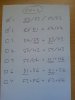
I've just started to learn COLL (excluding Sune cases) and have a plan for the next 7 weeks (attached). 4 cases per week, grouped where they look the same from above and / or where the algs are inversions of each other. I'm currently using week 1 algs in my Petrus solves and I learnt the week 2 algs / cases last night. :)

Edit: Case names are from Roux. D = Bowtie, E = Headlights, F = Chameleon, G = Pi, H=Double-Sune

20160419_131725 - small.jpg
 
Perhaps you should consider learning COLL? I'm sure you know that 5/16 4x4 solves have all edges oriented (without edge control) so almost 1/3 solves are ideal for COLL + EPLL. Slightly over 1/3 if you use sledgehammer for your final pair. ;)
Yes good point, thanks. I use a handful of easy COLLs already. For me, 9/16 solves are good for COLL as I use a setup to make sure that after OLL parity I always have all edges oriented. I use them quite frequently and used a Pi COLL in comp at Exeter :). Rather than directly solving cases, I learned a smaller number of algs and the multiple cases I can apply those to to avoid diagonal corner swaps. Solved corners is a bonus. The main reason I haven't learned more is because I would put higher priority on learning to do more of my PLLs properly on 4x4, or replacing the algs.
 
@efattah @Logiqx

Thanks for the comments.

I agree that timed solves are not the ultimate practice ground. I saw I was close to getting to a big round number of solves and decided to get up to the big 10K before putting the timed solves to bed for a while. I can credit timed solves with helping my TPS a bit and embedding the stuff I do know, but I'm quite looking forward to learning some new skills.

First off for me will be getting more to grips with Advanced Cross. I blitzed through some youtube videos at lunchtime and am keen to reduce the move-count I use on this step. It will help my dodgy FMC attempts in the Weekly Comp too. :D

I've found big cubes help my lookahead on 3x3 so will be mixing those in where time allows. (I got a new 5x5 PB today too which gives me big :)'s.) I'm aware of the closing-eyes method and have used it periodically, not always with success, but hey, practice is the name of the game!

I don't suspect I'll ever get super-fast (my username is a result of nerve damage from 25+ years ago and has an unavoidable effect) but I've got definite room to improve and a good idea of how to do it.

Cheers!
 
I've bought Aoshi and sold my 6x6 SS (I really hated that cube). Cant wait it'll arrive. I bought it from a guy who won it during Polish Open. Unfornatetly I didnt win though I could take a place in 5 bld during PO. The prize was Aoshi. :)
 
3rd solve of the day, after 50 timed solves and the other 50 or more untimed I got first sub-20 (19.83) solve with an easy scramble:

R2 F2 L2 U2 B L2 D2 B D2 B' F' R D L D' U B' L' F2 L' F'

z' y //preinspection
r2 F B //FB 3/3
U' r' U' r' U' r2 M' U' R U' R' U R U' R' U2 R' U R //SB 20/23
U' R U R' U R U L' U R' U' L //CMLL
R2 U' R' U' R U R U R U' R U' //LSE Uperm

alg.cubing.net
46stm.
Lucky solve - easy first block, lucky pair on second block, cmll I was practicing yesterday and U perm in the end. I did U perm with standard way.
 
Back
Top