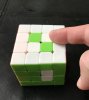
Let's say your UBL/UBR/UFR/UFL is A/B/C/D, your original buffer is UBL.
1) If it is solved, treat like a normal 3BLD, meaning start a new cycle break. Whatever target you started a new cycle, you'll get there when the cycle break ends.
2) You can float, meaning make a U', then your original B becomes your UBL. Then, you can start a normal cycle. But when that cycle ends, you have to do "U" to return to your original position.
I started #2 option but realized that I often forgot to unsetup floating (in the above example, U). So, I'm doing #1 now. If you use commutators and run into U face color, you can shoot to B/C/D instead of starting a new cycle. If you shoot all U faces, you rarely need to start a new cycle, mostly centers can be solved with one long cycle.





 . I'm comfortable with thumb from the top or bottom but there are lots of cases I would like to be able to do F face turns while leaving the thumbs in place, thus this attempt to use the index fingers.