So I won't do much timed solves for the rest of this week. First I'm travelling to a work-meeting, followed by a long weekend at my old parents place since they live nearby where I'm travelling. But I'm bringing my cube of course! There will hopefully still be cubing happening!

Last week I learned the 7 CMLL algorithms for orienting the upper corners after they are permutated correctly. (I hope I use the right language here?) Next step is to learn the 8 CMLL algorithms for permutating and orienting the upper corners when two of the corners have to be swapped diagonally. The reason is that I currently have to do the Niklas-algorithm twice for this diagonal swap, while for the others I only have to do it once. So learning this sub-set of the CMLL first will be "cost-efficient" since it will save me the most moves immediately.
I'm finding that some of the algorithms are actually not that hard to learn if I'm able to put names on small sub-segments of the algorithm. For instance when I learned The L1 algorithm last week, it had 16 moves and looked very hard to remember at first sight:
- L1 = U' R U2 R' U' R U R' U' R U R' U' R U' R'
But then I put names on two 3-move-segments:
- R U' R' --> happy
- R U2 R' --> flirt
And R U R' U' should already be known, so then I can write it like this in stead:
- L1 = U'-flirt-U'-sexy-sexy-happy
Using this method, I already have learned two of the new 8 CMLL algorithms that I'm planning to learn next, without even trying hard, just like this:
- H4 = F-sexy-sexy-sexy-F' = F-triangle-F'
- U6 = U'-F-sexy-F'
Also I can see that the sequence F R F' is common in several of the next algorithms. I think I might call it "naggy"!


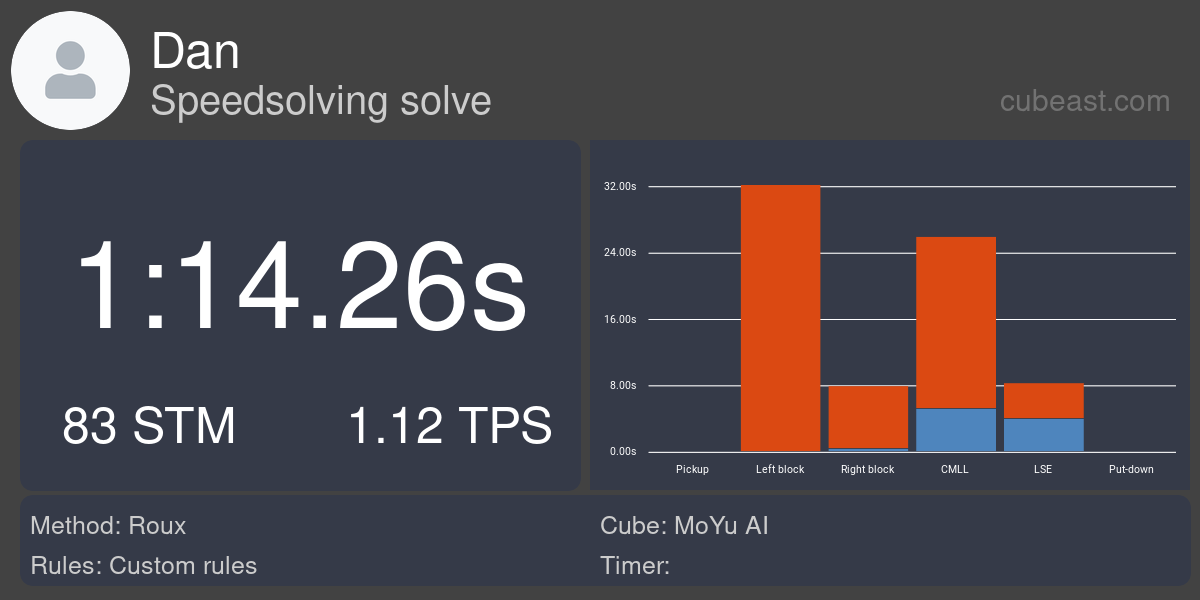

 One of the main motivations for my physical training the last years (running, but lately fast walking due to knee injuries) has been my Garmin watch + extra sensor, collecting all kind of metrics (yeah, a bit of a nerd in that sense, I guess)


