

academicmaslow
Regular
I’ve recently posted about my mosaics from Pyraminxes, and while working on mosaics I started wondering about the number of possible color patterns on a single face of the puzzle.
The number of Pyraminx states is known: 933120 configurations of the colored pieces, or 75582720 if tip orientations are included.
For mosaics, the state of the entire Pyraminx is not important — only the pattern on a single face matters.
The number of possible colorings of 9 stickers using 4 colors is straightforward to calculate: 4^9=262144
However, not all of these combinations are actually achievable on a real Pyraminx.
But I couldn’t find a calculation specifically for the number of possible/impossible patterns on one face. If someone has already done this, I’d be very interested to see it.
So I tried to derive it myself. My goal was to count impossible color configurations on a single Pyraminx face.
Below is the model and reasoning I used. I would really appreciate comments on whether I missed any constraints, or if there is a cleaner way to approach the problem.
Step 1 — Model
A Pyraminx face has 9 triangular stickers, which I group as follows:
Case 1 — All three slots contain two colors
If none of the slots are AA or BB, then every combination of AB / BA is impossible.
Additionally:
If the slots are AB or BA and all centers have the same color (and tips the other), then the following are impossible:
If one slot is AA or BB and the other two are AB or BA, then configurations where the tip colors match the monochrome slot are impossible.
In total 6 impossible combinations
Case 3 — Two monochrome slots
No impossible combinations here — all configurations can be obtained through piece permutations.
Step 3 — Counting (slot model)
Impossible slot configurations:
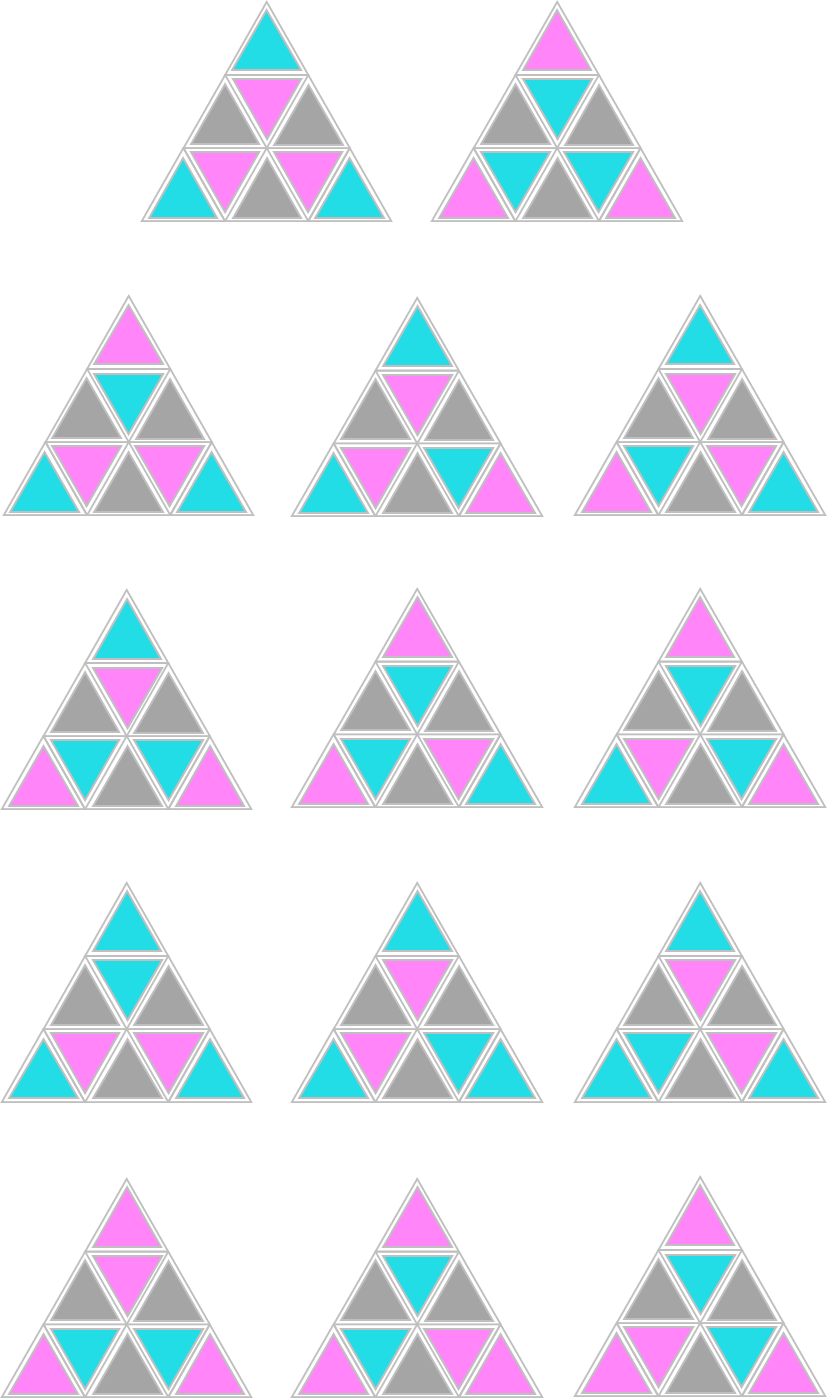
So there are 14 impossible slot configurations for a given pair of colors A&B, ignoring edges (see figure).
Step 4 — Extending to full face colors
The Pyraminx has 4 colors.
Number of ways to choose the two colors A and B used in the model is 6.
Edges were ignored earlier.
Each of the 3 edge stickers can be any of the 4 colors: 4^3=64
Total number of impossible face color configurations:
14×6×64=5376
So my current estimate is: 5376 impossible color patterns on a single Pyraminx face.
I’d really appreciate feedback:
The number of Pyraminx states is known: 933120 configurations of the colored pieces, or 75582720 if tip orientations are included.
For mosaics, the state of the entire Pyraminx is not important — only the pattern on a single face matters.
The number of possible colorings of 9 stickers using 4 colors is straightforward to calculate: 4^9=262144
However, not all of these combinations are actually achievable on a real Pyraminx.
But I couldn’t find a calculation specifically for the number of possible/impossible patterns on one face. If someone has already done this, I’d be very interested to see it.
So I tried to derive it myself. My goal was to count impossible color configurations on a single Pyraminx face.
Below is the model and reasoning I used. I would really appreciate comments on whether I missed any constraints, or if there is a cleaner way to approach the problem.
Step 1 — Model
A Pyraminx face has 9 triangular stickers, which I group as follows:
- 3 slots, each consisting of two stickers: center (C) + tip (T)
- 3 edge stickers (E)
- Slot stickers can be two colors: A or B.
- Edge stickers are ignored initially (their colors can be arbitrary).
- AB and BA are considered different.
- At most one slot may contain two stickers of the same color (AA or BB).
- If there is a slot AA or BB, then all tip stickers on the face must have the same color.
- If all center stickers are the same color, then all tip stickers must be the opposite color.
Case 1 — All three slots contain two colors
If none of the slots are AA or BB, then every combination of AB / BA is impossible.
Additionally:
If the slots are AB or BA and all centers have the same color (and tips the other), then the following are impossible:
- AB AB AB
- BA BA BA
If one slot is AA or BB and the other two are AB or BA, then configurations where the tip colors match the monochrome slot are impossible.
Slot1 | Slot2 | Slot3 |
| AA | AB | AB |
| AB | AA | AB |
| AB | AB | AA |
| BB | BA | BA |
| BA | BB | BA |
| BA | BA | BB |
Case 3 — Two monochrome slots
No impossible combinations here — all configurations can be obtained through piece permutations.
Step 3 — Counting (slot model)
Impossible slot configurations:
- No monochrome slots: 2^3 = 8
- One monochrome slot: 2 х 3 = 6
So there are 14 impossible slot configurations for a given pair of colors A&B, ignoring edges (see figure).
Step 4 — Extending to full face colors
The Pyraminx has 4 colors.
Number of ways to choose the two colors A and B used in the model is 6.
Edges were ignored earlier.
Each of the 3 edge stickers can be any of the 4 colors: 4^3=64
Total number of impossible face color configurations:
14×6×64=5376
So my current estimate is: 5376 impossible color patterns on a single Pyraminx face.
I’d really appreciate feedback:
- Did I miss any global Pyraminx constraints?
- Is there a better combinatorial model?
- Has this been computed somewhere already?


