CuSHan - Cubing Short Hand

mrdjnash

Member
Joined
Dec 22, 2019
Messages
16
Location
London, UK
YouTube
Visit Channel
Hi Everyone,

I created an alternative notation for cubing algorithms called CuSHan - Cubing Short Hand. It started off as a way for me to get around the clockwise / anticlockwise confusion I seem to struggle with when reading standard notation. I've shown it to a few non-cubers and they thought it seemed easier to pick up than standard notation, so I thought it might be worth sharing with other people. I've certainly found it easier for me to execute algorithms on the fly, as well as memorising new ones. It also has the added advantage of being easy to read backwards, so setting up cases to practice is also easier.

It's not intended by any means to replace the existing notation, but people who are strong visual learners, or have the same issues as I do with confusing clockwise / anticlockwise may find it a useful addition. Particularly when faced with learning the 57 OLL and 21 PLL algorithms for example!

I've been doing software development for quite a while so I've put together some resources to make it useful, like a translator to convert from standard notation to CuSHan, cheat sheets with Beginner’s Method and CFOP algorithms on, and an API for integrating into other sites if people wish to.

The main website is here: https://cushan.io/

There’s also a YouTube video explaining how to read it here:
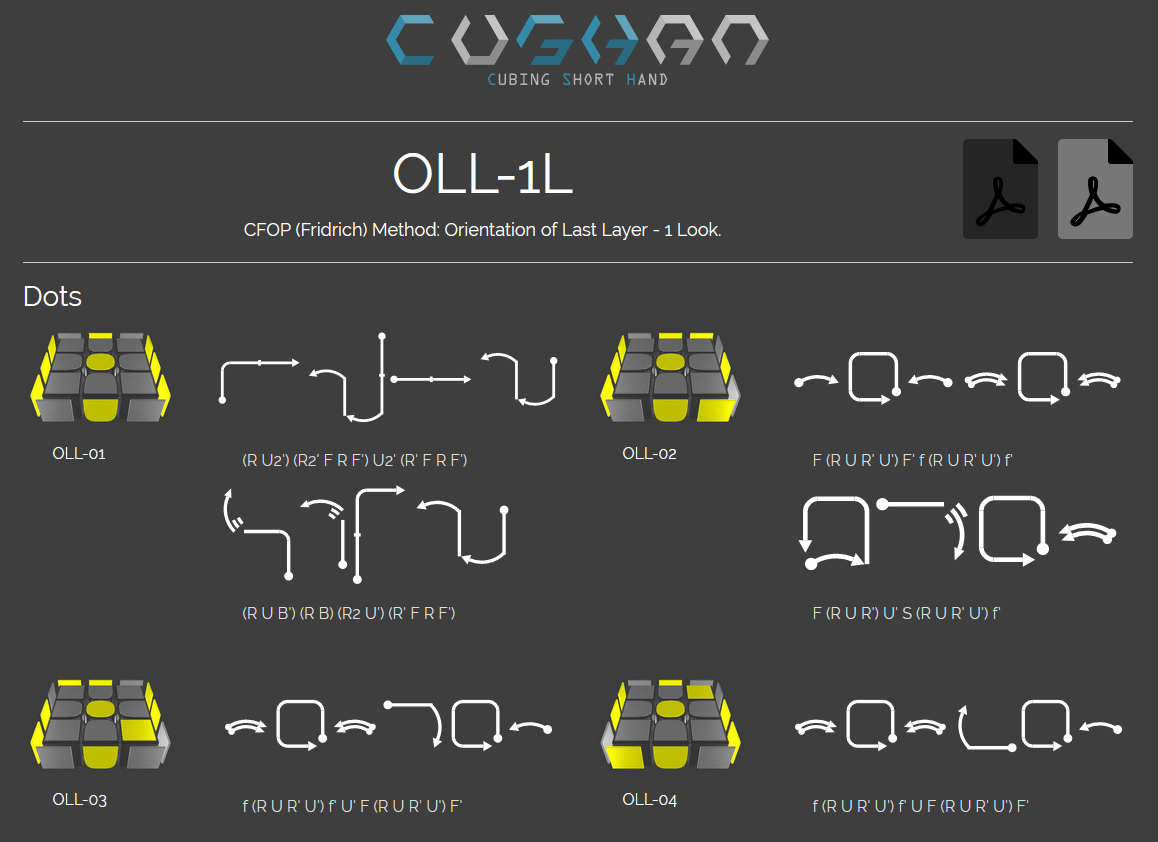
Capture.PNG
 
I think it's a cool idea, but imo it'd be a lot easier to read something like R U R' U' then a rounded loop. And when you get more complicated/longer algs, you'd have to dissect the drawings, which would take a lot longer. Traditional notion isn't really hard anyway, here's how I explain it:

A letter by itself (i.e: R) means a 90º clockwise turn of that face. If an apostrophe (‘) is added onto the end of the letter (i.e: R’), it means a 90º counterclockwise turn of that face

U - Up
U’ - Up Inverted

D - Down
D’ - Down Inverted

R - Right
R’ - Right Inverted

L - Left
L’ - Left Inverted

F - Front
F’ - Front Inverted

B - Back
B’ - Back Inverted

The letters are easy to remember, U is Up, F is Front, L is Left, etc. And if there's an apostrophe, you do a counterclockwise move instead of a clockwise one.

Also, reconstructions would look ridiculous. For example, here's a reconstruction of Yusheng Du's 3.47 in CuSHan:

Screen Shot 2019-12-22 at 5.25.36 PM.png
 
Last edited:
The CuSHan translator is actually kind of fun to play around with lol, I'm generating a bunch of images using random solves I'm getting off of the Reconstruction Thread. Here are a few I did:

Scramble: U R2 B R' L U F R D2 R L2 U' R2 U F2 D B2 U' R2 D2 R2

Normal notation:

M D U R' U' R2 F // FB 7/7
R' U' r' U' R' U R' U' R U R' U' R U R' U2 R' U R U' R' U' R // SB 23/30
R U R' U' R' F R F' R U R' U R U2' R' // CMLL 15/45
U2 M U M U' M' U2 M' U' M U2 M' U2 // LSE 13/58

CuSHan:

Screen Shot 2019-12-22 at 5.34.16 PM.png

Scramble: D2 L B L2 F2 U2 R2 U F2 D2 B2 D' L2 B L2 R D' L' R D'

Normal Notation:

z2 y

R' F R2 F2 U' R2 F'

U' L' U L U L' U L U' L' U L

L U' L'

U R' U R y U2 R U R'

U2 F (R U R' U')2 F'

CuSHan:

Screen Shot 2019-12-22 at 5.39.42 PM.png

Scramble: L2 U L2 D F2 D' F2 R2 D L2 B R2 F' L2 D' L B' U2

Normal Notation:

x' z2
F D R2' F' R
y U' R' U R
L U L' U L U L'
y' R' U R R' U' R' F R F' U R U' z' y y' x2 x' z z' x2 y2 y' y x2 z2 x2 L2

CuSHan:

Jayden McNeil's 4.97 in CuSHan.png
 
Last edited:
Learning notation is just like anything else it just takes practice, but that's a cool idea.
 
hmmm...
I tested it with some scrambles and things got really confuse because the signals overllaped with previous ones.
Maybe you want to check that out

Test these scrambles:

R' L' F' D2 L' F2 U2 L' F' L2 D2 F2 L2 B2 U' R2 D' R2 L2 F2

B D2 L D2 L2 D F' B' D L U2 B' U2 D2 B L2 U2 F' L2 B' U2

R2 B2 R2 D' R2 U' R2 U F2 D' F' L2 R2 D B' L' F2 L2 R U

Also, could you present an option to disable animation on the translator?
 
but people who are strong visual learners, or have the same issues as I do with confusing clockwise / anticlockwise may find it a useful addition.
Yep me too, I will definitely be trying this out. Unfortunately I just finished learning CMLL, so not sure what I'll apply it to yet lol.
 
Hi Everyone,

I created an alternative notation for cubing algorithms called CuSHan - Cubing Short Hand. It started off as a way for me to get around the clockwise / anticlockwise confusion I seem to struggle with when reading standard notation. I've shown it to a few non-cubers and they thought it seemed easier to pick up than standard notation, so I thought it might be worth sharing with other people. I've certainly found it easier for me to execute algorithms on the fly, as well as memorising new ones. It also has the added advantage of being easy to read backwards, so setting up cases to practice is also easier.

It's not intended by any means to replace the existing notation, but people who are strong visual learners, or have the same issues as I do with confusing clockwise / anticlockwise may find it a useful addition. Particularly when faced with learning the 57 OLL and 21 PLL algorithms for example!

I've been doing software development for quite a while so I've put together some resources to make it useful, like a translator to convert from standard notation to CuSHan, cheat sheets with Beginner’s Method and CFOP algorithms on, and an API for integrating into other sites if people wish to.

The main website is here: https://cushan.io/

There’s also a YouTube video explaining how to read it here:

View attachment 11136
Your next task is to connect it to the GAN 365I!

(Obviously you don’t have to, but it’d be cool if you did)
 
Thanks very much for all the great replies! And sorry for the delay in responding, Christmas kind of crept up on me! Merry Christmas by the way :)

hmmm...
I tested it with some scrambles and things got really confuse because the signals overllaped with previous ones.
Maybe you want to check that out

Thanks Filipe, I'll have a look. There's a path-finder algorithm that tries to stop overlapping where possible, but if the path means that there is no alternative it tries to present these in the best way possible - which still may look confusing! In this case, the algoritm should be split up into sections using commas. For example your scramble R' L' F' D2 L' F2 U2 L' F' L2 D2 F2 L2 B2 U' R2 D' R2 L2 F2 which looks like this as a single algorithm:

Capture 3a.PNG


Looks like this when broken up:

Capture 3.PNG


Which is probably a bit easier to read.

I think I'll add in a scramble generator as the next addition.

Also, could you present an option to disable animation on the translator?

Definitely. I'll add that in too.
 
Thanks very much ProStar! It'll be very interesting to see how people take to the idea. I think new cubers will probably be most likely to embrace it if they don't know either CuSHan or the standard notation, but I guess time will tell. I'll be doing a beginner's method video next, so that might raise some awareness.

I had a very interesting comment on Reddit where someone said they thought it might be good for people with dyslexia - which I'd never even thought of. If it helped at all with increasing inclusivity for new cubers then that would be amazing!
 
I find this to be absolutely amazing at what you were able to do. While some people will definetely prefer this I just can’t see myself switching. It’d be too much work for something that I find to be very minor.
 
Thanks Fredrick. I think that's totally fair - if you're already getting everything you need from standard notation then it's probably not worth it. Having said that, if you don't learn it you won't be able to play the game I'm planning to create in the next few months ;)
 
As others have said already, I am extremely impressed with the amount of work and effort that you have put into this already. Initially I was quite confused looking at it, but playing with some algs and moves it is starting to make a lot more sense. I'm undecided if I want to pursue it more, but it is intriguing enough right now that I'm going to spend some more time with it even if it just to make some pretty pictures :D

I like the lateral thinking that went into coming up with this idea so from me you get a full 10 points on this most definitely. Who knows what you may come up with next :)
 
Back
Top