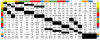
I've also been working at a system like these for a while. It's almost finished, so I'll probably be cross-posting it here and at artofmemory within a week. In my first attempt (this is my third) I went with something similar to Yo notation (though I was not aware of Yo Notation at the time), but abandoned it after making some examples and seeing many instances of repeat images. After some fiddling I decided that I was never going to avoid repeat images, since cubing algorithms naturally end up with similar move sequences, and so I decided to go the opposite direction and see if I could encourage repeat images to show up <i>on purpose</i> whenever the move sequence meant the same thing. This may well have been a mistake, but I'm still excited to try it out (though that won't happen for a while after I finish it since it uses my number system... which I have barely started filling out. :/
I would be interested in how
@abunickabhi deals with heavily repeating images given as Yo Notation will generate a fair number of them, and he is tackling large algsets. My approach was to embrace it and hope its not too much of a problem, but a more general way to deal with it would be awesome.
Or if anyone has come up with a system that somehow minimizes repeat images. The optimum would be applying a reversible hash function (Is that a contradiction in terms? I genuinely don't know.) to the alg and then memorizing the result, which should have each image in your system showing up with roughly the same frequency, and then translate back. Of course, that is wildly impractical, so if anyone has found a way to get some of the benefit of a hash function like that while still being able to be translated into cube moves instantly by humans, that would be a really cool approach, too.