

Navigation
Install the app
How to install the app on iOS
Follow along with the video below to see how to install our site as a web app on your home screen.
Note: This feature may not be available in some browsers.
More options
Style variation
You are using an out of date browser. It may not display this or other websites correctly.
You should upgrade or use an alternative browser.
You should upgrade or use an alternative browser.
Clock World Championship 2025 Podium has been changed...
- Thread starter CubeLite
- Start date
Lots of insane takes, skimming through both this thread and the WCA thread. 
Many brought up how the misscramble was harder and therefore should be allowed to stand. No! That's not how fair scrambling works!
Allegedly the scrambled puzzles were double-checked before being sent to the competitors, making the only possible sources of error a common oversight between the checkers (rare) or move in transport (also rare). These are both (supposed to be) extremely rare events, so we don't even have good data on what their orders of magnitude are, much less what the ratio between them is. This matters because these sources of misscrambles affect the scramble state distribution differently.
(i) Scramble checker oversight
Human vision treats the four cardinal directions (up, down, left, right) specially. Clock scrambles with many faces at 12/3/6/9 are thus less likely to be misscrambled because the checkers would immediately and instinctively notice the error.
Overlooked misscrambles in general (for other events as well) tend to be ones that "look similar", which by itself already slightly biases against scrambles that look distinctive (they're less likely to show up as overlooked misscrambles for generic-looking scrambles), and on top of that, the human factor in the scrambler misscrambling also introduces bias (e.g. if the scrambler systematically underturns/overturns).
The misscramble in question for Antoni's solve had a few faces that were not supposed to be 12/3/6/9 but were, and vice versa; this makes checker oversight extremely unlikely, in my opinion.
(ii) Move in transport
Making the simplifying assumption that the distribution of scramble states is uniform, the application of random moves (including no-op as a possible "move" here) independent of the scramble state will still result in a uniform distribution, which is exactly what we're looking for in fair scrambles! (4b3: "equal probability for each state")
There is little reason to believe that moves done in transport will be dependent on puzzle state for non-shapeshifting doctrinaire puzzles, which clock is. (Square-1 isn't, but the only likely move in transport is a small AUF/ADF anyway.)
Thus, for scramble fairness reasons, if the misscramble was caused by a move in transport, whether an extra attempt is granted and whether it should be retroactively disqualified both should not depend on whether the misscramble is harder or easier than the intended scramble.
tl;dr idklol, clonk is dumb event and I've spent too long thinking about it already
SkewbIsTheBestEvent
Veteran
Thus, for scramble fairness reasons, if the misscramble was caused by a move in transport, whether an extra attempt is granted and whether it should be retroactively disqualified both should not depend on whether the misscramble is harder or easier than the intended scramble.
So your saying it is fairer to give a competitor an entirely DIFFERENT scramble than the original? (which could be way more difficult or easier from the original compared to the misscramble which is only slightly more difficult or easier than the original)
My argument isn't that it should stand because Antoni got a harder scramble, it's that the WRC thinks the "fairer" solution would be an extra or a DNS would make an already unfair situation WAY more unfairer.
The WRC did the equivalent of telling Antoni and Brendyn "You only get 4 correct scrambles while everyone else gets 5" which just doesn't make sense to me why they are being retroactively punished because of a mistake not on their end. It is nobody's mistake (because misscrambles will happen by accident, whether done in transport or not, and there is nothing we can do about it).
That is not what I am saying. (Notwithstanding whether I actually believe that, on which I have not yet made a public stance.) It seems that you already agree with my main point so I'm not sure why you're trying to argue with me…?So your saying it is fairer to give a competitor an entirely DIFFERENT scramble than the original? (which could be way more difficult or easier from the original compared to the misscramble which is only slightly more difficult or easier than the original)
Yes, it's insane to disqualify results for reasons that are completely out of the competitors' control. My point is that it's insane regardless of whether the misscramble ended up easier or harder, provided that the misscrambles were caused by a process that does not systematically make scrambles easier. Move-in-transport falls in this category and, from my cursory reading, seems to be the most likely root cause of this incident. Conversely, even if one thinks that the current regulations are sane, whether the misscramble ended up easier or harder should also not factor into whether the original results should stand.
---
My own take on this is that if the rules are bad, then it is a good idea to break the rules and come up with better rules. But Chesterton's fence also applies – one should not immediately decide that a rule is bad just because they don't like some of the rule's consequences, without understanding the historical context behind how the rule came to be and what the feasible alternatives are.
Is 11i1 bad? I honestly do not know because I have not thought about it deeply enough. My first instinct is that it's dumb and insane (and I'd already thought so when I first saw the regulation changes at the start of the year), but I would be open to changing my mind if there were good reasons to have implemented this.
SkewbIsTheBestEvent
Veteran
Correct me if I'm wrong, I think what your saying is that the state of the misscramble compared the original doesn't matter, whether it was easier or harder. I think that misscrambles that are a move off (like in Antoni's case) should stand because of how close it is to the original scramble, even though it may give an advantage/disadvantage.whether the misscramble ended up easier or harder should also not factor into whether the original results should stand.
Not trying to argue with you, just trying to understand your opinionThat is not what I am saying. (Notwithstanding whether I actually believe that, on which I have not yet made a public stance.) It seems that you already agree with my main point so I'm not sure why you're trying to argue with me…?
For transport misscrambles, yes.Correct me if I'm wrong, I think what your saying is that the state of the misscramble compared the original doesn't matter, whether it was easier or harder.
For scrambler / scramble checker oversight, no opinion. I think this situation is annoying to analyse and it would make our lives easier if the scramblers could do their job properly.
SkewbIsTheBestEvent
Veteran
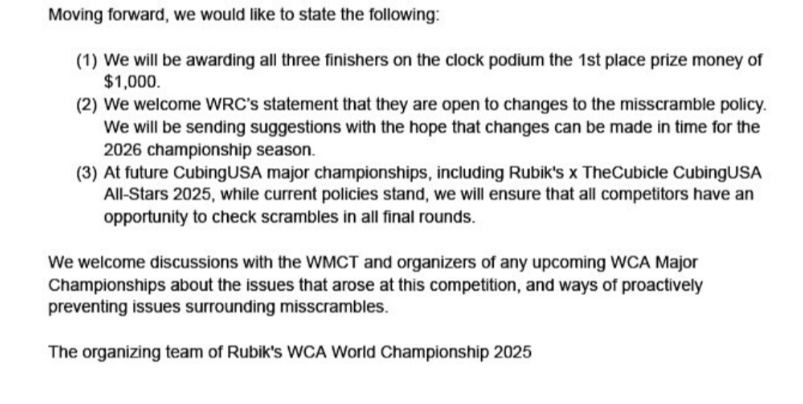
CubingUSA said this:

stoic
Premium Member
I note that even in the latest update^ it's still being proposed that retrospective scramble checking by the competitor is part of the solution to this happening again.
(*Actually now that I've re-read that I realise it's not actually a solution which would prevent this happening again, it's... a fix which, again, puts the onus on the competitor to retrospectively deal with scrambling/running errors and movement of puzzles in transit.)
This seems very unfair to me, and also quite impractical.
Here's the proposed fix:
1. Competitor competes; completes five solves.
2. Competitor seeks out scrambles as soon as possible; hopefully they're not required to compete in another event at this point. Also, a practical question - are they allowed to approach the scrambling/judging area if the round is continuing? Are the organisers going to have a dedicated area with dedicated staff for this job, now that everyone is going to want to check everything?
3. Competitor checks all five scrambles from memory. Do they need to pull video at this point?
I'd be interested to know how feasible everyone thinks this post-competing checking is. Personally speaking, I wouldn't remember say the second of five solves some 10+ minutes later, for any event. And, given that high-level clock with 7-simul or whatever is mostly a case of remembering a sequence of numbers (as I understand it) - is it more or less easy to remember scrambles if you're a specialist in clock? The solutions obviously aren't being stored in long-term memory.

OtaMota
Legend
I'd be interested to know how feasible everyone thinks this post-competing checking is.
Pretty feasible actually. Zayn is capable of remembering the solutions to his official 2x2 solves (plus solutions he was considering doing, but ended up not going for) weeks, if not months after the solves happened, especially amplified by the significance of a major finals. I have an own example and I am nowhere near as good as Zayn; I had an official 2x2 solve, then 2 minutes later, I was given a duplicate scramble from the last one, and I was able to identify it was a duplicate during inspection. I imagine it would be quite easy for world final caliber solvers to know when the scramble they were given was the correct one or not.The solutions obviously aren't being stored in long-term memory.
Edit: The Zayn thing is a hyperbole to some extent, if it’s a significant solve like a WR or world finals, yeah, he can remember it for a while, but if it’s some random solve he got in a local comp, he won’t remember it for too long. Just messaged Zayn.
Last edited:
stoic
Premium Member
Yeah I’ve had the same thing happen in 3x3 where I got the same scramble straight after, but I imagine my memory of it would degrade pretty quickly a few solves later.

Garf
Legend
- Joined
- Sep 4, 2020
- Messages
- 4,389
- Location
- the table, eating lasagna.
- WCA ID
- 2022TIND01
- YouTube
- Visit Channel
I was volunteering at WCA Worlds 2025, and while I didn’t scramble for finals at all, I know theres a lot of pressure of making sure people were given the correct scrambles, especially around the faster stages and with faster competitors. There were double checks for a lot of those competitors, but in the end each round was taking a toll on the volunteers. It was so bad that I had an incident where I were checking the cubes for Tymon and Ciarán during one of the rounds of 5x5, and the cubes got swapped since stupid me didn’t realize one was UV and one wasn’t and they felt the same (probably why Tymon took until finals to break the WR average, but who knows). I don’t think any other accident happened such as that, but the finals mis scramble was bad and should have prevented. Another thing is that I was getting a lot of mis scrambles on 7x7 during 2nd round I think, despite me literally making sure I wouldn’t mis scramble at all, and it really messed with me. I was also the main Mega scrambler in my volunteer group, since I was the fastest and most accurate one, but I know it wore me down by the end of the third day. Those are some of my mishaps that happened to me during the comp, and due to so many of these tiny details, I would say that’s why the comp was so far behind than usual.
As for whether Antione should have kept the champion title, I don’t know. All I can say is that instead of going straight into the interviews, they should have given some chance for competitors to check scrambles.
As for whether Antione should have kept the champion title, I don’t know. All I can say is that instead of going straight into the interviews, they should have given some chance for competitors to check scrambles.

Fred
Veteran
Appeal to reinstate Antoni Stojek as clock world champion is denied: https://forum.worldcubeassociation....-at-rubik-s-wca-world-championship-2025/66171

bldcuber314
Legend
- Joined
- Jan 24, 2024
- Messages
- 2,976
- Location
- grinding for nr 5bld mean
- WCA ID
- 2023JAIN31
That really sucks, at least we all know he was World Champion but not getting it officially recognised must really hurtAppeal to reinstate Antoni Stojek as clock world champion is denied: https://forum.worldcubeassociation....-at-rubik-s-wca-world-championship-2025/66171

FineGeoduck2211
Veteran
bro this is really unfairAppeal to reinstate Antoni Stojek as clock world champion is denied: https://forum.worldcubeassociation....-at-rubik-s-wca-world-championship-2025/66171

mdcuber9
Veteran
And the whole problem is, CubingUSA was trying to pull off the biggest competition ever, it was a very difficult and ambitious job, and they were trying their hardest. Due to time constraints Antoni was not given the opportunity to check scrambles when he wanted to. It’s really not the WCAs fault and they were ultimately blamed for the whole incident. I don’t really see what they could’ve done differently, because it would’ve still seemed unfair if they allowed his solve on the misscramble since it was a wrong scramble.
Fred
Veteran
They could have been flexible enough to change their rules when a new situation comes up that was clearly not the intended application of their rule. Just like with the Wang Yiheng sliding incident, the rules were unjust and needed to be changed to promote fair play. They did change the rules regarding sliding, and applied them retroactively to penalize the unfair 0.78 result, and this clock result should have been another clear case of needing to change the rules for fairness.And the whole problem is, CubingUSA was trying to pull off the biggest competition ever, it was a very difficult and ambitious job, and they were trying their hardest. Due to time constraints Antoni was not given the opportunity to check scrambles when he wanted to. It’s really not the WCAs fault and they were ultimately blamed for the whole incident. I don’t really see what they could’ve done differently, because it would’ve still seemed unfair if they allowed his solve on the misscramble since it was a wrong scramble.
OtaMota
Legend
I am extremely dissatisfied with the WRC’s and WAC’s decision. The WRC made a mistake when they wrote the regs in a way that allowed this to happen. The WCA should be held accountable when they do things that cause harm to competitors in their organization. I think the WRC should fix their mistake by reversing the harm that happened because of their failures of making fair regulations, not just promise fixes for future attempts, they should fix the current damage they have done.

abunickabhi
Legend
I am extremely dissatisfied with the WRC’s and WAC’s decision.
Why is there so much inconsistency and confusion in interpreting the rules and regulations?
Why is there difference in strictness in implementing these regs across all comps of levels?
Why is there so much inconsistency and confusion in interpreting the rules and regulations?
Why is there difference in strictness in implementing these regs across all comps of levels?
On the WCA forum I suggested... co-world champions (the "actual" and the "de facto") - with whatever limitations involved with the "de facto" - not include official times because of misscramble.
and or some form of apology or acknowledge of error (okay, need to read final ruling).
and or some form of apology or acknowledge of error (okay, need to read final ruling).
Similar threads

- Replies
- 10
- Views
- 2,491

- Replies
- 15
- Views
- 1,142


- Replies
- 25
- Views
- 3,485

- Replies
- 7
- Views
- 1,403
