
Navigation
Install the app
How to install the app on iOS
Follow along with the video below to see how to install our site as a web app on your home screen.
Note: This feature may not be available in some browsers.
More options
Style variation
You are using an out of date browser. It may not display this or other websites correctly.
You should upgrade or use an alternative browser.
You should upgrade or use an alternative browser.
best fridrich tutorial?
- Thread starter ahmedkl
- Start date


TEGTaylor
Regular
- Joined
- Jun 24, 2009
- Messages
- 128
- Location
- not where you are hopefully
- WCA ID
- 2009BROC01
- YouTube
- Visit Channel
badmephisto, look it up.

Joker
Veteran
badmephisto, look it up.
Yep. After that you can look at other people's vids like Felik's (fazrulz1 on youtube) to help you with some other things.
1 answer question thread
anyway, yes, badmephisto is the best.
http://www.youtube.com/user/badmephisto#grid/user/4A19F1D174B975BD for beginners,
http://www.youtube.com/user/badmephisto#grid/user/0B7E0E5922B76D76for everything else
anyway, yes, badmephisto is the best.
http://www.youtube.com/user/badmephisto#grid/user/4A19F1D174B975BD for beginners,
http://www.youtube.com/user/badmephisto#grid/user/0B7E0E5922B76D76for everything else
Last edited:

dillonbladez
Veteran
- Joined
- Nov 15, 2009
- Messages
- 1,197
- Location
- Toronto, Ontario, Canada :)
- WCA ID
- 2010CHAN03
- YouTube
- Visit Channel
Getting somebody to teach you would be best, IMO.
But badmephisto is pretty good, though i learned from RobH0629
But badmephisto is pretty good, though i learned from RobH0629


jiggy
Veteran
Hi again, ahmedkl!
As you can see from the other replies, the tutorials by Badmephisto which I linked you to in your other post are really the best ones out there for the Fridrich method.
F2L can be quite hard to understand at first, you're no longer mindlessly memorising algorithms and executing them blindly. Instead, you have to follow the movement of the pieces and try to understand what's happening. F2L is often described as 'intuitive' and that's really the key idea here: You are using your own intelligence to set up the corner-edge pairs, ready to be solved. Remember: The key idea behind F2L is to solve first layer corners and second layer edges simultaneously.
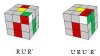
Unfortunately, I can't upload pictures in posts any more (firewall troubles), but if you look at the image I've attached to this post, I show that the basic (very simplified) idea behind F2L is to find corners and edges which belong together in an F2L slot and position them in such a way that they can be inserted at the same time. F2L contains many cases, and you must constantly be aware of which slots you have already filled, so I'm not going to list every single possible case here. However, if you watch Badmephisto's tutorial, he shows you all the cases you need to solve F2L as a beginner. Often, this will involve hiding either the corner or the edge, and moving the other piece such that you are presented with one of the cases in the attached image (or their mirror). This is a very intuitive process, and you just have to play with the cube to get a feel for it.
Take your time, watch how the pieces move and feel free to watch the tutorials more than once. At the end of the second part of the F2L tutorial, Badmephisto shows some example solves which you may find helpful.
Again, for your convenience:
Part 1
Part 2
When you get to it, I don't expect you'll have too much trouble with OLL and PLL. As with beginner's last layer, it's just recognising cases and learning algorithms.
Good luck and keep trying!
As you can see from the other replies, the tutorials by Badmephisto which I linked you to in your other post are really the best ones out there for the Fridrich method.
F2L can be quite hard to understand at first, you're no longer mindlessly memorising algorithms and executing them blindly. Instead, you have to follow the movement of the pieces and try to understand what's happening. F2L is often described as 'intuitive' and that's really the key idea here: You are using your own intelligence to set up the corner-edge pairs, ready to be solved. Remember: The key idea behind F2L is to solve first layer corners and second layer edges simultaneously.
Unfortunately, I can't upload pictures in posts any more (firewall troubles), but if you look at the image I've attached to this post, I show that the basic (very simplified) idea behind F2L is to find corners and edges which belong together in an F2L slot and position them in such a way that they can be inserted at the same time. F2L contains many cases, and you must constantly be aware of which slots you have already filled, so I'm not going to list every single possible case here. However, if you watch Badmephisto's tutorial, he shows you all the cases you need to solve F2L as a beginner. Often, this will involve hiding either the corner or the edge, and moving the other piece such that you are presented with one of the cases in the attached image (or their mirror). This is a very intuitive process, and you just have to play with the cube to get a feel for it.
Take your time, watch how the pieces move and feel free to watch the tutorials more than once. At the end of the second part of the F2L tutorial, Badmephisto shows some example solves which you may find helpful.
Again, for your convenience:
Part 1
Part 2
When you get to it, I don't expect you'll have too much trouble with OLL and PLL. As with beginner's last layer, it's just recognising cases and learning algorithms.
Good luck and keep trying!
Best tutorial - Polish tutorial!
http://kostkarubika.org/?dzial=fridrich_333
F2L
http://kostkarubika.org/?dzial=fridrich_333&pod=f2l_tabela
http://kostkarubika.org/?dzial=fridrich_333
F2L
http://kostkarubika.org/?dzial=fridrich_333&pod=f2l_tabela
Last edited:
thanks a lot jiggy i am gona watch the tutorials until i don't understand them . I have a question that as f2l is intuitive then how come it is fast?you have to think for the corner and edge piece align them then do it , isnt this time consuming?
jiggy
Veteran
Yeah, at first, this is very time consuming. However, F2L will become a second nature to you before too long! You may find this initially increases your solve times, but don't worry about that for now (I wouldn't even worry about timing yourself while you're learning this, you want to be taking your time at the moment). Once you get a feel for F2L, your times will rapidly decrease.
Don't worry, speed will come with practice! For now, just go slowly, watch and re-watch the tutorials and example solves, and think about how the pieces are moving. Believe me, you'll soon get it! =)
Don't worry, speed will come with practice! For now, just go slowly, watch and re-watch the tutorials and example solves, and think about how the pieces are moving. Believe me, you'll soon get it! =)

chris410
Veteran
- Joined
- Oct 12, 2009
- Messages
- 394
"thewestonian" has some good videos as well however, learning F2L I would say that badmephisto's videos are very good.
mr6768
Regular
watch erik akkersdijk's video . he explained nice .


Nestor
Premium Member
Some people are slow learners (like me...) but is pretty safe to say that in less than 2-3 weeks you'll be having better times using Fidrich, sometimes sooner.
Good luck and have fun
Good luck and have fun
Similar threads

- Replies
- 10
- Views
- 6,529


- Replies
- 15
- Views
- 3,289


- Replies
- 2
- Views
- 67

