Advanced Square-1 Methods/Theory

Well, yours and Stefan's explanations were at least fuzzy with respect to dealing with non-cubeshape positions differing only in how the U and D layers are rotated. Do you count them as distinct shapes?
Well... if they're distinct, then yes. If they're not, then no. Note I didn't speak about your shape "categories", I spoke about shapes, and I didn't speak of layer shapes but about puzzle shapes.

The only thing I see possibly missing/fuzzy in my definitions is the middle layer. So ok, choose one of the two middle layer pieces to use as reference.
 
Last edited:
My "swap" counting idea is to allow swapping two edges, swapping two corners, or "swapping" a corner and an edge that are adjacent to each other. I am not clear if this actually works,
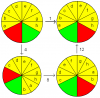
If I understand your idea correctly, I think it doesn't work. Look at the attached picture. As shown, you can get from the topleft state to the topright both with an odd or an even number of swaps of adjacent pieces.
 

Attachments

  • square1_parity.png
    square1_parity.png
    18.6 KB · Views: 47
I have an idea to explan it, whatever is the definition of parity on non cube shape (But supposing it exist and have some standard parity property).

/(3,3)/(1,2)/(4,-2) is a move séquence with a given parity modification. (-4,2)/(-1,-2)/(-3,-3)/ is the reverse, so it have the same impact on parity. If the parity at the begining and the end of /(3,3)/(1,2)/(4,-2)/(-4,2)/(-1,-2)/(-3,-3)/ is different, so the parity after /(3,3)/(1,2)/(4,-2) and before (-4,2)/(-1,-2)/(-3,-3)/ must be different. We can deduce thet the / is the parity modificator.
 
Yes, my "swap" counting idea doesn't work as stated. Thanks for the counter-example, Stefan.

However, I think it fails because of allowing a swap to leave a corner straddling the front divider. Let's suppose you have no piece straddling the front divider (doesn't qqwref insist you can't allow that anyway?). Then you can list the pieces clockwise around the top layer starting from the front divider. Then continue listing the pieces on the bottom layer clockwise starting from the front divider. We now have a Square-1 position described as a permutation of 16 objects (pieces). Since the arrangement of pieces are now considered to be an actual permutation of 16 objects, parity should now be well-defined for any arrangement satisfying the above description. Right? And that is even a superset of positions qqwref would want to allow us to have the puzzle in.

I note under this definition of parity, (1,0) from the solved state would be odd parity although we haven't changed the puzzle out of square-square shape. But that's OK since it's not (literally) *cubeshape*. If we rotate the top layer to bring the puzzle back to *cubeshape*, we will have even parity again.
 
Since the arrangement of pieces are now considered to be an actual permutation of 16 objects,
Well, it does give you a sequence of 16 objects, but I'd say to call it a permutation you also have to define their "correct" order (*). So that you can compare a given order with the correct order to determine the permutation. Any order will work as "correct order", and distinct shapes can use different "correct orders", though it might be nicer to have the same for all, and have it the order you get by reading your way from the solved puzzle.

(*) At least in order to determine parity. I just checked Wikipedia and the "group theory" definition comes closer to what I have in mind, speaking about a "bijection" rather than just a "sequence" as the "combinatorics" definition does. Btw, I find it interesting that neither the Wikipedia's nor Mathworld's article about "permutation" contains the word "parity". Edit 4: Well, Wikipedia does have a full article about Parity of a permutation. Which ... aha! ... says:

"If any total ordering of X is fixed, the parity (oddness or evenness) of a permutation σ of X can be defined as ..."

That's what I'm talkin' about...

parity should now be well-defined for any arrangement satisfying the above description. Right?
Agree. Once you have properly defined permutation, parity comes for free.
 
Last edited:
Since the arrangement of pieces are now considered to be an actual permutation of 16 objects,
Well, it does give you a sequence of 16 objects, but I'd say to call it a permutation you also have to define their "correct" order (*).

Well, of course I meant that the "correct" order (as you describe) would be the sequence you would get for the solved state of the puzzle. The thing is that you don't even have to care about shapes when using this definition of parity.(*) So naturally you don't have to specifically define a "correct" arrangement for each shape. What's even-parity for each shape is determined automatically. When determining parity by counting swaps, you can swap a corner with an edge if you want to, since you are only caring about the "ordering of pieces" rather than actual locations of pieces. I think this makes a lot more sense than rather arbitrarily assigning a separate parity convention for each shape.

(*) OK, you care about shapes when you're concerned about knowing what parity you'll get when going from some initial state to cubeshape. In this case, you have to know what parity effect the alg (for getting from the initial shape to cubeshape) has, or always choose even-parity algs for that purpose, for whatever piece-ordering method you use to define parity. You'll also want to rotate the top and bottom to set up the standard shape for the shape category before calculating the parity (assuming you want to use shape categories instead of hundreds of different puzzle shapes.) Well, actually, if you have 9 pieces in one layer, and 7 pieces in the other layer, you can't change parity (at least with this definition) simply by rotating the top or bottom layer.
 
I note under this definition of parity, (1,0) from the solved state would be odd parity although we haven't changed the puzzle out of square-square shape. But that's OK since it's not (literally) *cubeshape*. If we rotate the top layer to bring the puzzle back to *cubeshape*, we will have even parity again.

If this result pops out of your definition of parity, then your definition is not a good one. In actual square-1 solving parity is a tricky case which must be resolved with an algorithm, not just something you can fix with a (1,0). So, you might have defined *one* way to think about parity on a Square-1, but your definition certainly does not mesh with the way solvers think about parity as it relates to a position in cubeshape, so it's not useful at all.

No, the point is if you go from one cubeshape to another cubeshape without a complicated algorithm, even with my parity scheme, parity is not changed. The problem I think is that you are thinking of any square-square shape as cubeshape.

To deal with your objections that my parity scheme does not treat parity the way solvers think about parity, you can choose a representative shape for each shape category (barrel-barrel, mushroom-kite, etc.). This can be done by defining an orientation for each layer's shape with respect to the front divider. Then, instead of using the actual position the puzzle is in for the purpose of calculating parity, you rotate the top and bottom layers (if needed) to get each layer's shape to be the same as the defined representive shape for that shape category. For example, for square-square shapes, you use cubeshape as the representative. For other shape categories you can pick one. But there is one layer shape where a 180-degree rotation of the layer is guaranteed to change parity (besides "star" shape that similarly has a guaranteed parity changes for certain rotations, but never requires to be rotated for purposes of matching a representative shape), so you have to treat such a case specially.

When you make this adaptation to my parity scheme, I believe it amounts to practically the same thing as your scheme. The differences I see are that in my scheme, you can calculate parity directly from the position without caring about the shape once you've aligned the layers to match the representative for the shape category; whereas with your scheme you must either perform your alg to get to cubeshape, and then check parity, or you have to check the parity against a dictionary of reference positions for each shape. (Using shape category representatives again reduces the number of algs or dictionary size.) Second, with my scheme the parity for any position matching the representative shape has its parity determined automatically without the need for defining any alg to reach cubeshape. With your scheme, you define an alg that gets the representative to cubeshape, and then define parity so that the parity of the representative is the same as the cubeshape position reached.

I haven't taken time to fully verify my scheme works as I believe it does, so if you can prove me wrong, then I welcome you to show me where I'm wrong.
 
No, the point is if you go from one cubeshape to another cubeshape without a complicated algorithm, even with my parity scheme, parity is not changed. The problem I think is that you are thinking of any square-square shape as cubeshape.

That's not a "problem", that is just how we talk about parity when we solve Square-1. And any square-square shape IS cubeshape... often when solving Square-1 one or both of the two layers are misaligned a bit, but it is always square/square between algorithms. The reason your definition does not work is because nobody thinks that they are flipping parity when they misalign one layer of a Square-1 by 30 degrees. If your theory implies that this suddenly becomes odd parity, you've clearly gone in the wrong direction, because even without analyzing your theory in detail you have already found a contradiction (to the hypothesis that it models the actual way parity works on a square-1).

Remember that the original question was to tell us how Square-1 parity algs work, intuitively. If it takes quite a bit of work to tell if even a given position is odd parity - or if a given turn toggles parity - then the somewhat-arbitrary definition of parity that we have is clearly not going to help answer these questions. It is easy to simply declare which positions are odd parity but it is somewhat harder to make a definition which can help us understand parity algs.

In my opinion your approach is similar to the idea of trying to define a 3x3 corner orientation scheme other than the standard "U or D color on top or bottom" scheme. For instance maybe a piece in UFR is correct when the U/D sticker is on U, but the piece in UFL is correct when the L/R sticker is on L. Perhaps you can get such a scheme is mathematically consistent, but there is no point in using such an approach, because you are distancing yourself from the actual act of solving the puzzle. If your approach is not consistent with how we use the concept in real life, you cannot use it for real-world problems (such as "is this corner oriented?" or "do I have odd parity?") without making things much more complicated than they ought to be. A good way of defining parity, orientation, or anything else should be simple enough that you can quickly show every detail to a newcomer, and provide a concise argument for "why does this happen"-type questions.
 
No, the point is if you go from one cubeshape to another cubeshape without a complicated algorithm, even with my parity scheme, parity is not changed. The problem I think is that you are thinking of any square-square shape as cubeshape.

That's not a "problem", that is just how we talk about parity when we solve Square-1. And any square-square shape IS cubeshape... often when solving Square-1 one or both of the two layers are misaligned a bit, but it is always square/square between algorithms. The reason your definition does not work is because nobody thinks that they are flipping parity when they misalign one layer of a Square-1 by 30 degrees. If your theory implies that this suddenly becomes odd parity, you've clearly gone in the wrong direction, because even without analyzing your theory in detail you have already found a contradiction (to the hypothesis that it models the actual way parity works on a square-1).

Well the phrase "cube shape" means in the shape of a cube. If you perform (1,0) on a solved Square-1, it is no longer literally in the shape of a cube. Maybe that's why you write "cubeshape" as one word - to emphasize you mean something different than what "cube shape" (literally) means. I'll plan to avoid using "cubeshape" as one word in the future if I don't mean what you consider that to mean.

Let's look at square-square shapes. Each square layer, using 30-degree increments, has twelve possible positions with respect to the fixed middle layer piece. Four of these are non-twistable positions, so we'll disregard these immediately. This leaves 8 positions. Four of the remaining positions have the correct alignment with the fixed middle layer piece. The other four do not. I will call these correct positions and incorrect positions, respectively. If both layers are in the correct positions, then we can clearly determine the parity of the position by swapping edges with edges and corners with corners until we reach the solved state. We also see that if we rotate either layer a multiple of 90 degrees, we not only preserve the "correct" shape but we do not change the parity.

Now let's see what happens when we rotate a layer to an incorrect position. The edges in that layer now occupy a position formerly occupied by half a corner. We quickly see that we can not determine the parity of this position by swapping edges with edges and corners with corners. If we try to swap a corner with an edge, we have a problem because the corner doesn't fit in the space where the edge was. So we have a problem deciding what the parity of this position is.

So what do we do? Well, we think about the puzzle a little and first realize the puzzle can not be in the solved state if either square is in the incorrect position. We realize that we can get both squares in the correct position simply by rotating them until each of them is in one of the correct positions. Regardless of which of these possibilities we choose, we know that the resulting parity will be same. So what does this tell us about the parity of our present position? Nothing. But we do know that if we rotate the squares into correct positions (so that it has the possibility of being the solved state), the resulting parity is unambiguous. So in our usual concept of Square-1 parity if we are have a square-square shape, then we can pretend that the squares are in correct position, because we know we have to do that anyway to get the puzzle solved, and we can actually calculate the parity of that position. We have not proven that all square-square positions reached by simple rotating of layers must have the same parity. We have simply shown that we can disregard the actual parity of certain square-square positions (that we have a problem calculating the parity for anyway) because the actual parity for those positions don't really matter anyway.

Now why not simply define the parity of square-square shape positions to be the same regardless of how they are rotated? Well, we already know that there are cases where rotating a layer unambiguously changes parity. That can happen with the star layer shape, for instance. So definitely we can not say in general that we can rotate a layer and not change parity. I don't believe you can prove that rotating a square must preserve parity, and I would also argue that I believe it is perfectly valid to consider rotating one square layer into or out of "correct" position to always change parity.

Now I have attempted to explain parity in the Square-1 puzzle based upon the definition of the parity of a permutation. You seem to have "fudged up" a definition for Square-1 parity to fit your understanding of Square-1 parity. I believe your approach either is avoiding defining what the actual parity for (1,0) from the solved state position, or is simply defining it in a way that is not derived from the mathematical definition for the parity of a permutation. My approach defines a parity for that position based upon the mathematical definition of the parity of a permutation. As I have argued above, for explaining the usual Square-1 parity concept, neither my approach nor your approach depends upon knowing what the parity for the (1,0) position actually is. Square-1 speedsolvers care what the parity is when the squares are properly aligned, not what the parity is when the squares are not properly aligned. They don't need to actually align them to see what the parity will be when they are aligned.

I believe my approach, being based upon the actual definition of parity of a permutation, provides a more sound basis for extending the concept of determining parity for arbitrary shape positions. OK, my approach really has two parity concepts, a concept for calculating a specific position's "actual" parity, and secondly a way of relating that to how a speedsolver thinks about parity. I think my approach is able to provide a mathematically basis for explaining why your approach works.
 
Last edited:
Now I have attempted to explain parity in the Square-1 puzzle based upon the definition of the parity of a permutation. You seem to have "fudged up" a definition for Square-1 parity to fit your understanding of Square-1 parity. I believe your approach either is avoiding defining what the actual parity for (1,0) from the solved state position, or is simply defining it in a way that is not derived from the mathematical definition for the parity of a permutation. My approach defines a parity for that position based upon the mathematical definition of the parity of a permutation. As I have argued above, for explaining the usual Square-1 parity concept, neither my approach nor your approach depends upon knowing what the parity for the (1,0) position actually is. Square-1 speedsolvers care what the parity is when the squares are properly aligned, not what the parity is when the squares are not properly aligned. They don't need to actually align them to see what the parity will be when they are aligned.
I don't think you understand how this puzzle is solved at all. I also take offense to the fact that you are saying we have "'fudged up' a definition for Square-1 parity". It is not like Square-1 solvers have all gone "we are too dumb to understand parity so let's make a totally messed-up version for fun". We use a different definition of parity than the one you seem to have made up on the spot and then revised every few posts while still insisting that you are correct.

Here's the way it works: parity is typically thought of as a situation that cannot easily be resolved. When I say "easily resolved" I am referring to the fact that a great deal of square-square positions can be reached without ever leaving square-square. In fact, believe it or not, every square-square position that does not have "odd parity" (by our definition) can be reached without ever leaving square-square, and odd parity cannot be fixed this way. (I can prove this, if you want.) Do you get it now? Our definition of parity was designed to show us which positions are nicely behaved, and can be reached by simple, short, intuitive move sequences. Hence if we do a (1,0) on a solved Square-1 it is still a non-parity position - we have not avoided defining this, but rather we have not bothered to explicitly say it because we thought it was obvious. Even if our definition might not be a mathematical definition of parity from the standpoint of a scrambled Square-1, we refer to it as a parity because from the standpoint of square-square it is always an odd permutation of pieces. Again I will repeat that our definition works and yet is different than yours. We cannot learn anything about how to solve the difficult (odd parity) positions if we use a definition which says that we can create parity merely by doing a (1,0). I think you are repeatedly and stubbornly missing the fact that the problem we are trying to solve is not to merely create a definition of parity - because it is a trivial matter to arbitrarily say "this is parity" - but to create a definition of parity that helps us understand how to fix the difficult square-square positions.

If you want to talk strict mathematical parity, let's first recall that the Square-1 is actually a bandaged puzzle, and that the real puzzle (often referred to as a Square-2 by twistypuzzles members) has 12 equally sized pieces on each layer. But the fact that we can do this means that switching two corners (and only two corners) does not affect parity. Similarly, switching two edges DOES affect parity. But what does this mean? Let's take a Square-1 and do (3,0). That does a 4-cycle of corners and a 4-cycle of edges on top. If you look at this as a permutation, you have created parity. Clearly this definition is as useless as yours. But it is mathematically sound! It is obvious that being mathematically sound is not the only criterion here.

Again: the problem we are trying to solve is not to merely create a definition of parity, but to create a definition of parity that helps us understand how to fix the difficult square-square positions.
 
Last edited:
Long (really long, guys!) story short:

Bruce is talking about a definition useful for talking about permutation/parity for all shapes, so that we can talk about them in non-square-square shapes. I do find it useful for the original discussion I started and that led here.

Michael is more concerned about the actual speedsolving and permutation/parity for the square-square shape. His parity definition for non-square-square shapes works just as well.

I think you're both right, just have different objectives. No need to fight and drown us in words. Now please hug.
 
And yet we are no closer to defining parity for non-square-square shapes. Bruce said in too many words what Stefan and I said in the beginning: To determine parity in non-square-square shapes you first need to assign a non-parity permutation to use as a reference. I had already put this into action with my analysis of W-perm before Bruce had even made his first post! I showed that the B algorithm changed the parity of the puzzle with reference to the initial permutation. I did exactly what Bruce has suggested- I defined a non-parity permutation for a given puzzle shape, and determining changes in parity was easy after that.

If I am missing something and there is a difference between what I did and what Bruce is describing, then please point it out to me.
 
And yet we are no closer to defining parity for non-square-square shapes.
You say that because we already have three functioning definitions so we can't get any closer, right?

I don't quite get what you mean. My quoted statement explicitly says nothing of the sort, and it implies the exact opposite.
 
And yet we are no closer to defining parity for non-square-square shapes. Bruce said in too many words what Stefan and I said in the beginning: To determine parity in non-square-square shapes you first need to assign a non-parity permutation to use as a reference. I had already put this into action with my analysis of W-perm before Bruce had even made his first post! I showed that the B algorithm changed the parity of the puzzle with reference to the initial permutation. I did exactly what Bruce has suggested- I defined a non-parity permutation for a given puzzle shape, and determining changes in parity was easy after that.

If I am missing something and there is a difference between what I did and what Bruce is describing, then please point it out to me.

Yes, the obvious sort of way to fix parity is to set up a position from which you can make a move that an odd permutation where it's clear that it's an odd permutation because it only swaps edges with edges, and corners with corners (and undo the setup). But my idea that I've been discussing of late is a method that would seem to allow you to directly calculate a parity effect for any Square-1 move, not simply moves (or move sequences) that only swap like pieces. As qqwref points out, this doesn't match up exactly with the usual concept of Square-1 parity. At this point, this concept needs some further exploration.

(I had started working on a response to qqwref's post, but in light of other comments made, I may decide to simply PM my comments.)
 
And yet we are no closer to defining parity for non-square-square shapes.
You say that because we already have three functioning definitions so we can't get any closer, right?

I don't quite get what you mean. My quoted statement explicitly says nothing of the sort, and it implies the exact opposite.
If you're already at the goal, not getting closer isn't so bad. So our statements are compatible, not opposite.

We already have three definitions: mine, Michael's and Bruce's. Did you miss them?
 
Last edited:
Ok, let's start another point of the first post : the finger tricks.

I have a simple question : most of the cuber take the little part on the middle layer on the left (all of them ?). I use the big part on the left and find it much more easy to turn like this. I feel alone with this technique. Why everybody choose the little part on left ?
 
I hold the square-1 so that the seam is roughly straight forward ahead of me, rather than diagonal. See picture:

grips.jpg


The position of my left index finger is MUCH more comfortable with the small slice on the left than on the right, my grip is tighter, and it's easier to fingertrick both U and D slices with the left hand.
 
Back
Top