

Kirjava
Colourful
Intro
This information was scattered around the forum and some was undocumented. Decided it's about time to centralise it.
Read the original site at http://grrroux.free.fr/ and familiarise yourself with it. I've refrained from producing a tutorial for this method for a long time because the original writeup is just so good. I'll attempt to only cover notes that take you beyond this site. I will only cover things that have been proven to work and are used by people who are fast with them.
F2B
For the second block; it's unknown if always solving DR first leads to overall better solutions.
F and B moves can be cool for SB sometimes, I like to use FR2F' to solve DR if the front pair is done. No one uses D moves or rotations.
Look into generating solutions for second block cases that you consider ugly.
Put centres in their 'correct' orbit in 0 moves at the end of this step by changing the last R move to be either wide or not. It's better to do it here instead of after CLL because you need it for LSE lookahead.
CMLL
For algs, use this thread.
You can basically recognise EO and CMLL at the same time and execute it as one step. Knowing what your algs do to edges (perm and orient) is useful. Knowing COLL aswell is very useful.
The easy EO case can be better than an EO skip.
LSE
Do 6flip with this: RU'r'U'M'UrUr'
See my notes on performing M moves.
Ensure you're performing all cancellations.
Some people like doing F2M'F2UM' for the bad EO case but I don't like it.
Trace and influence 4b edges during 4a. In 4a you can change most U and M moves and retain a solution while influencing edge permutation.
Predict and force 4c skips during 4b. Try one looking 4b+4c. In most cases, it's easy to predict 4c. Some cases require extra attention though.
For these, the technique I'm using involves knowing the colour of the sticker at BU to be able to work out the case. You should be tracking the edge that will end up there after 4b and know what it is going to be before it gets there.
H perm is the only EPLL that you need to learn an alg for.
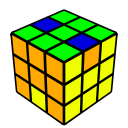
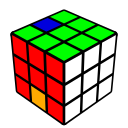
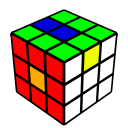
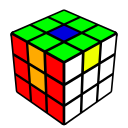
Here are a few cases that have solutions deviating from the standard system.
[table="width: 500, align: center"]
[tr]
[td]
 [/td]
[td]
 [/td]
[td]
 [/td]
[td]
 [/td]
[/tr]
[tr]
[td]UM'U2M2U2M'U'[/td]
[td]U'M2U2MU2MU[/td]
[td]UM'U2MU2M2U'[/td]
[td]M2UM'U2M2U2MU'M2[/td]
[/tr]
[/table]
For the dots case, E2 doesn't suck.
Colour Neutrality
My main gripe with Gilles' tutorial is that he teaches you to first choose a fixed first block then transition into being colour neutral. This is the wrong way to go about it, if you desire colour neutrality you should be doing it from the start. It's not like you can just switch to it in a month or something after nonCN is ingrained. It took me years to switch from [y2] to [x2,y2] and I'm still not perfect at it.
Be as colour neutral as possible, but don't worry too much if you cannot be. There are disadvantages and advantages to either system. No known fast Roux solver is CN yet; the popular 'styles' of colour groups seem to be [y,x2] and [y2,x2].
Some CFOP notes
For the second block, DR is important, but don't let that fool you into thinking that you only have two slots free. You can probably do the second block faster now by doing the 'cross edge' and two slots, but this would be way slower in the long run. rUr' is sexier than yU'L'UL.
Some COLL cases suck for CLL.
Non Matching Blocks
Opposite blocks appear to be quite easy to use for people with adjacent blocks proving difficult. Since no one can demonstrate doing them with any kind of speed, I will not include them here yet.
If you are neutral in an x2 sense, making opposite blocks should be easy as they will be blocks that you are already used to making. They really only come into play when solving the R2 pseudoblock has some easy solution. Because of this, non matching block solves tend to be faster than regular ones on average.
Solving CLL with this kind of pseudoblock is fairly straightforward.
If you're used to detecting permutations instead of looking at specific stickers, the case should be obvious to you.
If you're used to looking at stickers in locations, there is a trick you can follow for case detection - change front or back sticker colours to their opposites on corners from the opposite block.
One you get used to doing this eventually you just get used to the cases and are able to do them without translating.
I've heard that NMCLL is easy to see with hyperorientations, but cannot personally confirm it.
The pseudoturn can be resolved at the end of the solve often cancelling in with step 4b. However, my approach to doing so is usually performing an r2 move after solving 4b. This is due to the fact that when I originally started implementing this technique I didn't have a 4c recognition system so I'd use the r2 to be able to see what case it was, and I seemed be to doing stuff like M2 R2 instead of r2 in confusion. I might switch back to doing it at the end.
That's all for now, I'll add new ideas to it when I remember or think of them or maybe if someone requests it.
This information was scattered around the forum and some was undocumented. Decided it's about time to centralise it.
Read the original site at http://grrroux.free.fr/ and familiarise yourself with it. I've refrained from producing a tutorial for this method for a long time because the original writeup is just so good. I'll attempt to only cover notes that take you beyond this site. I will only cover things that have been proven to work and are used by people who are fast with them.
F2B
For the second block; it's unknown if always solving DR first leads to overall better solutions.
F and B moves can be cool for SB sometimes, I like to use FR2F' to solve DR if the front pair is done. No one uses D moves or rotations.
Look into generating solutions for second block cases that you consider ugly.
Put centres in their 'correct' orbit in 0 moves at the end of this step by changing the last R move to be either wide or not. It's better to do it here instead of after CLL because you need it for LSE lookahead.
CMLL
For algs, use this thread.
You can basically recognise EO and CMLL at the same time and execute it as one step. Knowing what your algs do to edges (perm and orient) is useful. Knowing COLL aswell is very useful.
The easy EO case can be better than an EO skip.
LSE
Do 6flip with this: RU'r'U'M'UrUr'
See my notes on performing M moves.
Ensure you're performing all cancellations.
Some people like doing F2M'F2UM' for the bad EO case but I don't like it.
Trace and influence 4b edges during 4a. In 4a you can change most U and M moves and retain a solution while influencing edge permutation.
Predict and force 4c skips during 4b. Try one looking 4b+4c. In most cases, it's easy to predict 4c. Some cases require extra attention though.
For these, the technique I'm using involves knowing the colour of the sticker at BU to be able to work out the case. You should be tracking the edge that will end up there after 4b and know what it is going to be before it gets there.
H perm is the only EPLL that you need to learn an alg for.
Here are a few cases that have solutions deviating from the standard system.
[table="width: 500, align: center"]
[tr]
[td]
[td]
[td]
[td]
[/tr]
[tr]
[td]UM'U2M2U2M'U'[/td]
[td]U'M2U2MU2MU[/td]
[td]UM'U2MU2M2U'[/td]
[td]M2UM'U2M2U2MU'M2[/td]
[/tr]
[/table]
For the dots case, E2 doesn't suck.
Colour Neutrality
My main gripe with Gilles' tutorial is that he teaches you to first choose a fixed first block then transition into being colour neutral. This is the wrong way to go about it, if you desire colour neutrality you should be doing it from the start. It's not like you can just switch to it in a month or something after nonCN is ingrained. It took me years to switch from [y2] to [x2,y2] and I'm still not perfect at it.
Be as colour neutral as possible, but don't worry too much if you cannot be. There are disadvantages and advantages to either system. No known fast Roux solver is CN yet; the popular 'styles' of colour groups seem to be [y,x2] and [y2,x2].
Some CFOP notes
For the second block, DR is important, but don't let that fool you into thinking that you only have two slots free. You can probably do the second block faster now by doing the 'cross edge' and two slots, but this would be way slower in the long run. rUr' is sexier than yU'L'UL.
Some COLL cases suck for CLL.
Non Matching Blocks
Opposite blocks appear to be quite easy to use for people with adjacent blocks proving difficult. Since no one can demonstrate doing them with any kind of speed, I will not include them here yet.
If you are neutral in an x2 sense, making opposite blocks should be easy as they will be blocks that you are already used to making. They really only come into play when solving the R2 pseudoblock has some easy solution. Because of this, non matching block solves tend to be faster than regular ones on average.
Solving CLL with this kind of pseudoblock is fairly straightforward.
If you're used to detecting permutations instead of looking at specific stickers, the case should be obvious to you.
If you're used to looking at stickers in locations, there is a trick you can follow for case detection - change front or back sticker colours to their opposites on corners from the opposite block.
One you get used to doing this eventually you just get used to the cases and are able to do them without translating.
I've heard that NMCLL is easy to see with hyperorientations, but cannot personally confirm it.
The pseudoturn can be resolved at the end of the solve often cancelling in with step 4b. However, my approach to doing so is usually performing an r2 move after solving 4b. This is due to the fact that when I originally started implementing this technique I didn't have a 4c recognition system so I'd use the r2 to be able to see what case it was, and I seemed be to doing stuff like M2 R2 instead of r2 in confusion. I might switch back to doing it at the end.
That's all for now, I'll add new ideas to it when I remember or think of them or maybe if someone requests it.
Last edited:


