A Few Tricks to Help You Avoid Cube Rotations

Cases 39/40 and 41/42 are a bit different because the edge stays good or bad when you rotate.

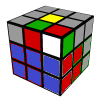
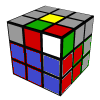
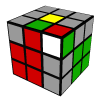
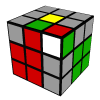
Here's another example, case #13. Instead of learning #13 and #14 both for FR target, I learn #13 for FR and BR targets, as shown here:-
attachment.php
attachment.php


Rotationless solutions are R U' R' U (R' F R F') R U' R' and R' U R U' R' U' R respectively. Now it's easy to cope with other slots using mirrors (e.g. R U' R' U R U R' or L' U L U' L' U' L or L U' L' U L U L') and even to utilize empty slots to keep work on your preferred hand (e.g. R U' R' U (R' F R F') U2 L U' L'). Note that rotations aren't always bad - in the first case you might prefer to do a d move then solve it like the second case.

It does amount to the same thing really, since case #14 is just one of the mirrors. I just find it helpful to think about all the slots, and not focus everything on FR.

(Oh and sometimes sledgehammer solutions don't mirror well to the back, in which case I might learn a different rotationless solution for the back slots.)

R U R' U2' R U2' (R2 F R' F') U' R U R'
R2 U2 F R2 F' U2 R' U R' - one of the few non-intuitive algs I use. Start with thumb on U face, use left for both U2s, and pull up with right ring for the F', for a regripless execution. Don't know if anyone else uses this but I found it myself using Cube Explorer :D

EDIT: of course the best way to deal with these stuck-slot cases is to try to force them out early by using the slot to solve other cases.
 

Attachments
  • F2L13.png
    F2L13.png
    6.6 KB · Views: 160
  • F2L13-BR.png
    F2L13-BR.png
    6.5 KB · Views: 161
Last edited by a moderator:
EDIT: of course the best way to deal with these stuck-slot cases is to try to force them out early by using the slot to solve other cases.
Or you might just stuck them while using the slot to solve another pair :D

Edit: also, it seems quite interesting to me to work on reversing the cases. It's not as easy as I would have thought to recreate the case the other way around. Interestingly, once I could reverse it, it seems easier to solve. Also sometimes I can get the reverse for on slot, say FR as a start usually, and when working on the back slots it seems a little harder depending on the case. What I'd like to achieve all in all is to get all the cases in muscle memory, in a reliable way. Meaning I know I'm performing optimal moves and I can solve them eyes closed in order to work on lookahead properly and go towards sub25 and later sub20 having a robust F2L. It just felt so clumsy until now. I could increase speed, try to minimize pauses, but it didn't felt "right". Keep jumping from solves and F2L case workouts ( solving every slot for each case ). I should hopefully see some benefits by this weekend and finally reach sub30.
 
Last edited:
I find (R U' R' U2)(R U' l U' R' U l') faster and better for look-ahead.

For tricky rotationless cases I often do this method of making a pair at the back and then inserting with l U' R' U l' or its mirror.

Is it possible that something is missing in your alg ? I don't even end up with my bottom cross anymore except I omit the last l'. But if the pair is on the back I find the sledgehammer for BR and BL really fast to perform also.
 
I find (R U' R' U2)(R U' l U' R' U l') faster and better for look-ahead.
How do you finger that? I can't get it to flow.

For lookahead I guess each to his own, but generally I find it easier with the really typical RUL and sledgehammer moves. The brain just gets used to how the other pieces move. Any special cases wreck my lookahead and I often use longer solutions just to keep it good for lookahead. If you use that insert a lot maybe it works for you, but I sometimes use sledgehammers at the back (l U' l' B etc.) and even those seem to mess with my lookahead. Rotationless inserts like r U R' U' M too. Maybe it's the wide moves.
 
Is it possible that something is missing in your alg ? I don't even end up with my bottom cross anymore except I omit the last l'. But if the pair is on the back I find the sledgehammer for BR and BL really fast to perform also.
Yes, I've corrected it above. You can read about this insert here under 'Reducing # of cube rotations'.
http://badmephisto.com/f2l.php
The problem I have with sledgehammer on front is that you tend to lose sight of the U face.
 
Still quite some work to do on optimizing my F2L I suppose. There are solves where I can do the whole F2L within 16-18sec, almost no cube rotation, others where I have to rotate a lot ( due to the stress of the timer I believe ), and I finish my F2L at 25sec or so ( sometimes almost 30 ). Working on a single case at a time takes way more time than I thought since you need to work on it for the 4 slots and I'm still not fluent on the only 5 cases I've been working on. If I can at least integrate these in my solves, then I could work on improving them while solving, but it doesn't seem to be the case yet. But I still think it's a good thing to focus on getting F2L pairs solved properly before increasing speed or getting into lookahead.

Edit:

So, it looks like I start to use my new F2L algs in my solves, I haven't worked on every case yet but still I find that when solving I use much more back slots than before and also I do way less cube rotations. Still I could come back to my previous averages and I am back at around 32sec. I'll keep working on all my F2L cases until I feel comfortable with them, my PLL algs are still improving constantly ( my LL takes about 8-12sec so there's big room for improvement there ). So all together I should gain a few seconds in the coming 2 weeks and I'll then focus on look ahead. So, thanks a lot for your videos ! It helped big time even though it's quite a transition.
 
Last edited:
What are the cases where it is best to rotate ? I find that usually I rotate more for the last pair than any other. I usually use 1-2 rotations in my timed solves, and one of them is the last pair usually, the others are cases where I have a RUR' setup, which is setup FUF', I find it so much easier to go for y'RUR'. But mostly I try to either orient my edge if I'm gonna insert in front slots or insert them with sledgehammer for back slots. I find that as long as I have 2 or 3 empty slots it is really easy to solve / insert a pair without cube rotation ( except solved slots are diagonally opposite each other ).
 
I can only speak from my experience trying to improve, and I am not fast, but I think avoiding rotations is over-rated. The key thing is to avoid breaks in flow. If a rotation requires a regrip and break in flow, it's bad. But awkward rotationless solutions could also cause a break in flow, or perhaps interfere with lookahead and indirectly disrupt flow. In some cases a rotation might be the most natural thing to do, if it flows well between the moves before and after it.
 
I can only speak from my experience trying to improve, and I am not fast, but I think avoiding rotations is over-rated. The key thing is to avoid breaks in flow. If a rotation requires a regrip and break in flow, it's bad. But awkward rotationless solutions could also cause a break in flow, or perhaps interfere with lookahead and indirectly disrupt flow. In some cases a rotation might be the most natural thing to do, if it flows well between the moves before and after it.
Yes I totally agree, that's why I try to include rotations back into my solves now, but I just try to do it smart and avoid rotations that aren't needed. I think it's not as bad for the last pair since you then directly jump into LL algs and rotating the cube isn't going to change anything at your recognition for LL ( except you do a x or x2 which doesn't make sense anyway ). But definitely, having too many rotations even though you can keep the flow is working against look ahead in my opinion. Even though I have much slower moves at the moment on my F2L, I get more and more 15sec F2L which never happened before. I greatly think this comes from the fact that I can spot my next pair more easily at the moment than I could before. And each time you rotate, you somehow need to rotate the image of the empty slots you have in mind. Not that I constantly think of my empty slots while solving, but somehow you're aware of them. They are very important since they may hold pieces for your next F2L pair ( no need to loose time looking at a solved slot ), and they allow you to solve other pairs with more ease.

I just thought that among the 41 cases there's maybe one or two that are messy to solve without rotation, where a rotation would be more beneficial somehow. anyway, I'll go on with my F2L practice. Have been solving F2L only for the past 3 days and there's definitely a great improvement, I'll probably give it another week to get more consistent results.
 
Yeah there's no right or wrong answer and I change my opinion week to week. At the moment for lookahead I favour RUL solutions avoiding U2s where possible, so all nice fast quarter moves. I include sledghammers at the front where I immediately know how it will affect the pieces I'm tracking. I find back sledgehammers mess with lookahead more but occasionally use them if I would need to pause and think otherwise. I try to focus more on never pausing than on finding the ideal solution in each case. I do separate untimed slow solve practice to train efficiency, but then don't force that into my timed solves. Efficiency improvements creep in over time.
 
I think focusing on not pausing and focusing on efficient moves is going in the same direction, they work together. Since efficient moves should allow you to keep track on the pieces you look for, if you execute them subconsciously it should definitely help to look ahead. At least that's what I'm trying to reach at the moment. But of course I always try not to go full speed on pair solving, except in a few cases like when there's a lot of F2L pieces on the U layer, I clear one or two easy pairs in a blink and slow down, which I should probably avoid anyway. I try to track pieces but I think it's come together once I master my F2L moves.
 
Thank you so much. I'm just trying to get less cube rotations. This helps a lot. :)
 
Title says it all. This will be a series covering Edge orientation and its manipulation, use of open slots, cube rotation saving inserts/algs, as well as some general tips and ways of looking at the cube that will help you to avoid as many unnecessary cube rotations as possible. The first few parts will be on edge orientation and its manipulation. I have parts 1-5 completed so far, more to come:

[video=youtube_share;_rtSJLujpWA]
[video=youtube_share;l9e8K7DpH3g]
[video=youtube_share;zYTta6UhFDk]
[video=youtube_share;sOC3hZtTj0k]
[video=youtube_share;cccZHIV9P8M]
[video=youtube_share;m_WbP0Lb9Ck]
I know this post is really old but I would love to see these videos. Is there any way I can watch them? The links don’t work anymore and copying the link to a new page doesn’t get me anywhere either.
 
Back
Top