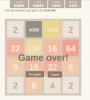
It is indeed true, I [post=963309]ended up[/post] with the same, though it's really just [post=963076]Ricardo's insight[/post] fleshed out a little.
Ah, I should've read more of the thread. Can you think of a way to prove it without just observing arbitrarily many cases? Also, would it still be true if you start with three or four tiles instead of two? I assume so, but it's strictly from observation.
Another (more) interesting observation, which I can actually prove:
Let the nth tile have value t(n). (t(0)=2, t(1)=4, t(2)=8, etc.) Then if you receive only a 2 on every turn (no 4s), the your score is \( \sum_s nt(n) \), for all active tiles s with degree n and value t(n).
Proof:
Using the scoring system, each active tile with degree n, when first merged, accumulates 2p(n-1)+t(n) points, where p(n-1) are the points accumulated from the (n-1)th tile.
Since p(0)=0, we get the following when we receive only 2s:
p(1) = (2 x 0) + 4 = 4
p(2) = (2 x 4) + 8 = 16
p(3) = (2 x 16) + 16 = 48
p(4) = (2 x 48) + 32 = 128
p(5) = (2 x 128) + 64 = 320
p(6) = (2 x 320) + 128 = 768
p(7) = (2 x 768) + 256 = 1792
p(8) = (2 x 1792) + 512 =4096
p(9) = (2 x 4096) + 1024 = 9216
p(10) = (2 x 9216) + 2048 = 20480
Note the following:
p(0) = 0 = 0 x 2
p(1) = 4 = 1 x 4
p(2) = 16 = 2 x 8
p(3) = 48 = 3 x 16
p(4) = 128 = 4 x 32
p(5) = 320 = 5 x 64
p(6) = 768 = 6 x 128
p(7) = 1792 = 7 x 256
p(8) = 4096 = 8 x 512
p(9) = 9216 = 9 x 1024
p(10) = 20480 = 10 x 2048
This is exactly p(n)=nt(n) (since t(n)=2^(n+1)). [very lazy way of finding an explicit formula for a recursive equation, I know]
So each active tile of degree n and value t(n) accumulates nt(n) points, and the total score is the sum of all points of each active tile, which is precisely \( \sum_s nt(n) \), for all active tiles s with degree n and value t(n).
Q.E.D.
________________________________________________________________________________________________________________________________
Also, since it's unrealistic to only get 2s and no 4s, it follows that your score is actually \( \sum_s nt(n)-4f \), for all active tiles s with degree n and value t(n), where f is the total number of 4s given.
Question: Does anyone know the probability of a getting a 4 instead of a 2?


 I'll read more carefully next time.

 Am I the only one to have not yet completed it?