

I received a package from Indy. Inside was a letter and a USB. The letter read, "Dear Tito, Thank you for all your help the other day. I am currently in Ommeren, a small village in the Netherlands, and am in the middle of searching for treasure using a map that is said to have been left behind by a German soldier.
I went to the location marked on the map and while digging, I came across an old wooden cube. I believe this cube has something to do with the treasure, so I've been looking into it, but I haven't been able to solve the mystery yet. So, I'd like to ask you again, I've enclosed a USB recording of what the cube looks like, so could you please analyze it? Thank you very much."
I immediately looked at the image stored in the USB, and the cube looked like this:
- It was a 1x1x1 cube like the one below.
- The surface had corroded and faded over the years, but it was painted in 3 different colors, and X-ray analysis revealed that Greek letters, arrows, and numbers were engraved on each face, as shown below.
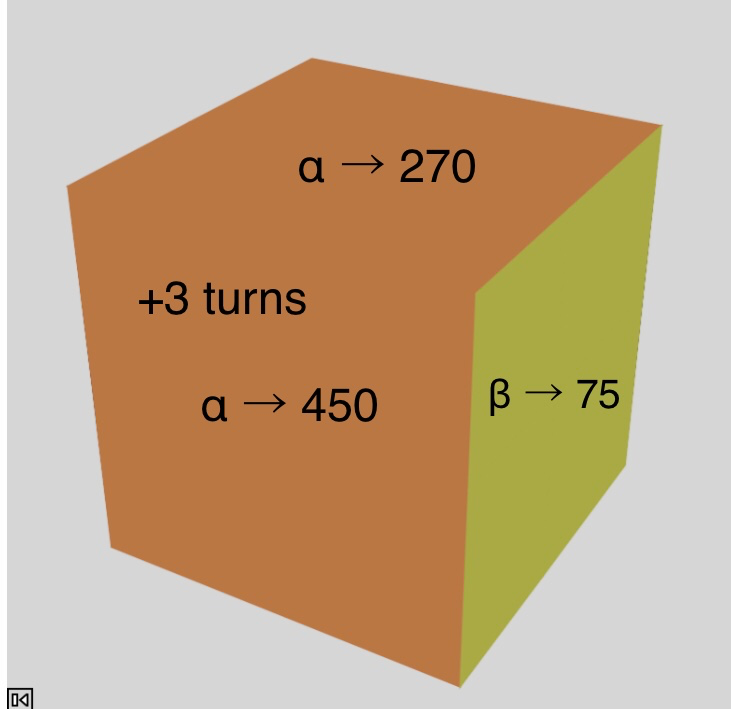
U face: α → 270
F face: α → 450
R face: β → 75
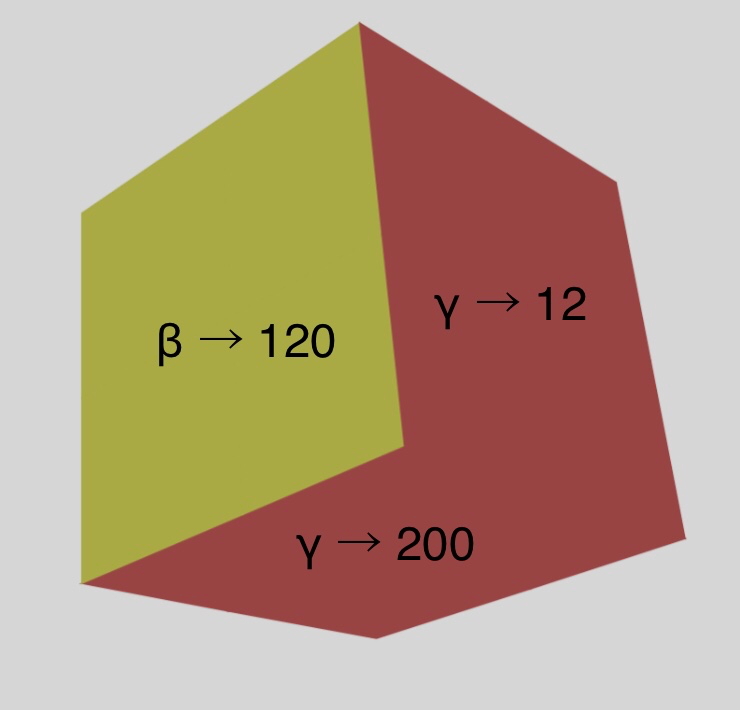
B face : β → 120
L face: γ → 12
D face: γ → 200
- I also saw the words "+3 turns" on the F face.
(U, F, R faces view)
(B, L, D faces view)
Based on the above information, I thought the problem was to guess in which direction this cube needs to be rotated three times (each 90 degrees) so that the initial digits (α, β, γ) each become the engraved digits, applying some math formula. However, since we don't know the initial 3 digits, the 3 rotation directions, or the calculation formula, it doesn't seem like it will be easy to solve. Let's think about it a bit more...
Can you solve it, readers?
I went to the location marked on the map and while digging, I came across an old wooden cube. I believe this cube has something to do with the treasure, so I've been looking into it, but I haven't been able to solve the mystery yet. So, I'd like to ask you again, I've enclosed a USB recording of what the cube looks like, so could you please analyze it? Thank you very much."
I immediately looked at the image stored in the USB, and the cube looked like this:
- It was a 1x1x1 cube like the one below.
- The surface had corroded and faded over the years, but it was painted in 3 different colors, and X-ray analysis revealed that Greek letters, arrows, and numbers were engraved on each face, as shown below.
U face: α → 270
F face: α → 450
R face: β → 75
B face : β → 120
L face: γ → 12
D face: γ → 200
- I also saw the words "+3 turns" on the F face.
(U, F, R faces view)
(B, L, D faces view)
Based on the above information, I thought the problem was to guess in which direction this cube needs to be rotated three times (each 90 degrees) so that the initial digits (α, β, γ) each become the engraved digits, applying some math formula. However, since we don't know the initial 3 digits, the 3 rotation directions, or the calculation formula, it doesn't seem like it will be easy to solve. Let's think about it a bit more...
Can you solve it, readers?
Last edited:


