

academicmaslow
Regular
Hey everyone,
Since 2020 I experiment with dual-sided mosaics of verious types.
Now I'd like to share my recent work on a new class of dual-sided patterns on a Rubik's cude. I called it Corner Dual-Sided Isomorphic (CDSI).
The idea is the following: take two adjacent faces of the cube (Front and Right) and place a two-color pattern on each. The two patterns are geometrically identical – the same arrangement of stickers – but the colors are inverted using opposite color pairs (red/orange, blue/green, white/yellow). So you get a mirror in color, not in geometry.
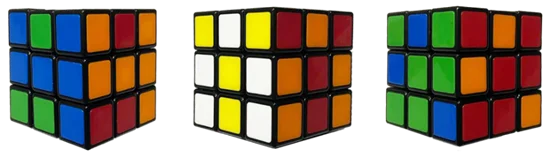
The whole system content 12 288 possible patterns
So I create a database of 256 algorithms, each 14 moves or fewer.
Now anyone can build corner mosaics (even without cubing skills - you need to know only Singmaster's cube Notation):
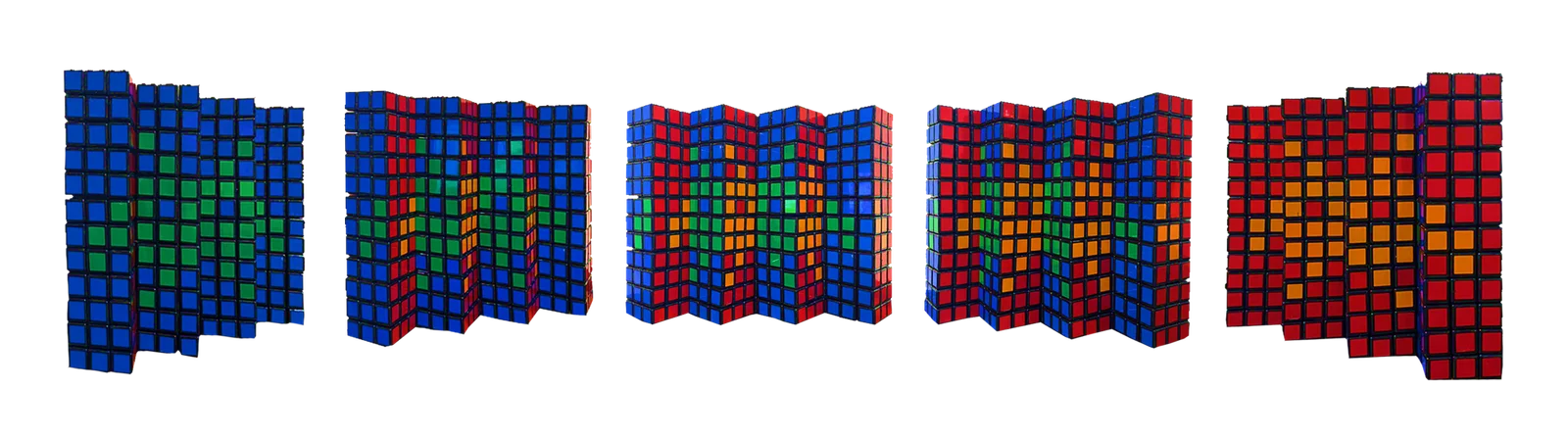
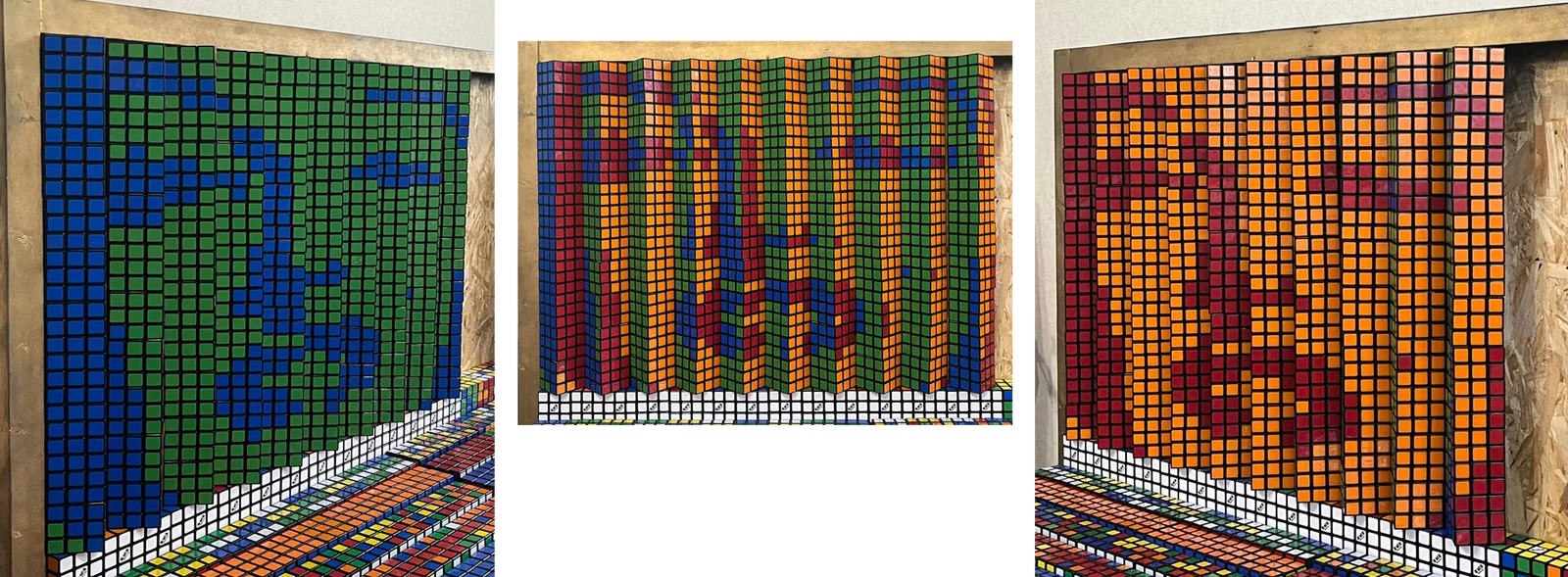
As you can see visual effect when scaled up to mosaics of dozens or hundreds of cubes:
Here is a video with my presentation at the Bridges 2026 Conference on Mathematics and the Arts Conference.
Full paper with the methodology (and a list of algotrithms) is availible at Bridges 2026 web page: https://archive.bridgesmathart.org/2026/bridges2026-253.html#gsc.tab=0
If anyone here has experimented with adjacent-face patterns before?
Since 2020 I experiment with dual-sided mosaics of verious types.
Now I'd like to share my recent work on a new class of dual-sided patterns on a Rubik's cude. I called it Corner Dual-Sided Isomorphic (CDSI).
The idea is the following: take two adjacent faces of the cube (Front and Right) and place a two-color pattern on each. The two patterns are geometrically identical – the same arrangement of stickers – but the colors are inverted using opposite color pairs (red/orange, blue/green, white/yellow). So you get a mirror in color, not in geometry.
The whole system content 12 288 possible patterns
- 256 distinct half-patterns on a single face (the center is fixed, so 2⁸ variable stickers). The center can also have two colors. So we have 512 shapes.
- 24 valid color combinations (12 adjacent face pairs × 2 orientations).
So I create a database of 256 algorithms, each 14 moves or fewer.
Now anyone can build corner mosaics (even without cubing skills - you need to know only Singmaster's cube Notation):
- Choose a binary image.
- Split it into 3×3 blocks.
- Choose one of the 24 color schemes.
- Apply the algorithms to cube.
- Repeat cube by cube.
- Mosaic is done.
As you can see visual effect when scaled up to mosaics of dozens or hundreds of cubes:
- Front view – a blended mixed-color image.
- Viewed from one diagonal (~45°) – resolves into a clean two-color pattern from one face.
- Viewed from the opposite diagonal – reorganizes into a different two-color image using the inverse color pair on the other face.
Here is a video with my presentation at the Bridges 2026 Conference on Mathematics and the Arts Conference.
Full paper with the methodology (and a list of algotrithms) is availible at Bridges 2026 web page: https://archive.bridgesmathart.org/2026/bridges2026-253.html#gsc.tab=0
If anyone here has experimented with adjacent-face patterns before?


