Twisted101
Veteran
The method development competition of 2023 has officially ended! Here are the methods:
Team 5.708 @JDAW6 with JJ Method
Method description pure copy and paste:
Team Hawaii @HawaiianKociemba2 with 2NAKe method
Method description pure copy and paste:

 docs.google.com
Team Cubersaurus @DoAnKhang with Triceratops Method
Method description pure copy and paste:
 docs.google.com
Team TAM @Twisted101 , Horrormusician and Cubealgs with PBCS Method
Method description pure copy and paste:
 docs.google.com
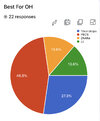
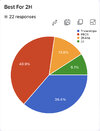
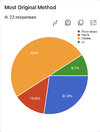
Vote for your winners here:

 docs.google.com
You cannot vote for a winner of FMC as that is not exactly controversial as you just pick the one with the lowest movecount which is Triceratops method from @DoAnKhang . Congrats for triceratops Method for winning fmc!
Team 5.708 @JDAW6 with JJ Method
Method description pure copy and paste:
First you Solve a 2x2x2 in the back left (if u like R U Gen ) Or in the back right (if u prefer L U gen).
Next Do EO but preserve the block in the back.
Thirdly, solve the FL pair.
Here you have to do corner permutation which is summed up nicely by Devagio
Just like EO of edges in R and U layers allows them to be solved without the intervention of F and B faces, CP of corners in R and U layers allows them to be solved without the intervention of F, B, L and D faces. What is a solved CP exactly? We do not really have to care to answer that question beyond noting that it is a permutation of the 6 corners in the R and U layers such that it is solvable using R and U; I have already done the work and you just gotta learn some rules.
1) After you solve the two corners in the bottom left, you can solve the CP by "swapping" a pair of the remaining corners. Determining which corners to swap exactly is the hard part, we'll get to that later. We'll first see how to swap them.
2) The "swapping" can be done by using one of the following 3 triggers:
a. F' U' F swaps corners in spots UFL and UFR
b. F' U F or F R’ F’ swap corners in spots UFR and UBR (edited)
c. F R F' swaps corners in spots UBL and UBR
Any or all of these moves may even be wide moves, as per the convenience of solving the DL edge of the CP-line. Also, if the corners you want to swap aren't in these locations, simply get them there using R and U moves (or their wide versions).
Now we get into the numbering system, which will be used to determine which corners to swap. For now, assume that the two corners in bottom left are already solved, and for now say we have yellow on bottom. The following bit is quite complicated, but with practice, it'll become second nature in less than an hour.
I have numbered the white-green-orange corner as 1, the white-orange-blue as 2, white-blue-red as 3 and the white-red-green as 4. The corner that is supposed to be solved in DFR is called 5, and the corner that is to be solved in DBR is called 6.
Now, imagine a thread in the cube going from locations UFL-UBL-UBR-UFR-DFR-DBR. The locations UFL, UBR and DFR are called odd places, and the locations UBL, UFR and DBR are called even places. Also, there are three couples: UFL-UBL, UBR-UFR and DFR-DBR. Trace these on a cube and you will see the obvious patterns.
Now that the naming is out of the way, we can have a look at how to identify which corners to swap to solve CP.
1) Look for corner 5. If it is in an odd location, we will "read" the thread from UFL to DBR. If corner 5 is in an even location, we will read from DBR to UFL (The meaning of reading is obvious later).
2) Now look for corner 6. It can be in 3 possible locations.
a. If corner 6 is in the couple of location of 5, do nothing.
b. If corner 6 is in another couple and the parity of its location is different from the parity of location of 5, then visualise the corners in the third couple swapped, and corner 6 swapped with the corner in the couple of corner 5.
c. If corner 6 is in another couple and the parity of its location is the same as the parity of location of 5, then visualise the third corner in the same parity location swapped with the other corner in the couple of corner 6, and corner 6 swapped with the corner in the couple of corner 5.
3) Now read the thread in the direction as dictated by rule 1, with the considerations of rule 2, ignoring 5 and 6. You will obtain some permutation of the numbers 1, 2, 3 and 4. Starting from 4, cyclically read the numbers (For eg: 3421 changes to 213).
You will have one of 6 possible sequences:
123: CP is solved
132: swap either 2-3 or 1-6 or 4-5
213: swap either 1-2 or 3-5 or 4-6 (edited)
231: swap either 1-4 or 2-5 or 3-6
312: swap either 3-4 or 1-5 or 2-6
321: swap either 3-1 or 2-4 or 5-6
You can choose any one of these swaps based on convenience of simultaneously putting the DL edge.
This is basically all you need to get started with this method given you understand the concept of EO.
Till then, here is an example.
Scramble: L2 F2 D2 B' R2 B' D2 B' U2 L2 R' B D' F2 L' D R2 F L B2
x' y' (putting solved corners in bottom left)
a. 5 is in UFR, an even position, thus we read starting from DRB
b. 6 is in DRB, also an even position. Thus we visualise UBL swapped with DFR and UBR swapped with DRB.
c. Now, skipping the couple that will now have 5 and 6 as we have visualised, we read - DRB-DRF-UBL-UFL, which after the swaps has converted to UBR-UBL-DFR-UFL, which is 2143
d. Removing 4 we have 321, i.e. we have to swap either 1-3 or 2-4 or 5-6.
e. A good way to solve CP while solving DL is to swap 5-6 as follows:
U R2 f' u' F (the final u' is a wide move to facilitate the next step, which will be U R' u' R' u2)
Here, the U R2 was to set up 5 and 6 to swappable positions, and the trigger used was a variation of F' U' F.
Then finish off the cube 2 GEN RU or LU depending on what u chose.
Team Hawaii @HawaiianKociemba2 with 2NAKe method
Method description pure copy and paste:
2NAKe (MethodDevComp 2023)
2NAKe was my 3x3 method submission for the 2023 Method Development Competition hosted by Twisted 101. I created this method with the goal of having a method with a somewhat decent movecount, utilizing OLLCP in some form or another The average movecount of a solve with 2NAKe is between 50 and 55 ...
docs.google.com
Team Cubersaurus @DoAnKhang with Triceratops Method
Method description pure copy and paste:
The Triceratops method
The Triceratops method I have had the idea for this method for quite some time now and this is the first time I share this method to the community. This is a method that combines the low move count of Roux block building and algorithmic steps like Mehta with relatively good ergonomics in ...
docs.google.com
Team TAM @Twisted101 , Horrormusician and Cubealgs with PBCS Method
Method description pure copy and paste:
PBCS Method
PBCS Method The PCBS method is a method made for Method Development Competition 2023. Purposed by Daylen Hall (The Horrormusician), Kristopher Tibbetts (Twisted101), and Ethan Hayes (CubeAlgs101). It’s a 3x3 speedsolving method with a low movecount and good ergonomics. It also has a high TPS pote...
docs.google.com
Vote for your winners here:
Method Dev Comp 2023 Voting
docs.google.com
You cannot vote for a winner of FMC as that is not exactly controversial as you just pick the one with the lowest movecount which is Triceratops method from @DoAnKhang . Congrats for triceratops Method for winning fmc!
Last edited: