• Welcome to SpeedSolving.com — the world’s largest puzzle community!

    You’re currently browsing as a guest, which means you have limited access to discussions, resources, member profiles, and community features.

    Join 50,000+ cubers and puzzle enthusiasts from around the world to ask questions, share solves, improve faster, and be part of the community.

    Registration is free, fast, and easy — create your account today.

    Already a member? Log in here to hide this message and start participating.

Older cubers discussions

I was wondering how switching the buffer would work with memo but from this I gather you only move the buffer at a cycle break?
Yeah I don't think it changes memo, except for influencing which piece you start the next cycle on. It's mostly an execution technique. As Grzegorz said, you switch buffer, but you of course have to do it between comms and at a cycle break, and only half of cycle breaks fall on a comm boundary. Some top cubers know multiple alg sets so can switch to different algs for the new buffer. Another way is to setup a different piece to your usual buffer; for example if UF is your usual buffer, switch to UR by setting it up with a U move (remembering that other U layer targets are now offset too).

Floating buffers is advanced stuff that IMHO is not really worth it until you're world class :).
 
  • Like
Reactions: h2f
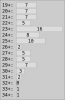
3x3: I still feel like I'm in "remedial mode" even though I've been threatening or beating every PB except my outlier Ao5. I finally managed a running Ao50 in the mid 24s with about 90 timed solves today. Nothing sub 19 in the bunch so the main improvement was consistency and a lot fewer mistake and disaster solves. I currently have a half dozen OLLs in the remedial pile, which is all I can handle for the moment. Only one of those is solid enough for use under timer duress; no matter how much I drill them before a session I still blank out on recog in real solves. The bell curves for my normal solves and mistake solves are obvious from the time distribution. More sup 25 mistake solves than I'd like but everything is moving the right direction and shoring up OLLs will eventually help that as well.

dist.png
 
Interesting that this was done on the self-magnetized Yuxin Little Magic.... GTS3LM don't allows me to achieve this (probably because of its size+ridges+color scheme combination).
1. 13.12 U' R2 B2 D' R2 U2 B2 L2 U L2 F R' B2 L' D F2 D2 B' U2 L2
 
Interesting that this was done on the self-magnetized Yuxin Little Magic.... GTS3LM don't allows me to achieve this (probably because of its size+ridges+color scheme combination).
1. 13.12 U' R2 B2 D' R2 U2 B2 L2 U L2 F R' B2 L' D F2 D2 B' U2 L2
Nice! I’m not sure a 13.xx is in my near future, but you I suppose everything could go right AND a little luck. These days I’m usually pretty happy with anything under 20 still.
 
3x3: I still feel like I'm in "remedial mode" even though I've been threatening or beating every PB except my outlier Ao5. I finally managed a running Ao50 in the mid 24s with about 90 timed solves today. Nothing sub 19 in the bunch so the main improvement was consistency and a lot fewer mistake and disaster solves. I currently have a half dozen OLLs in the remedial pile, which is all I can handle for the moment. Only one of those is solid enough for use under timer duress; no matter how much I drill them before a session I still blank out on recog in real solves. The bell curves for my normal solves and mistake solves are obvious from the time distribution. More sup 25 mistake solves than I'd like but everything is moving the right direction and shoring up OLLs will eventually help that as well.

View attachment 9803
I still have a similar experience with my times. Still WAY more mistakes and sup-25s than I’d like, but overall, I feel like I’m getting a little faster. I would like to somehow get more consistent. I feel like my times still have a large range/variance so any given solve is a crapshoot as for time. Same can be said about my 4x4 times too. Although with the parity those times can vary considerably more.
 
I’ve been sort of working on OH lately. Not a ton, but with a comp in Jan having a cutoff of 1:00, I want to be consistent enough to beat that in my first two solves. Then, I can finally get an average.

Then, I just got 34.66! That’s a huge PB BREAKING MY PREVIOUS OF 40.30 from MAY! I suppose it’s easy to get PBs when you don’t really focus on an event then decide to give it a little attention.
 
Oh, absolutely. If I want to get faster at 3bld I need not look any farther than my memo, personally. But I still like to understand the mechanics of it and all that makes sense.

The scramble I've got yesterday (sub 1 :-) was a good example. UBL buffer was solved. Not only that, all U faces are solved except UFL. So, you can simply do U - one cycle - U'. That solves the entire corner scramble for that example. When you memo, do the same as usual but shift the pair since you'll do a pair for the 2nd and 3rd (1st and 4th are setup for floating and un setup).

Max's latest WR, he floated a cycle made 8 alg (originally 9 alg).

For 3BLD, I'm far from utilizing floating but I use a lot for 4/5BLD. If you use U2 or advanced U2 for 4/5BLD, and if your buffer is Ubl, then, any sticker on U layers can be solved using floating (U/U'/U2) with pair. When I trace centers & comes to a cycle break, I simply float U face and make a new unused U layer sticker as buffer to start a new cycle.
 
I still have a similar experience with my times. Still WAY more mistakes and sup-25s than I’d like, but overall, I feel like I’m getting a little faster. I would like to somehow get more consistent. I feel like my times still have a large range/variance so any given solve is a crapshoot as for time. Same can be said about my 4x4 times too. Although with the parity those times can vary considerably more.

It's getting more difficult to target a single thing for my longer averages (keeping in mind that Ao50 is a "longer" average for me). For quite a while my OLLs were the primary culprit on my slower times as I was working on full OLL but at this point that is cut down to maybe a dozen, mostly lower frequency OLLs. So now it's probably all about a holistic approach with my solves rather than individual steps. The slower solves are a grab-bag now, from bad cross to poor lookahead, execution mistakes (botching cross or F2L pairs), and even dexterity issues/fighting with the puzzle.

If I were to pick a single focus item now it would probably be cases with F2L pieces in the wrong slot where I'm still not very quick or efficient. After that would be cross drills, especially studying how to manage xcross. I'm awful at preserving pairs and usually just ignore them when I get them because historically I spend more time trying to preserve them than just breaking them up and solving as normal. That's something that could conceivably move my "potential wall", which is currently sitting around 19, was 20 -21 before.


Mike wrote this a while ago and I also agree : around 20s average, the major road block seems to be efficiency in F2L. I practiced quite a bit & was able to get down sub 20s very frequently (not global though) but look ahead and OLL can help so much if your efficiency is not good enough. I was so eager to finish all F2L back then - didn't bother to learn good and efficient way of handling F2L. Not even good understanding of each case other than "obvious" and intuitive method.

Once I settle down BLDs (not sure when it will be), I wanna go back to F2L and more basic of 333 to practice more efficient way --> basically reducing turn count.

I'm bad at anything resembling a "drill"... cross drills and blind pair solving would be very beneficial but I find it difficult to do them. But I've been very good about continually refining my F2L cases all along, from :50 averages 'til now, that has been one of my good habits and I consider it a zero end game. I think F2L refinements are actually carrying me at the moment. My LL is probably still a little sluggish compared to when I was last at peak, leading me to feel like I'm still rusty, but the F2L refinements I was last working on continued to solidify even without a lot of solve spamming. I'm comfy with right, left, or back slots and EO twiddling for just about every case (which leads to difficulty retaining lower frequency dot OLLs because I rarely see them normally). There is still refinement to do on cases where a piece is in the wrong slot, that's definitely a common enough culprit for a slower solve. JPerm has a brilliant PDF out there on all F2L cases, not just last slot, it's even better than sliced bread if you're looking to optimize some awkward cases.

Lookahead though, that's still my bane. As I've described before when it's going well I "just see things", no hunting, no thinking, what I need is simply revealed exactly when I need it. If I can force myself to do drills, blind pairs is probably the best prescription there.

PDF link in the description:
 
And just because I've never seen this one and its mirror in any lists I thought I'd throw this one out there. Very specific situation but it is serving me well after taking some time to get into muscle memory, totally comfortable with it in solves under duress. Only 7 moves, flows reasonably well if not entirely regripless, solves back slots while flipping EO without any B moves or rotations by turning the sledgehammer on its side. Not great for F2L lookahead but the majority of the time I have need of it is on the last slot.

https://alg.cubing.net/?setup=z2&alg=l_U-_R-_U_l-_U-_R&type=alg
I definitely need to keep working on F2L and look ahead. That’s the key to my better times. When look ahead goes well and I can see things as they develop, I get “good” (for me) times. Otherwise, I’m mid-to-high 20s.
 
I definitely need to keep working on F2L and look ahead. That’s the key to my better times. When look ahead goes well and I can see things as they develop, I get “good” (for me) times. Otherwise, I’m mid-to-high 20s.

Ditto, though I'm apparently right at the brink of another breakthrough. Merry Christmas to me as I knocked over a half second off my Ao12 and got it under :22.
 
Back
Top