• Welcome to SpeedSolving.com — the world’s largest puzzle community!

    You’re currently browsing as a guest, which means you have limited access to discussions, resources, member profiles, and community features.

    Join 50,000+ cubers and puzzle enthusiasts from around the world to ask questions, share solves, improve faster, and be part of the community.

    Registration is free, fast, and easy — create your account today.

    Already a member? Log in here to hide this message and start participating.

Older cubers discussions

I'm all behind @newtonbase's post except I still keep track of solved pieces with my fingers, I rarely/never do the math. I'm doubtful anyone even remotely approaching "fast" traces with fingers but it's not the thing holding me back yet and it's been working (until a better intuitive "feel" for when I'm done comes around). For edges I don't track the M slice targets with fingers since you'll run out but it's only 3 to remember (I also free up fingers when I know an entire face is done).

It may be bad long-term advice but different things work for different people. If you can keep up with a running sum that's bound to be better.
 
The "running sum" is better thought of as a "decreasing sum." It's what many of us do when playing bridge, to remember how many cards in a suit (trump, or any suit) the opponents have left. Start with 13, subtract yours and dummy's trumps, for example 8. Mentally say "5 left". Start drawing trumps, both follow = "3 left", then only one follows = "2 left." Don't forget to subtract also for a ruff by an opponent. When the decreasing sum gets to zero you are done. Counting down is easier than counting up. Eventually, that becomes automatic. With the cube, you also have to add 1 for a new cycle.

As to which are still left, that's a different problem, with different approaches!

Thanks again @newtonbase.
 
Last edited:
Images/Audio web-app update: I've massaged my local data to make images individual rows in their own table instead of a single string per letter pair. Now that they're individual entities it'll be easy to manage add/edit/delete per letter pair. Most of the sawing and hammering is centered around prepping this as a single page app without the need for a server. For testing I'm planning to distribute a static HTML file you can just open in a browser and it'll load all the css/js resources it needs.

Flashcards now with individual images:

flashcards-v2.png
 
Yes, whenever you have odd number of targets, you have to do parity.
FYI,
1) if you have odd number of corners, you should have odd number of edge targets. (Exception - some people do swap of two edges to make them even but don't worry about it for now)
2) Number of targets:
- Corner : 7 - solved or twisted pieces + number of cycle break
- Edge: 11 - solved or flipped pieces + number of cycle break

Since you had 9 corner targets, that means you had 2 cycle breaks. But you said only one cycle break - I guess you used OP for corner twist.
So, my guess, you had one corner twist, one cycle break = 7 - 1 (twist) + 1 (cycle break) = 7 targets. (taking out two from the twisted targets).

@newtonbase / I don't count it any more but actually, and also in general (can't define the scope of general, though), we (or I) consider flip/twist same as solved when it comes to counting target numbers - at some point, number itself doesn't matter - more to check whether the tracing has been completed or not. At the end of each memo, when there are flips or twists, just add corresponding letter pairs or just visualize them (especially for 3BLD).
What about other folks?
 
The "running sum" is better thought of as a "decreasing sum."
I can only speak for myself, but for me it's not really counting at all, at least not with arithmetic.

I do edges as audio with 4 letter words. A single 11 edge cycle would be two 4-letter words and a 3-letter word, so that's my default "target". Each time I hit a cycle break my target gets longer - so after the first break I'm expecting there will be three 4-letter words, etc. If I am expecting three four letter words and I hit the buffer piece when the last word has only two letters, I know I'm looking for two spare edges. If I then see one solved, I know I'm looking for another one solved or flipped, etc. I'm never really thinking 12 or 13; only where I am relative to my initial target of 4/4/3.

Again, there's an interesting analogy with bridge. 13 cards in a suit, draw three rounds, if everyone follows, there's one left. But if it goes 4-4-3, there's two left. Counting by fours.
 
Last edited:
I can only speak for myself, but for me it's not really counting at all, at least not with arithmetic.

I do edges as audio with 4 letter words. A single 11 edge cycle would be two 4-letter words and a 3-letter word, so that's my default "target". Each time I hit a cycle break my target gets longer - so after the first break I'm expecting there will be three 4-letter words, etc. If I am expecting three four letter words and I hit the buffer piece when the last word has only two letters, I know I'm looking for two spare edges. If I then see one solved, I know I'm looking for another one solved or flipped, etc. I'm never really thinking 12 or 13; only where I am relative to my initial target of 4/4/3.

I do exactly the same: my audio has 4-4-4 rhythm. When I miss 1 or 2, looking for solved/flipped pieces to confirm.
 
Just checking in to see what's been going on lately. Lot's of blind talk as usual! :)

Ever since I figured out the Square-1 around a month ago, I've been doing intermittent practice to get faster.

Current PBs are a 32.00 single, 40.46 Ao5 and 47.99 Ao12 so I still have some way to go before I can make the UK cutoff of 45s. I'm finding it quite enjoyable so I'll keep practising and see where I hit a wall.

I also decided to write up my original Square-1 method and the various algs that I discovered. Possibly of interest to anyone on this thread who is into Square-1? It's basically the Vandenburgh method with alternative algs and intuitive parity. I use better algs now but it's nice that I'm essentially using same method just with better algs!

https://github.com/Logiqx/twisty-docs/blob/master/square-1/noob.md
 
@newtonbase / I don't count it any more but actually, and also in general (can't define the scope of general, though), we (or I) consider flip/twist same as solved when it comes to counting target numbers - at some point, number itself doesn't matter - more to check whether the tracing has been completed or not. At the end of each memo, when there are flips or twists, just add corresponding letter pairs or just visualize them (especially for 3BLD).
What about other folks?
I don't do the maths either any more. It's more like "That seems a bit short"
On a 3BLD solve today I got 7 corners so did the edge swap to avoid parity but got an odd number. Realised I'd missed the last corner letter so added that, kept the edge memo and ended up doing parity and edge swap on a non parity solve It was a slow success but I was quite pleased with myself.
 
I don't do the maths either any more. It's more like "That seems a bit short"
I do the same; twice in the weekly competition this week that led to a DNF for me. :-( So, especially for big cubes BLD, it is probably worth it to keep doing the calculations, unless you're one of the top folks going for WR. A few extra seconds to prevent a DNF is likely worth it.
 
I do the same; twice in the weekly competition this week that led to a DNF for me. :-( So, especially for big cubes BLD, it is probably worth it to keep doing the calculations, unless you're one of the top folks going for WR. A few extra seconds to prevent a DNF is likely worth it.
I do use the maths on 4BLD wings as it's too easy to miss a small cycle. Fingers do the job on centres.
 
Last edited by a moderator:
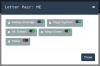
I've made some adjustments to the letter pair images app from testing on my phone. I want to make sure it's usable on mobile first, desktop is a lot easier to pretty up as long as everything fits on a phone. I have UI elements in place to delete individual images and set them private/public (would allow you to skip certain records from exporting/sharing). They're not wired-up yet or aligned nicely, but they're in place.

Still a lot of bullet points before feature-complete but there is solid progress. Current image search list in a modal:

image-results-modal.png
 
I've made some adjustments to the letter pair images app from testing on my phone. I want to make sure it's usable on mobile first, desktop is a lot easier to pretty up as long as everything fits on a phone. I have UI elements in place to delete individual images and set them private/public (would allow you to skip certain records from exporting/sharing). They're not wired-up yet or aligned nicely, but they're in place.

Still a lot of bullet points before feature-complete but there is solid progress. Current image search list in a modal:

View attachment 9349
I'm looking forward to this. Glad it will be mobile compatible
 
I'm looking forward to this. Glad it will be mobile compatible

Yeah, it's 2018 and this is a perfect fit for a phone app: it has to work well in a phone footprint. It's browser based so it should run anywhere you can run a compliant browser. I'll eventually set it up so you can create a home screen shortcut, making it behave more like an app without needing different versions per platform.

I'm in a rare window of opportunity where I can sink my teeth into this in lieu of work under the legit premise that it's going to bolster some areas that will help me a lot for the day job in the coming months. A labor of love is the best learning project. There's some family health stuff going on, adding a little chaos to the mix, but otherwise I've finally had the time to sit and hammer on this idea.

The main thing I want to be careful of is making sure it's flexible enough to be extensible in the future. This is a very niche app but there's also nothing at all like it out there or I'd be using it instead of writing it. It's already a spreadsheet-killer for me in its current state so it has the potential to be a must-have, albeit for a really small audience. I'm already very reliant on the data I have in this thing, once I release it into the wild then others may also. I want to make sure I think it through so we don't end up painted into a corner when it's time to add features.
 
I've made some adjustments to the letter pair images app from testing on my phone. I want to make sure it's usable on mobile first, desktop is a lot easier to pretty up as long as everything fits on a phone. I have UI elements in place to delete individual images and set them private/public (would allow you to skip certain records from exporting/sharing). They're not wired-up yet or aligned nicely, but they're in place.

Still a lot of bullet points before feature-complete but there is solid progress. Current image search list in a modal:

View attachment 9349
Yeah, it's 2018 and this is a perfect fit for a phone app: it has to work well in a phone footprint. It's browser based so it should run anywhere you can run a compliant browser. I'll eventually set it up so you can create a home screen shortcut, making it behave more like an app without needing different versions per platform.

I'm in a rare window of opportunity where I can sink my teeth into this in lieu of work under the legit premise that it's going to bolster some areas that will help me a lot for the day job in the coming months. A labor of love is the best learning project. There's some family health stuff going on, adding a little chaos to the mix, but otherwise I've finally had the time to sit and hammer on this idea.

The main thing I want to be careful of is making sure it's flexible enough to be extensible in the future. This is a very niche app but there's also nothing at all like it out there or I'd be using it instead of writing it. It's already a spreadsheet-killer for me in its current state so it has the potential to be a must-have, albeit for a really small audience. I'm already very reliant on the data I have in this thing, once I release it into the wild then others may also. I want to make sure I think it through so we don't end up painted into a corner when it's time to add features.

It will run in Android, I hope? I would want it mainly for my ipad.
 
Patience pays off - after 36 DNFs I got PB in 5bld 10:31.98 [5:50]. PB by 3 seconds.

've noticed that progres in blind events is not even. One day your solves go fine but the second day all goes bad. And sometimes best solves came out of nowhere - my previous PB was 3 months ago and it was such solve. I was averaging 15 minuts but the solve was ideal and exceed my skills by a lot. Today my average is around 11-12 minutes and the solve was closer to my skill and it wasnt ideal - it had too many reviews and should be shorter by a minute or so.
 
Back
Top