• Welcome to SpeedSolving.com — the world’s largest puzzle community!

    You’re currently browsing as a guest, which means you have limited access to discussions, resources, member profiles, and community features.

    Join 50,000+ cubers and puzzle enthusiasts from around the world to ask questions, share solves, improve faster, and be part of the community.

    Registration is free, fast, and easy — create your account today.

    Already a member? Log in here to hide this message and start participating.

Older cubers discussions

I would note that if you're using M2 it's more confusing to execute one target than two, so for sighted solves always do an even number of edge targets at a time.

Ditto, plus I'll add if you're not learning M2 from the start (I haven't watched JPerms vids) then you probably should. It's not enough harder to bother learning OP edges first and the move savings vs. OP edges is significant.
 
M2 doesn't ring a bell. I'm guessing J-Perm was using a "beginners" type method, perhaps that is the OP method? I'll have to look up the M2 thing and also look for what Speffz scheme.

Bottom line: I'm interested now...
 
M2 doesn't ring a bell. I'm guessing J-Perm was using a "beginners" type method, perhaps that is the OP method? I'll have to look up the M2 thing and also look for what Speffz scheme.

Bottom line: I'm interested now...
M2 is slightly harder to learn than OP for edges but you will end up using it if you carry on so it's worth a look.
Speffz is the most common letter scheme and is as easy to learn as any other so it's an obvious choice.
You'll also need to choose your orientation. I'd recommend official WCA with white top and green front. It's easier to follow other people's solves that way.
 
The lettering scheme doesn’t matter between M2 and OP, right? Just the edge buffer moves (from top-right-Center to back-bottom-Center), right?

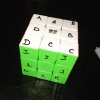
I’m going to label a cube as previously recommended just to help learn the scheme. That’s today’s project.... shouldn’t take too long.
 
The lettering scheme doesn’t matter between M2 and OP, right? Just the edge buffer moves (from top-right-Center to back-bottom-Center), right?

I’m going to label a cube as previously recommended just to help learn the scheme. That’s today’s project.... shouldn’t take too long.
The letters are exactly the same for all methods. The M2 buffer is DF (bottom-front-center).
 
DF means “Down Front” , right? Not the letter-scheme location.... just want to be sure so I don’t learn everything wrong. Lol

First step...
 

Attachments

  • 18EE0FD7-5823-474F-9086-644A60221DD0.jpeg
    18EE0FD7-5823-474F-9086-644A60221DD0.jpeg
    986.4 KB · Views: 13
I know that notation well...

Do you have to do the edges before the corners? Or can you them in either order?

I suspect edges first is necessary to apply the parity alg if odd number of targets. However, if even number of targets, probably doesn’t matter?
 
I know that notation well...

Do you have to do the edges before the corners? Or can you them in either order?

I suspect edges first is necessary to apply the parity alg if odd number of targets. However, if even number of targets, probably doesn’t matter?

This is one of the hottest topic in BLD - edge first vs corner first.
Many BLDers do memo corner - edge, then execute edge - corner. Images for corners, audio for edges (memory method). When you trace / memo, better memo'ing corner first since you can tell whether it will be odd or even numbers. (My) Logic is that tracing corner is easier, faster and requires less number of targets (between 6 ~ 8, mostly) so you're likely to get it right and fast.

For parity, I usually do at the end of the whole solve - just not to mess up the parity execution.
 
@Shaky Hands I saw that Guildford is in March this year which seems quite early. How many PBs are you going to get there this year? I am in the process of learning 4x4 went from 6 minutes to 2.30 average and remembered you did a 1.56 minutes single on the 5x5 so am some way off. I can't comprehend how it's even possible. Do you use Yau? My next step is to learn Yau for the 4x4 but I hear it is best to average 2 minutes on the reduction method first.
 
For parity, I usually do at the end of the whole solve - just not to mess up the parity execution.

You can do edges, then corners and finish with parity?

I thought you had to do edges, parity, corners...

I thought the parity replaced the corners to how you had them during inspection and so had to do it PRIO
@SpartanSailor, think I am going to join you in learning to blind slove as it combines two things I love: speedsolving and memory techniques. I have reached my target of going sub 20 average on the 3x3 (though I have not done it in in comp) as yet. Gonna go check out Jperm's video. Let me know how you get on.

Spent some time trying to just get edge targets while using the blind methods, but with looking. 1 target at a time. Just trying to get smooth the setups and undo setups. That’s not very intuitive yet. But I’m thinking about the target so I can associate the moves with a particular target.

I don’t want to make everything an alg, but it seems like I could use the same set up sequence anytime I go to a particular target... but, today was the first day and I made more mistakes than anything—ha!
 
Nice to see @Selkie on cubeskills.com. Great average on your critiqued solves! Is your main a GTS 2M cubible with stronger magnets? I really like that cube but it keeps getting too slow/gummy. Santa was generous cubes-wise this Christmas though I have not found a better one. I have been disappointed by the valk power M, the turning, the very bright -cyclone boys-like colours on the stickerless version... I like the feel and speed of the Gan RSC (I know!) but it needs magnets! The Gan SM is a great cube too, bar the poor quality stickers and some lock ups. I still feel the GTS 2M is more forgiving with my horrible turning style. How long did it take you to go from sub 20 to sub 15?

Anyway, I am rambling on

Happy New Year to you all :)

Hoping to see some of you old cubers at the next UK comp in 2018.

PS: thanks @Logiqx for updating the list of the over 40. It's such a cool place to check and it gives us something to strive for (dreaming of overtaking Lars Petrus next)
 
Spent some time trying to just get edge targets while using the blind methods, but with looking. 1 target at a time. Just trying to get smooth the setups and undo setups. That’s not very intuitive yet. But I’m thinking about the target so I can associate the moves with a particular target.

I don’t want to make everything an alg, but it seems like I could use the same set up sequence anytime I go to a particular target... but, today was the first day and I made more mistakes than anything—ha!

Sounds very methodical. Might try that first. You probably made mistakes due to the festive season fatigue. Today I spent hours solving for "fun" and I hardly got any sub 20. Should know when to call it a day really - it's an addiction. BTW which method did you go for in the end? found this interesting article for beginners like me. http://teachkidsengineering.com/solve-rubiks-cube-blindfolded/. They use M2 for edges OP for corners and speffz for letter changes. Still all greek to me...
 
Sounds very methodical. Might try that first. You probably made mistakes due to the festive season fatigue. Today I spent hours solving for "fun" and I hardly got any sub 20. Should know when to call it a day really - it's an addiction. BTW which method did you go for in the end? found this interesting article for beginners like me. http://teachkidsengineering.com/solve-rubiks-cube-blindfolded/. They use M2 for edges OP for corners and speffz for letter changes. Still all greek to me...

The lettering is the same, so, for now I’m going with OP edges as well. Just to learn the target locations... using T-perm (my favourite PLL, btw) means I don’t have to thing about that alg while trying to learn the target locations.

I realise that’s not efficient since I’ll have to learn M2 anyway, but that has 4 special cases.... given my time constraints, I choose to be “methodical”, as you say. I’m not trying to get to super fast and efficient blind solving (not now anyway). I’d prefer rock solid understanding first. So...

Long answer to say, “OP edges and corners”
 
Back
Top