Hello Kelvin,
thanks a lot for your fast answer and of course it shall be correct what you wrote about the parity. I was thinking that it might be possible to design a perfect asymmetric QUBAMI. But for sure I did not try all 1728 options. ;-)
Back to my conclusions for the solve. As I wrote in the first post, my starting point was to make the two possible, different 3D SUDOKU cubes out of 2 stickerless 3x3x3 cubes. After trying to solve the first, I noticed that there seem to be a lot of curiosities or parity issues. Then I thought it might be better to solve the 3D SUDOKU first on paper and apply it pater to the cube.
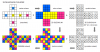
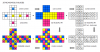
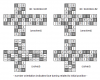
So I made six 3x3 squares with numbers from 1 to 3 for each side. 3 x 2 identical for each center and arranged them on the table like a typical 6 sided cube sticker pattern (lying cross). I chose numbers, because the orientation of each number would indicate what turning angles already have been applied. (0° - number top up, 90° - numbers top left, 180° numbers top down, 270° - numbers top right). Please see attached picture.
Now, sure that this will bring me to the solution I thought about all the possible 90° turns and concluded by myself, that just turning for ?? times 6 squared papers won´t be very smart. Thus, to reduce the amount of possible positions for these squares, I started thinking about this 3D SUDOKU and made some assumptions (I will refer to the same numbers posted before).
1. No same color diagonals ending in the same corner:
All characteristics of the QUBAMI corner pieces are even,
- eight (8) corner pieces
- two (2) 3-color corners
- six (6) double color corners (a pair (2) for each color)
Based on that I assumed, that the solved 3D SUDOKU need to have somehow equivalent properties, but if you connect same color diagonals with double color corner pieces that would mean, that 3 out of 8 corner pieces connect all 6 diagonals of the cube.
That did not make sense to me. So I decided to focus on parallel diagonals of the same color.
2. No same color pair corners in one edge:
OK, if same color diagonals are not connected, some different color diagonals need to be connected. And that brought me to the assumption that there must be 2 chains of all 3 colors could be connected. And that would be symmetric (joined together like the two parts of a tennis ball).
But coming from point 1 there are always 2 parallel diagonals of the same color and two corner pieces with the same paired color appeared somehow difficult for my chains. There is only one mirrored position how to allocate these pairs in one edge. That appeared very restrictive to me. So I decided to try to avoid this. OK. Finally it was no 100% possible and I left with 2 of these pairs on each cube. One of them on starting/ending points of the chains. ***
3. 3-color corner pieces in the same edge:
If you join the two 3-diagonal chains together (tennis ball) you have always a starting and ending point of each one of these chains in an opposite cube corner. That means that always 2 starting or ending point of these chains are in one common edge.
Based on this I assumed, because I only had 2 chains, that one starting or ending point of each 3-color chain might be one of the two 3-color pieces.
And this leads to the conclusion, that these 2 pieces cannot be in opposite corners of one layer, only in the same edge or in opposite corners of the cube.
But If you have the 3-color pieces in opposite cube corners that would be the same like in the original solved 3 color scheme. That did not make sense to me.
Conclusion:
I don´t know. Maybe it was just good luck, making these assumptions and/or conclusions, but I solved both 3D SUDOKUs based on that. And both cubes show exactly the described characteristics.
I also made some assumptions about the position of the same color edges, but the only one that has been confirmed was, that all 3 of them definitely cannot be in one same layer.
Anyhow. It was a big fun to play with my “self-made” 3D SUDOKUs and QUBAMI. I will ask a friend to take some pictures of my 3 puzzles to publish them in this thread. Hope that helps.
Best regards.
*** Modified after checking the cubes again - due to my error with the parity cases in the last post.
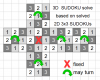
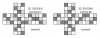
PD: for better understanding of the 3D SUDOKU solve procedure with numbers this picture might give a better explanation:


 )