Rubik's Cube to the 4th Power

TIME is NOT what the fourth dimension is. time is the movement of which an object moves through the w-axis in the fourth dimension

when we look at something we are only seeing the 3D segments of the object. when we are seeing it being stationary in the third dimension they are actually moving rapidly in the the fourth dimension.

in the third dimension we have units for length, width, and depth such as meters, foots, etc. but in the fourth dimension the unis for w-axis is seconds, minutes, hours, and so on. you could think time as the speed in third dimension, and minutes as meters. however you cannot call the w-axis as time, just like you cannot call lengths as speed.
 
Don't bring this any farther Stefan! All I wanted was pictures of a cube, and look
 
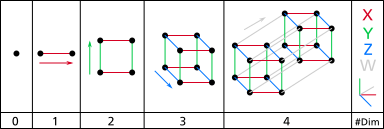
384px-Dimension_levels.svg.png


Not to continue the discussion of dimensions of course...

I really think that's the worst name for a product though...

Manufacturer: I know!!! lets name our cube the rubik's 4-d! It's such an awesome name!
Me:.......yeah.....
 
I think that's why it got brought up, because "Rubik's Cube to the 4th power" or "Rubik's Cube 4th dimension" are unforgiveably awful names for this puzzle.

Incidentally: time can be thought of as a 4th dimension, but it is NOT a spatial dimension, so thinking of it as "the 4th dimension" and imagining hypercubes and so on is wrong. (For proof that time and space are fundamentally different, think about how you can have a memory of the past, but not the future.) However! You still can measure time in meters if you use the conversion factor of c, the speed of light. You end up with very large numbers if you use macroscopic scales, but for relativistic actions it works surprisingly nicely. (For instance, the magnitude of your speed becomes a number from 0 to 1.)
 
I love how some say time is the fourth dimension and others say it isn't, and they're both wrong.
What's the fourth dimension, then? :confused:
Whatever you desire it to be. It *can* be time but it doesn't need to be, that's why it's wrong to say it is or it isn't. It simply depends on what you're doing, and what you want to express. It can be useful to use time as fourth dimension, for example if you want to arrange a meeting. You arrange where to meet (our three spatial dimensions can be used for this) and also when to meet. So for arranging meetings, using our three spatial dimensions plus time as a fourth can be good. Although I admit you'd probably use addresses and room numbers for the location rather than x/y/z coordinates unless you're some scientist or a space traveller. But I hope you still get the point.

Also, there's no intrinsic order. If I want to use time as one dimension in addition to others, I can call time the first dimension and renumber the others (if I have them numbered in the first place).

And of course there are totally different systems where you have totally different dimensions. Take our cube algs, for example. If I want to quantify them, using these five dimensions might be useful:
- Length in HTM
- Length in QTM
- Length in STM
- Length in SQTM
- Time it takes me to execute on average

So what's the fourth dimension? Depends on what you're doing. Whatever is useful for you.
 
In this case btw I don't like the Wikipedia article. It already starts wrong:

In physics and mathematics, a sequence of n numbers can be understood as a location in an n-dimensional space.
The word "space" links to the article about Euclidean space. That's just wrong. The link should explicitly say "Euclidean space" or link to the article about space:
http://en.wikipedia.org/wiki/Mathematical_space
As you can see, Wikipedia does have such an article, and Euclidean space is just one of many.

It continues:

When n = 4, the set of all such locations is called 4-dimensional Euclidean space.
Wrong. Not all 4-dimensional spaces are Euclidean.

Haven't read the whole article, but it appears to be about 4-dimensional Euclidean space. So the word "Euclidean" should go into the title as well as that first sentence.

Btw, to add to my above cube algs example: To keep track of the algs in your collection that you actively use, a sixth dimension might be useful, namely one just telling whether you actively use the alg. So just a boolean dimension with two possible values.
 
time can be thought of as a 4th dimension, but it is NOT a spatial dimension, so thinking of it as "the 4th dimension" and imagining hypercubes and so on is wrong. (For proof that time and space are fundamentally different, think about how you can have a memory of the past, but not the future.)
Hmm... at least Wikipedia's paragraph about spatial dimensions doesn't define a requirement to go forwards and backwards (or whatever you'd call it). Can you point me to a definition of "spatial dimension" that does include this requirement, so that your claimed proof applies?
 
It's not a definition, but rather what we know from experience. It is physically possible for an object to move left AND right, forward AND back, up AND down. The fact that we cannot do this with time shows that time is fundamentally different from the three spatial dimensions we are familiar with. The difference is what I am proving, not that there is a definition I have which fits the spatial dimensions and does not fit time. (I'm sure it is possible to write such a definition, but I don't have one in mind.)
 
Oh I absolutely agree that time appears fundamentally different the way you describe. Was just wondering because you explicitly said "it is NOT a spatial dimension", cause for that statement you first need to know what a spatial dimension is, and I don't and would like to. The paragraph on Wikipedia is short and not really a definition, and on MathWorld I couldn't even find it at all. I'm genuinely interested in a definition but don't know where else to look.
 
Last edited:
lol I can't believe this debate sprouted due to a cheesy name...
 
... and a Super Mod contributed to the thread going off topic (don't kill me, Stefan, I'm just saying).
 
Well I thought the original question had been sufficiently answered, otherwise I might've not gone off-topic. Although it's really not that much off topic.
 
Back
Top