

academicmaslow
Regular
I've previously posted about dual-sided mosaics made from Rubik's Cubes and my approaches to creating symmetrical MDSI (Mirror Dual-Sided Inverse) and CDSI (Corner Dual-Sided Isomorphic) mosaics.
Since then, I've developed CubeState, an algorithmic method that makes it possible to create dual-sided mosaics from two independent images placed on either opposite or adjacent faces. The method automatically adapts the images to physically achievable Rubik's Cube configurations and generates the corresponding assembly algorithms.
Here is a 3D visualization of Marty and Doc's portraits, made from a 28×28 grid of cubes:
One of the key ideas behind CubeState is the concept of partial observation. Given a set of known stickers, the algorithm can enumerate all physically reachable cube configurations consistent with that observation. If the desired pattern is unreachable, it finds a reachable configuration with the minimum number of visual changes.
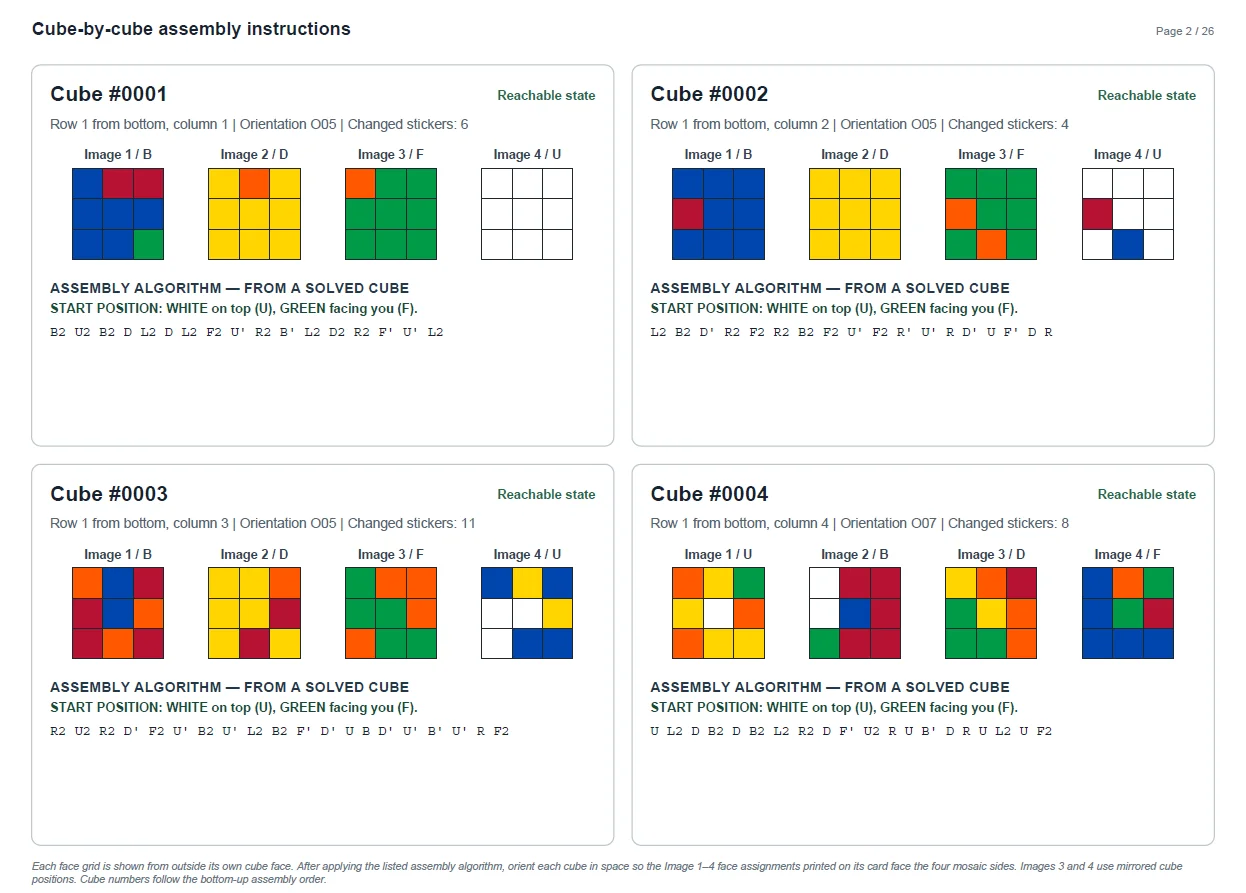
This also opened the door to four-sided (belt) mosaics. Creating such mosaics by hand is particularly challenging because four different images must coexist on the same physical cubes while satisfying all Rubik's Cube constraints. With this approach, the adaptation and algorithm generation can take just seconds or minutes, depending on the mosaic size.
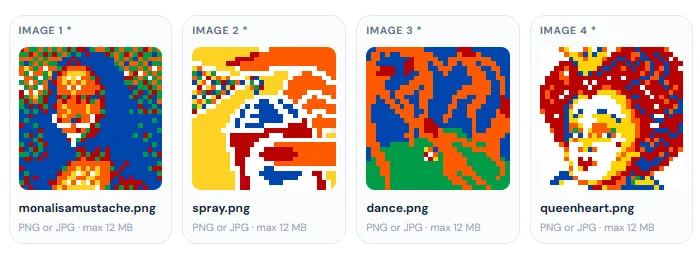
Here is an example. I took four independent one-sided mosaics, each consisting of a 10×10 grid of cubes, and adapted them into a single four-sided mosaic.
Initial images
Adopted images
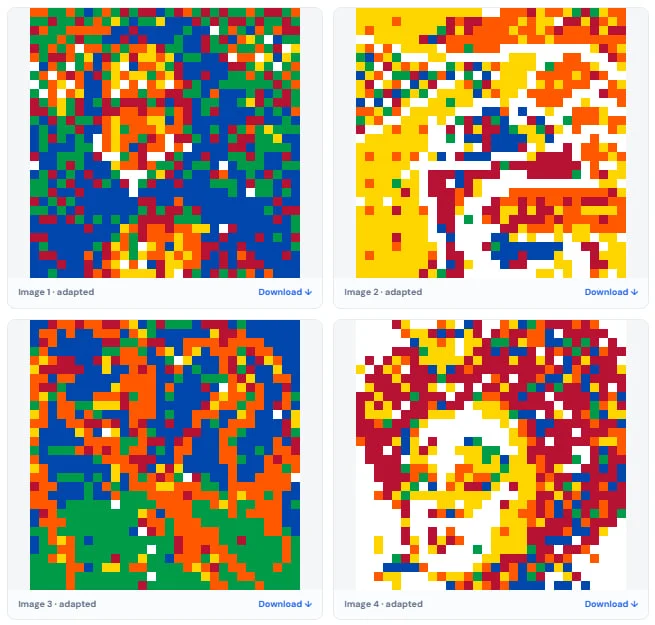
It took less than 30 seconds to adapt all four images and generate the assembly algorithms.
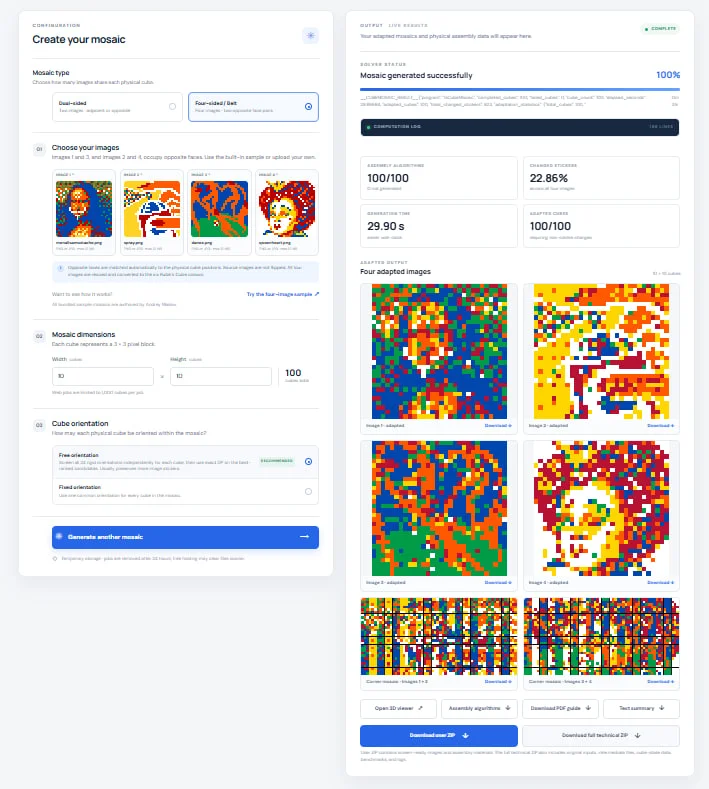
I'm still testing and improving the tool, but it looks like both dual-sided and four-sided mosaics can now be created much more easily, including configurations that would be extremely difficult to design manually.
Since then, I've developed CubeState, an algorithmic method that makes it possible to create dual-sided mosaics from two independent images placed on either opposite or adjacent faces. The method automatically adapts the images to physically achievable Rubik's Cube configurations and generates the corresponding assembly algorithms.
Here is a 3D visualization of Marty and Doc's portraits, made from a 28×28 grid of cubes:
One of the key ideas behind CubeState is the concept of partial observation. Given a set of known stickers, the algorithm can enumerate all physically reachable cube configurations consistent with that observation. If the desired pattern is unreachable, it finds a reachable configuration with the minimum number of visual changes.
This also opened the door to four-sided (belt) mosaics. Creating such mosaics by hand is particularly challenging because four different images must coexist on the same physical cubes while satisfying all Rubik's Cube constraints. With this approach, the adaptation and algorithm generation can take just seconds or minutes, depending on the mosaic size.
Here is an example. I took four independent one-sided mosaics, each consisting of a 10×10 grid of cubes, and adapted them into a single four-sided mosaic.
Initial images
Adopted images
It took less than 30 seconds to adapt all four images and generate the assembly algorithms.
I'm still testing and improving the tool, but it looks like both dual-sided and four-sided mosaics can now be created much more easily, including configurations that would be extremely difficult to design manually.
Last edited:


