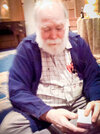
Remembering David Singmaster, the father of cubing notation, theory, and layer-by-layer

Lucas Garron

Premium Member
Joined
Jul 6, 2007
Messages
3,757
Location
California
WCA ID
2006GARR01
YouTube
Visit Channel
IMG_8383.jpg


We lost David Singmaster earlier this week. As some of you know, he was instrumental in early cubing theory, publishing "Notes On Rubik's 'Magic Cube'" and a "Cubic Circular" in the 80's:
This is where he introduced the core notation for moves and pieces that we use to this day, discussed things like commutators and the original Thistlethwaite algorithm (which provided the first serious upper bound for God's number) and developed the first answers to questions we still ponder today.

He was also quite likely the first to publish a layer-by-layer solution starting with cross, which remains the core of the first solution that the vast majority of most new speedcubers learn to this day, and that most advanced still use in an adapted form as CFOP.

I was lucky to meet him a handful of times starting in 2010, when he was already sporting a luxurious white mane. I wanted to share some of these pictures, because they show he was active and jovial into his 80's, traveling, making friends, and writing about puzzles. He kept track of the earliest speedcubing competitions, he was at the World Championship in Hungary in 1982, and even competed officially in 2012. It's easy to take our modern speedcubing community for granted, but David Singmaster effectively maintained one the first international cubing communities and it's likely that we wouldn't be quite the same without him. 💔

IMG_8556.jpg


If you'd like to learn more about him, are interviews from 2014 and interview from 2018 that might be worth a bit of of your time:


Other memorials and posts about David:
I've also posted a memorial site at: singmaster.cubing.net
 

Attachments

  • IMG_0247_181518.jpg
    IMG_0247_181518.jpg
    415.2 KB · Views: 10
  • IMG_8519.jpg
    IMG_8519.jpg
    323.8 KB · Views: 4
  • IMG_8531.jpg
    IMG_8531.jpg
    351.6 KB · Views: 4
  • IMG_8551.jpg
    IMG_8551.jpg
    482.2 KB · Views: 3
  • IMG_8552.jpg
    IMG_8552.jpg
    469.2 KB · Views: 5
Last edited:
Oh no! So sorry to hear about this, hopefully we'll remember him for a long time to come. Just wanted to say thanks a lot, David.
 
I had the privilege of visiting his home in London twenty or so years ago. I don't remember exactly how that happened - I think I first met him at a puzzle meet in London. What I do remember is his joy at showing me his puzzles, and his large collection of books on recreational mathematics. I regret that I only took one picture of the visit on my (analog) camera, namely a picture of his puzzle collection. I will always be indebted to him for inviting me to the Gathering for Gardner in 2004, which I have attended ever since.

singmaster-collection2.jpg
 
Last edited:
M,E,S,x,y,z notation should should belong to the scrapyard!!

M=MR'
E=MU'
S=MF
x=CR
y=CU
z=CF

Nothing to memorize that way!

Sorry for bumping an old thread...:cool:
 
His post is badly timed/placed I will say.

iirc, singmaster did not invent the slice notation or rotation notation we use today (MESxyz)

I agree that C and M prefixes would be pretty useful and less to memorize, but an improvement I would make is instead of a prefix, have it as a suffix like Rw, so a x rotation is a Rv (what v stands for idk, but this notion for rotations already exists especially for non nxns, and I would like to see used more often)

For a slice move, I think Rs (R slice) might be better than the MR (Middle R)you suggested imo.
 
iirc, singmaster did not invent the slice notation or rotation notation we use today (MESxyz)

I avoided pointing things out at the time and going into detail out of respect for the situation. But yeah, Singmaster's contribution is outer turn notation and the apostrophe and use of "2" for double turns. The other parts of notation come from various others.

As for Layer By Layer, the earliest known publication is by Donald Taylor. Singmaster switched to LBL from Corners First after having learned of LBL from others. It's possible that Notes on Rubik's Magic Cube helped popularize LBL, but it's difficult to properly make that connection.


Back
Top