• Welcome to SpeedSolving.com — the world’s largest puzzle community!

    You’re currently browsing as a guest, which means you have limited access to discussions, resources, member profiles, and community features.

    Join 50,000+ cubers and puzzle enthusiasts from around the world to ask questions, share solves, improve faster, and be part of the community.

    Registration is free, fast, and easy — create your account today.

    Already a member? Log in here to hide this message and start participating.

Older cubers discussions

... I would recommend to go for at least 5 so that you can get US Nats qualification. ...

I agree with shooting for more cubes. I got off to a slow start with MBLD because I rarely practised it, assuming my 3BLD improvements would just carry over. If I had practised it earlier I'd certainly have started competing at 6+ in order to use the full hour. ...

Interesting. It wouldn't have occurred to me that the next step after one was... SIX lol. I can see the logic with time management, though, since the ceiling remains at 10 mins/cube until beyond 6.

For the journey method I suppose I'd have to build up six rooms. I've only skimmed the details on the technique and watched Noah's video on it, but haven't ever tried to put it into practice (for my 2/2 I just did what I do for a single blind but twice as long).
 
Last edited:
For the journey method I suppose I'd have to build up six rooms. I've only skimmed the details on the technique and watched Noah's video on it, but haven't ever tried to put it into practice (for my 2/2 I just did what I do for a single blind but twice as long).

It's very normal - actually, once you getting faster in 3BLD, you wish you can get N x times per multiple BLD but in reality, it's much longer than Nx of your 3BLD time. More you try, you need to review more. For example, 10 cubes, 1-4 memo and review 1-4, 5-8 memo, and review 5-8, memo 9 and review 1-4 & 5-8 (or 1-8), then 9. After this, normal 3BLD for the last one (10th) - so, you'll see how many times you have to review which adds more time than normal BLD.

The advantage of MBLD is that (at least what I felt) you have less stress on time but more focus on accuracy and long term image (rooms). That helps for 3BLD as well since short term memory gets stronger and confident.

I tried MBLD couple of times per week, added cubes until I max out (by 1 hour limit) to set my time limit.

Downside of practicing MBLD, once you finish one session, you no longer have any will power or brain energy to do more BLD practice :)
 
Grzegorz (@h2f) and myself have debated before but it's around 2.2-2.5x. The amount of extra memo is really a minor consideration in learning 4BLD though and it's a way more interesting and exciting challenge than a 3 cube MBLD.

Yeah, it was the conclusion of our talk. I remember when I started 4bld it took me around 30 minuts to make 1st sighted solve. And I agree - it's more exciting challenge. In fact amount of information is around 3 cubes but you organize it in a different way than 3 cubes so it's a little bit easier. I think doing 4bld makes 3bld easier though when I'm around 1 minute now in 3bld a find both events to be different: 3bld is like a short distance run - let's say 100m. 4bld is longer - like 400 or 800 m in aethletics.
 
If you can do 10 min/cube for 2 or 3 you should have no problem using your full hour for 6 cubes. Just my 2 cents :).

There's a logic to this that I hadn't realised before. Thanks.

If I get my MBLD target at this weekend's competition, I will up my MBLD ambitions in time for the November comp.
 
Another package collected from the local post office today after a 2 month wait. Just something interesting for me to try really.

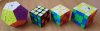
4 cubes in all. 2 x 50mm MF3rs a black and a stickerless. A 57mm Cyclone Boys FeiTeng 4x4, and the new QiYi QiHeng S Megaminx.

I have a 50mm Dayan and wanted to see how the mini MF3rs compares as some people have given it good reviews. The stickerless out of the box is amazing for the price and outperforms my setup Dayan that has a good number of solves on it. The black is not as good as the stickerless and seems to catch more. Going to play with the tensions a little. But one of the first things I'm going to do with both is put magnets in. This little mini is crying for some magnets and I think it will be even better so I'm excited to do it.

The Cyclone Boys FeiTeng is also surprising. While not on the same level as my Yuxin or WuQue, I can see it has a lot of potential and is also going to get magnets fitted soon. Out the box solves have gone quite nicely, and for the price point my initial thoughts are is that it is a great cube.

Lastly the Megaminx. I'm not very good with Megaminx with my best time around the 4:30 mark. I still use a beginners LL method which involves spamming Sune and Anti-Sune. Not very efficient. I have a YJ YuHu which just catches a lot and I find frustrating to solve on, so I don't do much Megaminx. Hoping to change that with a better one. Out of the box I can feel it's a lot better than the YuHu so I'm looking forward to spending some time with it now.

20170919_115015.jpg
 
There's a logic to this that I hadn't realised before. Thanks.

If I get my MBLD target at this weekend's competition, I will up my MBLD ambitions in time for the November comp.
Good luck mate :).

There is a caveat/assumption to my assertion though, which is that you have a system where time/cube isn't much worse than linear. For example, if after every cube you are going back and reviewing every previous cube, you're going to be doing loads of reviews and that takes time. Maybe 15+ for 6 cubes and growing rapidly as you add more cubes. If you have that problem, the best solution is to fix your system now and avoid those unnecessary reviews. Any non-linear system will just make it way harder to progress.
 
... There is a caveat/assumption to my assertion though, which is that you have a system where time/cube isn't much worse than linear. For example, if after every cube you are going back and reviewing every previous cube, you're going to be doing loads of reviews and that takes time. Maybe 15+ for 6 cubes and growing rapidly as you add more cubes. ...

This is what leads me to think I might enjoy mbld even more than 3bld. I tend to memo so carefully that it sticks which doesn't lend itself to speed but I don't have to review much or at all unless I know there's a mistake.

I see the wisdom of "memo faster, review more" that you shared in the past for 3bld and I expect that'll start happening more with practice/confidence, but to this point I still memo 3bld as if I need to retain it for 10 mins or more (because initially I did).

I'm curious to get a high-level idea of how you utilize rooms for mbld. I understand the general concept but whatever you're specifically doing is sure working for you!
 
This is what leads me to think I might enjoy mbld even more than 3bld. I tend to memo so carefully that it sticks which doesn't lend itself to speed but I don't have to review much or at all unless I know there's a mistake.

I see the wisdom of "memo faster, review more" that you shared in the past for 3bld and I expect that'll start happening more with practice/confidence, but to this point I still memo 3bld as if I need to retain it for 10 mins or more (because initially I did).


If you think about it, it's not just memo timing what you're referring to memo. Most cases, 10+ & 7+ letters, making images out of ~20 letters are not that time consuming. On top of that, if you keep practicing, you're running into similar letter pairs so often, you don't need to make up new images any more (not completely but more or less). There are "only" 400+ letter pairs, after all. So, at your stage, the most time consuming part, I guess, is actual tracing rather than memo.

And for 3BLD, the wisdom is just memo faster not so much of review. Review more part is for MBLD only. The only way to push your memo time and make it quick and faster is not reviewing what you just memorized.


I'm curious to get a high-level idea of how you utilize rooms for mbld. I understand the general concept but whatever you're specifically doing is sure working for you!

You make images based on objects in your room. For 10 cube MBLD, I use 20 different places in my home, assigning each room/place to one edge or corner of each cube. And I make my rule to go around those places in a sequence I always follow. Start from my study shelf, desk, closet, walk to living room shelf, window seat, and so on. This sequence is always the same.

And, for example, my first letter sequence is like: TR - SC - MY - PB - EL.
And I'm trying to link this cube (edge pieces) to my study shelf. There is a TRophy from last Summer Comp where I've got MY PB of ELeven two.(I've never been a podium - so obviously, this is a make-up :-) ). You build images of several cubes like this, and each cube (edges and corners) to a different rooms and objects.

When you finish your first cube, then move to the next room/place, and use the image you built up from there to recall what letter sequence was.

Not sure whether it makes sense to you, but this is at least how I do multi.
 
I see the wisdom of "memo faster, review more" that you shared in the past for 3bld ...

I'm curious to get a high-level idea of how you utilize rooms for mbld. I understand the general concept but whatever you're specifically doing is sure working for you!
Memo faster, review more is certainly advice for MBLD not 3BLD. For 3BLD it's bad to review at all.

I don't think I do anything special with rooms. As Jae described, I just have fixed locations in my house and I work through them putting a scene in each. Definitely it's important to have instant images for each pair so you don't waste time thinking them up, or have to settle for poor images. So an image list is a good idea. Then it's important to anticipate mistakes and address that in your scene, for example, to avoid errors like recalling pairs in the wrong order. A good system for flips and twists is important too.
 
And for 3BLD, the wisdom is just memo faster not so much of review. Review more part is for MBLD only. The only way to push your memo time and make it quick and faster is not reviewing what you just memorized.

Memo faster, review more is certainly advice for MBLD not 3BLD.

I wasn't quite clear that this was in the context of pushing my current memo for speed:

Remember that repetition is the most powerful way to get memo to stick, much more so than going slowly. Try this: scan your edges or corners, whichever you do first, to the point where you have pictured an image scene, but do not dwell on it trying to "force" it into memory. Just move on, even if you know you will immediately forget it. That's OK. Now memo the other piece type the same way. Then come back to the first set. Try to remember it, but if you can't, don't waste time racking your brains, just immediately memo it again - which is helpful anyway because you can check you scanned the cube right. Then move on again. Repeat until the memo has stuck, but it's important to alternate between piece types. Usually it'll stick by the third iteration and you'll be surprised how strong it is. You'll probably still remember it the next day :).

TL;DR: three quick, cursory memo iterations are more effective than one slow, careful memo.

Keeping in mind that I don't normally return to edges after memoing them (I currently start with edges) unless I run into an odd/even mismatch or some other indication that something is afoul.
 
Last edited:
I wasn't quite clear that this was in the context of pushing my current memo for speed:
Got you. My recent comment should have had "in the long run" added :). Obviously there's no time for reviews in a 10 second memo, but if you're at the stage where you're struggling to get memo to stick at all, using more reviews will help.
 
Today there was an unofficial comp in my city, I finished second. I got a 20.21 in the first round and a bit less than 24 seconds in the final round (first solve was a DNF due to me not used to using a timer, then a 31 seconds solve followed by a 21, 18 and 18).

This was my fastest solve (16.90):
Nice job congrats! It seems so strange to have an unofficial comp on the street. :) How do you hear about them?
 
I received some new stuff :)
IMG_1657.JPG
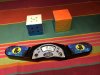
The new YueXiao Pro, the redi cube, and finally I got myself a timer.

The YueXiao seems pretty nice, but does not quite feel like the old YueXiao. These days, I almost use exclusively my GTS2M, and I think I am relying a lot on the magnets. But no fear! I also bought a bunch of magnets :). I will magnetize the YueXiao and my 57mm 4x4.

Using the timer is cool, next step is to connect it to my computer, and, as a week-end project with the kids, to build a timer display with an Arduino.
 
There are "only" 400+ letter pairs, after all. So, at your stage, the most time consuming part, I guess, is actual tracing rather than memo.

576 letter pairs (including double letters) but who's counting? Oh wait, that'd be me :D. I have a spreadsheet where I'm collecting my letter pair images and it's definitely more than half filled-out, maybe even as much as two thirds. I actually started learning 3bld back in Jan but I've had a handful of breaks in practice so it has been two steps forward, one step back. As a result, my collected image list is much farther along than I am.

Tracing used to be the biggest bottleneck but that continues to improve in proportion with practice. Where my weird brain gets stumped is assigning good images to my pairs quickly. I think it's related to a family of things I'm not particularly good at like Boggle, crossword puzzles, hangman, Scrabble, Wheel of Fortune, etc. If I were able to rely on my sheet and didn't hit any empty cells I'd wager I'm twice as fast... it's that bad.

Thus the methodical attention to my list. I try to remember pairs that gave me trouble so I can look them up later and if I don't have anything at least mark them, if not fill them in right away. I'm not just collecting one or two images when I fill in a pair either, I put down as many memorable people and objects as possible and maybe an action/description or two if I'm lucky, for flexibility. Still just a matter of practice to slowly transfer those to the grey matter but it's my primary speed focus because it is certainly not progressing as quickly as tracing faster is.
 
576 letter pairs (including double letters) but who's counting? Oh wait, that'd be me :D.

Haha, I believe it is 440. 11 edge pieces (flip) * 10 edge pieces (flip) = 4*11*10=440 (You don't memo buffer piece, so take that out). Corner will be 378 but since less than edges, maximum 440.
 
Back
Top