
Navigation
Install the app
How to install the app on iOS
Follow along with the video below to see how to install our site as a web app on your home screen.
Note: This feature may not be available in some browsers.
More options
Style variation
You are using an out of date browser. It may not display this or other websites correctly.
You should upgrade or use an alternative browser.
You should upgrade or use an alternative browser.
Known Distance-25 in the Quarter-Turn Metric
- Thread starter swipymam
- Start date

Perhaps. I was checking against your findings (https://www.cube20.org/distance20s/): “There are essentially only two known distance-25 positions, both immediate neighbors of the above distance-25 positions; scrambles for them are:These are the two already-known distance-25 positions.
U1U1F1U1U1R3L1F1F1U1F3B3R1L1U1U1R1U1D3R1L3D1R3L3D3 Scramble: ccciiiihhhhqqqqttt (vibcatch24.github.io/R-CS/)
U1F1U1U1R3L1F1F1U1F3B3R1L1U1U1L1U1D3R3L1D1R3L3U1U1” Scramble: bdbuvuvtetemnmnhhh
The two positions I mentioned were not there.
Scramble: cccffffhhhhrrrrttt R L' U B D R' F B U R' B' R' U D2 R L B2 U2 D2 R L
Scramble: uvudbdbnmnmtetehhh R2 L2 F2 D' F B' U D' F' U' D' L' B2 U D' R2 F' R' L' D'
It is difficult for me to verify with my imperfect solver at the moment whether these additional scrambles require fewer than 25 qtm, or if they are simply absent from the source mentioned above. Am I possibly overlooking something? If so, what is it?
I see some symmetries in these positions. Perhaps you excluded them intentionally?
Last edited:
The two positions you give are just rotated versions of the ones in the files. For brevity the files only include one symmetry representative. But the positions you list above are indeed distance 25, just not new.
To see this without any code, just put your scrambles into any visualization program, and observe that the positions are exactly one quarter-turn away from the known distance-26 position.
To see this without any code, just put your scrambles into any visualization program, and observe that the positions are exactly one quarter-turn away from the known distance-26 position.
Following your advice, I have visualized all of these positions, without a doubt that they have long been known to you.To see this without any code, just put your scrambles into any visualization program, and observe that the positions are exactly one quarter-turn away from the known distance-26 position.
Could you please explain something? I see that the top two positions are one move (D, D') away from the single 26q* position located in the center. But for the bottom two positions, I don't see this move. Could you elaborate on this, as it seems to be related to symmetries?
Perhaps the explanation for this is the existence of another 26q* position:
Scramble: bdbdbdbtetetetehhh R2 L2 F2 D' F B' U D' F' U' D' L' B2 U D' R2 F' R' L' U' D' (18t, 26q*, 21f) ↩
Last edited:
Yes, the cubes (ccccccchhhhhhhhttt) & (bdbdbdbtetetetehhh) are equivalent. The imperfect solver was overlooking an additional R<->L swap, which is why some of the solutions converged while others did not. Thank you very much for your time and attention.So, clearly, they are equivalent.
Let's summarize the search for 25q positions. Out of all ≈ 4.3*10^19 possible positions of the 3x3x3 Rubik's Cube, there are only 3 equivalent positions that require 26q* moves to solve (in the QTM metric):
I. Scramble: ccccccchhhhhhhhttt F U2 R' L F2 U F' B' R L U2 R U D' R L' D R' L' U2 D2 (26q*)
II. Scramble: bdbdbdbtetetetehhh R F2 U' D R2 F R' L' U D F2 U F B' U D' B U' D' F2 B2 (26q*)
III. Scramble: dbdbdbdeteteteteee U L2 F B' U2 L U' D' F B L2 B R' L F' B R F' B' R2 L2 (26q*)
Despite being equivalent to each other, they are still distinct positions (which is clearly visible from their Catch-24 position codes).
In turn, each of these 3 positions leads to 12 more positions at a distance of 25q (there are 36 different 25q signatures in total).
The move for changing the above-mentioned positions is shown after the < symbol
I.
Scramble: iiiccccqqqqhhhhttt F U2 R' L F2 U F' B' R L U2 R U D' R L' D R' L' U' D2 ( 25q) < U
Scramble: fffccccrrrrhhhhttt F U2 R' L F2 U F' B' R L U2 R U D' R L' D R' L' U D2 ( 25q) < U’
Scramble: ccciiiihhhhqqqqttt F U2 R' L F2 U F' B' R L U2 R U D' R L' D R' L' U2 D’ ( 25q) < D
Scramble: cccffffhhhhrrrrttt F U2 R' L F2 U F' B' R L U2 R U D' R L' D R' L' U2 D ( 25q) < D’
Scramble: ccxtccxohhhohhhptt U2 D2 F2 L' U D' R' L D' F' B' R' F2 U' D R2 F' U' D' L' ( 25q) < R
Scramble: ccwsccwphhhphhhott R U D F R2 U D' F2 R F B D R L' U' D L F2 D2 U2 ( 25q) < R’
Scramble: xtccxtchhohhhohtpp U2 D2 F2 L' U D' R' L D' F' B' R' F2 U' D R2 F' U' D' R' ( 25q) < L
Scramble: wsccwschhphhhphtoo L U D F R2 U D' F2 R F B D R L' U' D L F2 D2 U2 ( 25q) < L’
Scramble: tccccxthohhhohhnnt R2 L2 U2 F' U D' F' B U' F' B' L' D2 F' B R2 U' R' L' B' ( 25q) < F
Scramble: sccccwshphhhphhmmt F R L U R2 F B' D2 L F B U F B' U' D F U2 L2 R2 ( 25q) < F’
Scramble: cxtxtcchhhohhhottn R2 L2 U2 F' U D' F' B U' F' B' L' D2 F' B R2 U' R' L' F' ( 25q) < B
Scramble: cwswscchhhphhhpttm B R L U R2 F B' D2 L F B U F B' U' D F U2 R2 L2 ( 25q) < B’
II.
Scramble: uvudbdbnmnmtetehhh R2 L2 F2 D' F B' U D' F' U' D' L' B2 U D' R2 F' R' L' D' ( 25q) < U
Scramble: vuvdbdbmnmntetehhh U R L F R2 U' D B2 L U D F U' D F' B D F2 L2 R2 ( 25q) < U’
Scramble: bdbvuvutetenmnmhhh R2 L2 F2 D' F B' U D' F' U' D' L' B2 U D' R2 F' R' L' U' ( 25q) < D
Scramble: bdbuvuvtetemnmnhhh D R L F R2 U' D B2 L U D F U' D F' B D F2 R2 L2 ( 25q < D’
Scramble: bdwsbdwpetepeteohh U2 D2 F2 R' F B' R' L F' R' L' D' B2 R' L U2 F' U' D' L' ( 25q) < R
Scramble: bdxtbdxoeteoetephh R U D F U2 R L' B2 D R L F R L' F' B R F2 D2 U2 ( 25q) < R’
Scramble: wsbdwsbtepetepehoo U2 D2 F2 R' F B' R' L F' R' L' D' B2 R' L U2 F' U' D' R' ( 25q) < L
Scramble: xtbdxtbteoeteoehpp L U D F U2 R L' B2 D R L F R L' F' B R F2 D2 U2 ( 25q) < L’
Scramble: hdbdbjhtktetkteqqh U F2 R L' U2 F U' D' R L F2 L F B' R' L B R' L' F' B2 ( 25q) < F
Scramble: edbdbgetltetlterrh U F2 R L' U2 F U' D' R L F2 L F B' R' L B R' L' F B2 ( 25q) < F’
Scramble: bjhjhdbtetktetkhhq U F2 R L' U2 F U' D' R L F2 L F B' R' L B R' L' F2 B’ ( 25q) < B
Scramble: bgegedbtetltetlhhr U F2 R L' U2 F U' D' R L F2 L F B' R' L B R' L' F2 B ( 25q) < B’
III.
Scramble: vuvbdbdmnmneteteee R2 L2 B2 U' F' B U' D B' U' D' L' B2 U D' R2 F' R' L' D' ( 25q) < U
Scramble: uvubdbdnmnmeteteee U R L F R2 U' D B2 L U D B U D' F B' U B2 L2 R2 ( 25q) < U’
Scramble: dbduvuvetetmnmneee R2 L2 B2 U' F' B U' D B' U' D' L' B2 U D' R2 F' R' L' U' ( 25q) < D
Scramble: dbdvuvuetetnmnmeee D R L F R2 U' D B2 L U D B U D' F B' U B2 R2 L2. ( 25q) < D’
Scramble: dbjhdbjktetktetkee U D B2 R2 L2 U D R2 L' U' D R B L D' F B R D' B' D' ( 25q) < R
Scramble: dbgedbgltetltetlee U' F R F U' R' L' F D' R' U' F' B D' B' F' R2 B' F' D2 R L2 ( 25q) < R’
Scramble: jhdbjhdetktetktekk F B U2 R2 L2 F B L2 R' F B' L U R F' U D L F' U' F' ( 25q) < L
Scramble: gedbgedetltetltell U D' R F L U' F B R U' F' U' R L2 D U F2 L2 R2 D U ( 25q) < L’
Scramble: sbdbdwsepetepetmme R2 L2 D L2 F' B D2 L U' D' F B L2 F R' L F B' R B’ ( 25q) < F
Scramble: tbdbdxteoeteoetnne F R' F' B R L' F' L2 F' B' U D L' D2 F B' L2 D' R2 L2 ( 25q) < F’
Scramble: dwswsbdetepetepeem R2 L2 D L2 F' B D2 L U' D' F B L2 F R' L F B' R F' ( 25q) < B
Scramble: dxtxtbdeteoeteoeen B R L U R2 F B' D2 L F B D F' B U D' B D2 L2 R2 ( 25q) < B’
Last edited:

Herbert Kociemba
Veteran
- Joined
- Nov 29, 2008
- Messages
- 302
Eventually it is noteworthy that there are essentially only two different known 25q* positions. For example for your first scramble
S1 = F U2 R' L F2 U F' B' R L U2 R U D' R L' D R' L' U' D2 (26q*)
S1*U, S1* U', S1*D and S1*D' all result in equivalent positions.
S1*R, S1*R', S1*L and S1*L', S1*F, S1*F', S1*B and S1*B' also are all equivalent to each other and give the other position.
S1 = F U2 R' L F2 U F' B' R L U2 R U D' R L' D R' L' U' D2 (26q*)
S1*U, S1* U', S1*D and S1*D' all result in equivalent positions.
S1*R, S1*R', S1*L and S1*L', S1*F, S1*F', S1*B and S1*B' also are all equivalent to each other and give the other position.
Reducing 12 actual positions, each one move away from the initial state, to just two is quite a puzzle, but I suppose I can agree with you, if we call the 'two distinct positions' two distinct categories of positions that are solved using mirrored or inverse algorithms.Eventually it is noteworthy that there are essentially only two different known 25q* positions.
Herbert Kociemba
Veteran
- Joined
- Nov 29, 2008
- Messages
- 302
It is not difficult if you look at the symmetries of the 26q* position S1 with Cube Explorer.
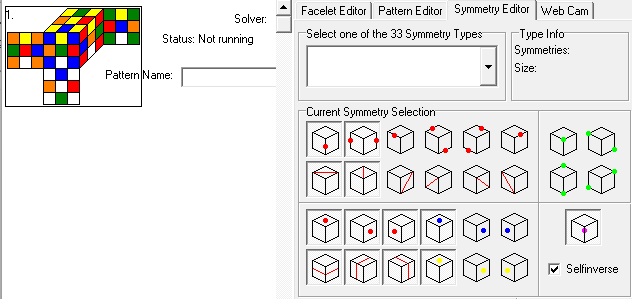
The blue dot on the top means that the position has a 90° rotational symmetry around the UD axis. This implies that R, F L and B moves lead to equivalent positions. The red dot on the R face means that there is a 180° rotational symmetry around the RL axis. This implies that U and D moves give equivalent positions. There is a horizontal mirror symmetry which maps the U to the D face (and the D face to the U face). This shows that U' and D' moves give equivalent positions to U and D moves. Another mirror plane maps the R face to the L face and another the F face to the B face. This shows that R', L', F' and B' moves lead to equivalent positions as R, L, F and B moves. So there are only two equivalence classes, one with 8 positions and one with four positions.
The blue dot on the top means that the position has a 90° rotational symmetry around the UD axis. This implies that R, F L and B moves lead to equivalent positions. The red dot on the R face means that there is a 180° rotational symmetry around the RL axis. This implies that U and D moves give equivalent positions. There is a horizontal mirror symmetry which maps the U to the D face (and the D face to the U face). This shows that U' and D' moves give equivalent positions to U and D moves. Another mirror plane maps the R face to the L face and another the F face to the B face. This shows that R', L', F' and B' moves lead to equivalent positions as R, L, F and B moves. So there are only two equivalence classes, one with 8 positions and one with four positions.
A beautiful conclusion to my research, which I believe was not redundant and helps to better understand the (categories) classes of symmetry.It is not difficult if you look at the symmetries of the 26q* position S1 with Cube Explorer.
Can one more question about non-spatial symmetries be clarified?
It says: "Only 79 780 positions of distance-24 in the quarter-turn metric are known. Of these, 78,820 have some form of symmetry; there are 3,324 different positions with respect to symmetry and antisymmetry. " - Of these 3,324 (3341) different positions, at least 1/6 (596) are reversible, for which the scratch sequence is their same solution (as for the S1-superflip consisting of four spots).
That is, the antisymmetry property, or in other words the presence of a position having symmetry with respect to the inversion operation, is quite large (1/6). I wonder if this is inherent for states "far" from the solution (like distance-24) or if there is some general pattern?
Herbert Kociemba
Veteran
- Joined
- Nov 29, 2008
- Messages
- 302
Your observation is right. Symmetry and antisymmetry happen much more often for positions which have a large distance to solved in both QTM and HTM. I have no good explanantion for this.
By the way antisymmetry is more complicated than symmetry. While there are 33 types of symmetry, there are 131 types of antisymmetry. While there are exactly 164,604,041,664 symmetric cubes - with exactly 1,091,994 of them with 20 moves in HTM, which is about 600,000 times more than the ratio of 20 move positions for all cubes - we only know the number of cubes for each of the 131 antisymmetry types. But we do not know the number of 20f*/26q* positions among these. See https://kociemba.org/antisymmetric.html if you want to know more about antisymmetry.
By the way antisymmetry is more complicated than symmetry. While there are 33 types of symmetry, there are 131 types of antisymmetry. While there are exactly 164,604,041,664 symmetric cubes - with exactly 1,091,994 of them with 20 moves in HTM, which is about 600,000 times more than the ratio of 20 move positions for all cubes - we only know the number of cubes for each of the 131 antisymmetry types. But we do not know the number of 20f*/26q* positions among these. See https://kociemba.org/antisymmetric.html if you want to know more about antisymmetry.
Last edited:
Similar threads
V
- Replies
- 5
- Views
- 828
V

- Replies
- 15
- Views
- 2,151

- Replies
- 3
- Views
- 1,553

