

Space:
The final frontier.
These are the voyages of the starship Enterprise. Its 5-year mission…
One day, while the USS Enterprise was investigating the exact mass of the P Cygni, which is a hyper-giant luminous blue variable star in the constellation Cygnus, located about 5,300 light-years from Earth.
Suddenly, a Klingon spaceship appeared before them, apparently used cloaking method to move in, and the Enterprise went unnoticed.
When Ms. Uhura noticed the sudden appearance of a Klingon spaceship and turned to report it to Captain Kirk, all time on board the ship stopped for a split second, a pause so brief that no one noticed.
Ms. Uhura shouted, "Captain, a Klingon spaceship has appeared under our noses!", and added, "We have a communications beam coming through and they are requesting to speak to you, Captain. If we attempt to attack or flee, they will fire a Photon torpedo." Captain Kirk told her, "OK, put me through," and communication began.
"Captain Kirk, it's been a while. I'm Gowron. I was sad to lose the Kube match the other day, but we Klingons believe in fair play, so I have no regrets."
"Today, to show you the high level of our technological capabilities, we wanted to introduce you to a puzzle WE invented called Klock, and we used cloaking to suddenly appear in front of you and surprise you a bit. You probably didn't notice that time on board the ship stopped for a moment."
Mr. Spock quickly operated the instruments and pulled up the clock time log in the computer, and was astonished to see that it indeed showed that time had stopped. He told Captain Kirk, "Captain, Gowron is right, time on board the ship has stopped for 40 picoseconds. I read an article in the past about a research team at Cornell University who were able to stop time in a device for 40 picoseconds by adjusting the light. It appears they have developed a device that uses a kind of beam to stop time at a remote object."
Gowron continued, "As I said before, we believe in fighting fair and square, so we're not going to destroy your ship now. I've beamed the puzzle in, so see if you can find the solution."
Captain Kirk and Mr. Spock went to the transportation room and found the package. When they opened it, they found the following puzzle and instructions inside.
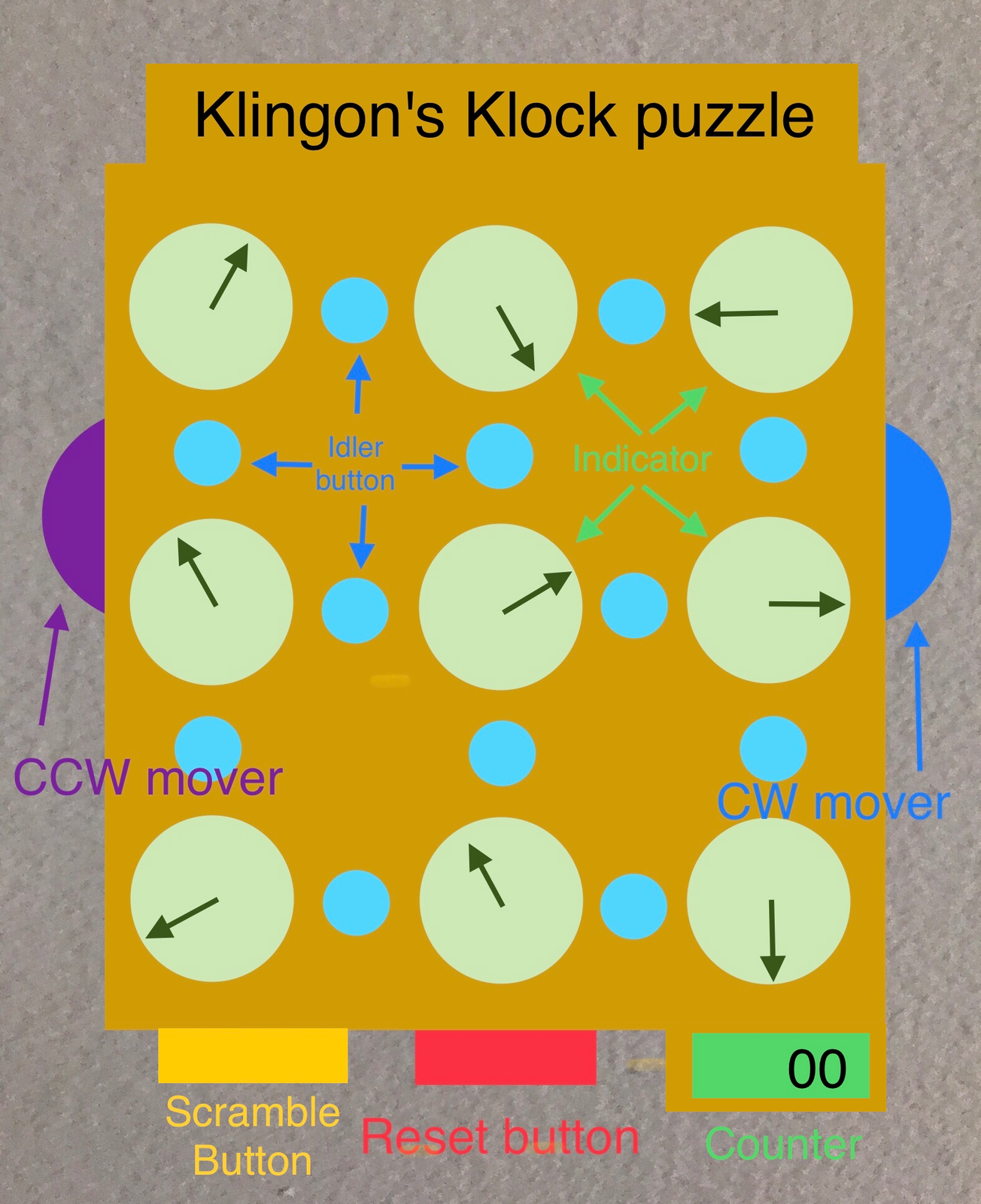
① Press the Scramble button to display random times on the 9 clocks. Play begins from here.
② Press the Idler button to move only the clocks on either side of it. You can press any number of Idler buttons at once.
③ Use the dials on both sides to turn the time on the clocks you want to move clockwise or counterclockwise.
④ Once you have turned the dials as much as necessary, press the Reset button on the bottom to return all Idler buttons to their original, unpressed state.
⑤ Repeat steps ② to ④ above until the time on all clocks is '16'. The solve is complete.
⑥ The counter will always display the total "moved hours", and the winner is the player who completes the puzzle in the least amount of 'moved hours'.
Note) "Moved hours" counts the hours per clock moved with the dials, and does not affect the count no matter how many clocks are moving at the same time.
Captain Kirk and Mr. Spock suspected that the puzzle was a copy of the popular Clock puzzle on Earth, and Mr. Spock immediately began searching for a solution to the puzzle.
The final frontier.
These are the voyages of the starship Enterprise. Its 5-year mission…
One day, while the USS Enterprise was investigating the exact mass of the P Cygni, which is a hyper-giant luminous blue variable star in the constellation Cygnus, located about 5,300 light-years from Earth.
Suddenly, a Klingon spaceship appeared before them, apparently used cloaking method to move in, and the Enterprise went unnoticed.
When Ms. Uhura noticed the sudden appearance of a Klingon spaceship and turned to report it to Captain Kirk, all time on board the ship stopped for a split second, a pause so brief that no one noticed.
Ms. Uhura shouted, "Captain, a Klingon spaceship has appeared under our noses!", and added, "We have a communications beam coming through and they are requesting to speak to you, Captain. If we attempt to attack or flee, they will fire a Photon torpedo." Captain Kirk told her, "OK, put me through," and communication began.
"Captain Kirk, it's been a while. I'm Gowron. I was sad to lose the Kube match the other day, but we Klingons believe in fair play, so I have no regrets."
"Today, to show you the high level of our technological capabilities, we wanted to introduce you to a puzzle WE invented called Klock, and we used cloaking to suddenly appear in front of you and surprise you a bit. You probably didn't notice that time on board the ship stopped for a moment."
Mr. Spock quickly operated the instruments and pulled up the clock time log in the computer, and was astonished to see that it indeed showed that time had stopped. He told Captain Kirk, "Captain, Gowron is right, time on board the ship has stopped for 40 picoseconds. I read an article in the past about a research team at Cornell University who were able to stop time in a device for 40 picoseconds by adjusting the light. It appears they have developed a device that uses a kind of beam to stop time at a remote object."
Gowron continued, "As I said before, we believe in fighting fair and square, so we're not going to destroy your ship now. I've beamed the puzzle in, so see if you can find the solution."
Captain Kirk and Mr. Spock went to the transportation room and found the package. When they opened it, they found the following puzzle and instructions inside.
- There are 9 clocks only on the front.
- The clock face has '16' at the top and numbers 1 to 15 going clockwise from there (a Klingon day has 16 hours).
- There is a dial on the right side to turn the clock clockwise, and a dial on the left side to turn it counterclockwise.
- There are a total of 12 Idler buttons between the clocks.
- At the bottom there are a Scramble button, a button to reset all Idler buttons, and a Counter that displays the total "moved hours".
① Press the Scramble button to display random times on the 9 clocks. Play begins from here.
② Press the Idler button to move only the clocks on either side of it. You can press any number of Idler buttons at once.
③ Use the dials on both sides to turn the time on the clocks you want to move clockwise or counterclockwise.
④ Once you have turned the dials as much as necessary, press the Reset button on the bottom to return all Idler buttons to their original, unpressed state.
⑤ Repeat steps ② to ④ above until the time on all clocks is '16'. The solve is complete.
⑥ The counter will always display the total "moved hours", and the winner is the player who completes the puzzle in the least amount of 'moved hours'.
Note) "Moved hours" counts the hours per clock moved with the dials, and does not affect the count no matter how many clocks are moving at the same time.
Captain Kirk and Mr. Spock suspected that the puzzle was a copy of the popular Clock puzzle on Earth, and Mr. Spock immediately began searching for a solution to the puzzle.
Last edited:


