
Navigation
Install the app
How to install the app on iOS
Follow along with the video below to see how to install our site as a web app on your home screen.
Note: This feature may not be available in some browsers.
More options
-
 Welcome to SpeedSolving.com — the world’s largest puzzle community!
You’re currently browsing as a guest, which means you have limited access to discussions, resources, member profiles, and community features.
Join 50,000+ cubers and puzzle enthusiasts from around the world to ask questions, share solves, improve faster, and be part of the community.
Registration is free, fast, and easy — create your account today.
Already a member? Log in here to hide this message and start participating.
You are using an out of date browser. It may not display this or other websites correctly.
You should upgrade or use an alternative browser.
You should upgrade or use an alternative browser.
K4 EOLL
- Thread starter Silky
- Start date
D
Deleted member 36445
Guest
have you seen my k4 LL trainer?Looking to develop K4 EOLL algs. I believe that there should be 64 in total ( saw the number is some other thread a while back ). If they've already been genned just drop them here.
I know a few, if you post the cases here I can help putting some solutions I know
D
Deleted member 36445
Guest
do you know of a good video that teaches big cube edges commutators?
I've seen an example solve o k4 LL but I don't know how to aproach all the cases directly
I've seen an example solve o k4 LL but I don't know how to aproach all the cases directly
do you know of a good video that teaches big cube edges commutators?
I've seen an example solve o k4 LL but I don't know how to aproach all the cases directly
There's also this. There used to be a video tutorial on youtube but I think it's been taken down. As far as I've seen the main approach is CLL => 1st Dedge => 2nd Dedge => L4E. With the previous link it would be CLL => 1st Dedge => EOLL => EPLL. Not 100% sure if there are actually 64 cases for EOLL but if we figured out a system for CLL => EOLL => EPLL that would cut out an entire step for LL. Would have to see how the algs would turn out.
D
Deleted member 36445
Guest
heyyyLooking to develop K4 EOLL algs. I believe that there should be 64 in total ( saw the number is some other thread a while back ). If they've already been genned just drop them here.
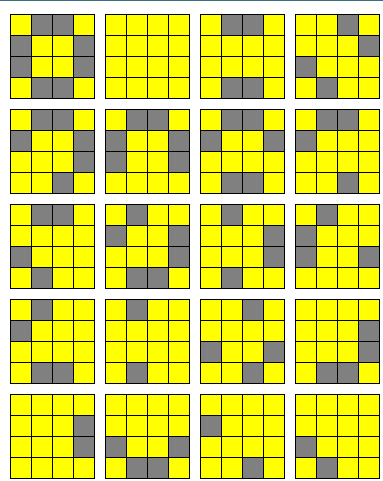
So I finished the script to generate the possible cases.
There are 70 legal cases, but removing symmetries (auf) there are 20 cases. (one of them is all edges oriented...)
| number of symmetries | number of cases |
| 1 | 2 |
| 2 | 2 |
| 4 | 16 |
GitHub - shuantsu/k4_eoll_cases: k4_eoll_cases|hidden
k4_eoll_cases|hidden. Contribute to shuantsu/k4_eoll_cases development by creating an account on GitHub.
 github.com
as there are only 20 eoll cases that would be:
40 cll
20 eoll
?? epll
but take in mind pll parity, you can reduce the number of epll if you don't take parity into account, so I think it may have potential
Last edited by a moderator:
D
Deleted member 36445
Guest
these are all the algs needed to solve the 20 cases, you can use 2 of them max + aufs to solve any case.
btw do you know any good 4x4 equivalent of cube explorer?
btw do you know any good 4x4 equivalent of cube explorer?
Last edited by a moderator:
btw do you know any good 4x4 equivalent of cube explorer?
Batch solver is the only one I know of but it requires certain parameters to set up; of which I'm unfamiliar. You could check on Trang's discord

Christopher Mowla
Premium Member
Hi.
First of all, I have been (well, I haven't been into cubing that much for the past 4 years or so) interested in K4 off and on since 2008. Here's a capture of the original K4 webpage that was probably published in 2006 (if interested)!
But okay. Firstly, you can look at this webpage that I saved as a PDF (Ben Whitmore's site is no longer online) to get at least 1 alg (for many cases, there is more than 1 alg) for each of the 477 possible OLLs that there can be on a 4x4x4.
Ben found most (if not all) of those with his KSolve++ program, I believe. But you can see that maybe he deleted the download link, but here's the version that I downloaded in March of 2018. I never used KSolve or KSolve++ to know how to use them (in full), so I cannot help you there. But there are . . . or at least there were . . . plenty of people on here who do. (I have almost always made big cube edge algs by hand and took pride in doing so.)
In addition, Clément Gallet's 4x4x4 solver has been used (by him) to find many amazing short (if not move optimal) for various 4x4x4 PLL parity cases (and at least 1 3 dedge flip case). You can search for Clément Gallet on the 4x4x4 parity algorithms speedsolving wikipage to get an idea of what it can do!) Here's one of his posts about it, but this is the solver itself. (I couldn't . . . and/or didn't have the time to . . . find it online.)
Notes:
But, from my post in my cubing contributions hyperlink thread, here is additional K4 content that I have contributed over the years.
Specifically, under the Algorithm Sets and/or Guides heading, you may find 3-Look K4 Last Layer Method interesting. It's a method for solving the LL wings with at most 3 algs, where:
So if you compare my 3-step method's required number of algs vs the required number of algs for solving the wings in 2 steps (EOLL then EPLL), maybe you will determine that it's more feasible to solve them in 3 steps instead of 2? But the more power to you if you wish to do the latter! But maybe people like Tempus will come along and present like, 12 algs to compose all cases in just 2-look!
And from this point to 30 minutes in that same video, I explain the basic idea behind "piece-isolating commutators". Most 3-cycle algorithms can be decomposed into a conjugation (or cyclic shift) of a piece-isolating commutator. But piece-isolating commutators can be used to do more advanced things for sure.
And, it's probably overkill, but you can maybe see my huge post about commutators on math.stackexchange whenever you have time (should you be interested).
But besides commutators, you can use conjugates (of a single slice turn) to create a variety of 2 2-cycle cases. I bet you know Stefan Pochmann's r2 F2 U2 r2 U2 F2 r2 = [r2 F2 U2: r2], but as you can see in my 3 step K4 method PDF (and in complete set of last layer 2 2-cycles, my F3L PDF, etc.), I have made many algorithms from Stefan's idea.
And I find this "conjugation method" (although it forces you to use F or B moves . . . or perhaps M moves, if that makes it possible to avoid F and B moves) to be more intuitive than commutators (for these basic cases, that is). For example, here's a video I made about how to solve parity intuitively. You see throughout the video of me explaining how to set up the centers and edges simultaneously to achieve different results, using this conjugation method. After you see that, then maybe you can understand the variety of algorithms I listed in this post for solving various cases.
That's my 2 cents about this topic. If you have questions, feel free to ask.
And, although I have made cubing videos in the past (primarily "parity algorithm theory - related videos), I never made one on my 3-Look K4 Last Layer Method. If you wish to (but cannot follow) the instructions/guide in the PDF, and would like me to make a video about it, let me know. (But again, I'm just stopping by briefly today to post this . . . not into cubing at the moment. So I would appreciate if you try to understand it. But if not, let me know.)
P.S.
It was really hard to find some of these links using Google search today. I typed the thread titles (verbatim), and no results came up! It's as though Google wants us to forget our own history! (I luckly have saved many of these threads . . . or know how to find them . . . that's the only reason I could find them!)
First of all, I have been (well, I haven't been into cubing that much for the past 4 years or so) interested in K4 off and on since 2008. Here's a capture of the original K4 webpage that was probably published in 2006 (if interested)!
But okay. Firstly, you can look at this webpage that I saved as a PDF (Ben Whitmore's site is no longer online) to get at least 1 alg (for many cases, there is more than 1 alg) for each of the 477 possible OLLs that there can be on a 4x4x4.
Ben found most (if not all) of those with his KSolve++ program, I believe. But you can see that maybe he deleted the download link, but here's the version that I downloaded in March of 2018. I never used KSolve or KSolve++ to know how to use them (in full), so I cannot help you there. But there are . . . or at least there were . . . plenty of people on here who do. (I have almost always made big cube edge algs by hand and took pride in doing so.)
In addition, Clément Gallet's 4x4x4 solver has been used (by him) to find many amazing short (if not move optimal) for various 4x4x4 PLL parity cases (and at least 1 3 dedge flip case). You can search for Clément Gallet on the 4x4x4 parity algorithms speedsolving wikipage to get an idea of what it can do!) Here's one of his posts about it, but this is the solver itself. (I couldn't . . . and/or didn't have the time to . . . find it online.)
- If I recall correctly, Clément's solver was actually a derivative work of Bruce Norskog's 's 5 phase 4x4x4 solver (which Bruce used to find all kinds of lower/upper bounds for the 4x4x4, such as this post, for example, on Domain of the Cube puzzle theory site (which has now been moved to/has become cubeman.org).
- And not to digress too much, but just in case you wish to contact Clément, and you cannot do so through speedsolving, if Domain of the Cube has a messaging service, you can contact him from there, as he made this post on Domain of the Cube around the same time he posted here on speedsolving. He was inactive, regarding his solver, for many years prior, but seemed to be on the role that year! . . . He and Bruce are both legends to me (they are in my top 10 list for sure)! I was actually excited to be able to converse with Clément during that short time!
I have never looked at how the algs affect PLL parity (or to see if some of them are odd parity algorithms), but maybe you will desire to look at what Ben's algs do for different corner cases, should they have the same effect on edge orientation? (In other words, be willing to "orient" the wings before solving corners?)but take in mind pll parity, you can reduce the number of epll if you don't take parity into account, so I think it may have potential
Notes:
- If you two desire to do EOLL with just 1 algorithm, then perhaps Ben's algs are a good start (but also, later on in this post, I provide a link to a PDF which contains algs that I found for all 20 cases).
- If you two wish to also solve EPLL with just 1 algorithm, here's a PDF I made while back which shows all of the cases. (On the last page, I show the 20 cases for EOLL.) And, although it's incomplete, here is a PDF with algorithms for some of those cases. Algorithms I found for the 20 EOLL cases are on the last 2 pages. (Well, I didn't provide an algorithm for the trivial case . . . you can see the alg set in my A complete set of brief last layer 2 2-cycle algorithms and/or A complete set of brief last layer 4-cycle algorithms, or you can simply use what you already have . . . or use Ben's.)
But, from my post in my cubing contributions hyperlink thread, here is additional K4 content that I have contributed over the years.
K4 Method Content
Software
TI-83/84 plus 4x4x4 Last Layer Wing Edge Solver|Animated GIF Ex. [For non-members, Link to thread, The Program, ReadMe]
Algorithm Sets and/or Guides
F3L
"2 Gen" 3-cycle algorithms
3-Look K4 Last Layer Method
A complete set of layer layer 3-cycle algorithms
A complete set of brief last layer 4-cycle algorithms
A complete set of brief last layer 2 2-cycle algorithms
Short and/or fast algorithms for "oriented" 1 3-cycle and 1 2-cycle cases
Theory
Counting the number of last layer 3-cycles, The PDF (for non members to access)
Counting the number of last layer 2 2-cycles and 4-cycles
Counting the number of last layer wing edge "PLLs" (in a single orbit), The PDF (for non members to access)
Minimum number of required 3-cycles to solve an entire orbit of wing edges
Counting the number of K4 OLLs for the nxnxn: Paper (Part 1), Paper (Part 2), Alternate form of the formula
Specifically, under the Algorithm Sets and/or Guides heading, you may find 3-Look K4 Last Layer Method interesting. It's a method for solving the LL wings with at most 3 algs, where:
- Number of algorithms to be learned (including mirrors, inverses, and related algorithms): 66.
So if you compare my 3-step method's required number of algs vs the required number of algs for solving the wings in 2 steps (EOLL then EPLL), maybe you will determine that it's more feasible to solve them in 3 steps instead of 2? But the more power to you if you wish to do the latter! But maybe people like Tempus will come along and present like, 12 algs to compose all cases in just 2-look!
Here's a video by Dan Cohen that maybe you were thinking of?There used to be a video tutorial on youtube but I think it's been taken down.
Not that it's much of anything (but it can be considered "core knowledge", I suppose), I reserved the last 4 minutes of my commutator tutorial video for solving 3-cycle cases with conjugates of the Niklas (the entire video is exploiting the Niklas . . . using variations of it to solve the entire 3x3x3 cube).do you know of a good video that teaches big cube edges commutators?
I've seen an example solve o k4 LL but I don't know how to aproach all the cases directly
And from this point to 30 minutes in that same video, I explain the basic idea behind "piece-isolating commutators". Most 3-cycle algorithms can be decomposed into a conjugation (or cyclic shift) of a piece-isolating commutator. But piece-isolating commutators can be used to do more advanced things for sure.
And, it's probably overkill, but you can maybe see my huge post about commutators on math.stackexchange whenever you have time (should you be interested).
But besides commutators, you can use conjugates (of a single slice turn) to create a variety of 2 2-cycle cases. I bet you know Stefan Pochmann's r2 F2 U2 r2 U2 F2 r2 = [r2 F2 U2: r2], but as you can see in my 3 step K4 method PDF (and in complete set of last layer 2 2-cycles, my F3L PDF, etc.), I have made many algorithms from Stefan's idea.
And I find this "conjugation method" (although it forces you to use F or B moves . . . or perhaps M moves, if that makes it possible to avoid F and B moves) to be more intuitive than commutators (for these basic cases, that is). For example, here's a video I made about how to solve parity intuitively. You see throughout the video of me explaining how to set up the centers and edges simultaneously to achieve different results, using this conjugation method. After you see that, then maybe you can understand the variety of algorithms I listed in this post for solving various cases.
That's my 2 cents about this topic. If you have questions, feel free to ask.
And, although I have made cubing videos in the past (primarily "parity algorithm theory - related videos), I never made one on my 3-Look K4 Last Layer Method. If you wish to (but cannot follow) the instructions/guide in the PDF, and would like me to make a video about it, let me know. (But again, I'm just stopping by briefly today to post this . . . not into cubing at the moment. So I would appreciate if you try to understand it. But if not, let me know.)
P.S.
It was really hard to find some of these links using Google search today. I typed the thread titles (verbatim), and no results came up! It's as though Google wants us to forget our own history! (I luckly have saved many of these threads . . . or know how to find them . . . that's the only reason I could find them!)
Last edited:
D
Deleted member 36445
Guest
Dude that's so much more than just two cents!That's my 2 cents about this topic. If you have questions, feel free to ask.
Thanks so much for looking up the resources and sharing your knowledge!

Gnome
Regular
There is also this (now unlisted) PDF on Andy Klise's site lifted nearly verbatim from the original Barlow site (a printout of which still lives in my laptop bag after all these years.. memory like a sieve).
So I finished the script to generate the possible cases.
There are 70 legal cases, but removing symmetries (auf) there are 20 cases. (one of them is all edges oriented...)
I probably typoed a few moves here and there; I'll fix mistakes when I'm notified of them.
OLL 20 (use your favourite alg)
skip
OLL 57 (use your favourite alg)
(2R' R) U' (2R R') F' 2R' U 2R U' F R U R' {BW} / (y) F' R 2U2 R' F U2 F' R 2U2 R' F / (y) 3r 3u' 3R2 3u 3r' U2 3r 3u' 3R2 3u 3r'
r' U' R' F R F' U r F R U R' U' F' {BW}
r' U2 r' D' r U2 r' D r2 R' F' U' F U R (doesn't preserve CP) {BW} / r' U' R U' R' U2 r2 U2 r' U r U2 r' U2 r U' r' {BW}
(y') r' F' U F U' r U2 R2 U' F' U F2 R F' R (doesn't preserve CP) {BW} / r U2 R' U' R U' r' 3r' R2 U R' U R U2 R' U M'
(y) r' U' R' F R F' U r (doesn't preserve corners) / (y2) r U R' U' 2R' 3R U R U' R' 3R' {CM}
f R U R' U' f' (doesn't preserve corners) / (y2) R' U' R U r U2 r2 R U' R' U r2 U2 r' {BW} / (y2) 3R R U R' U' 3R' 2R U R U' r' {CM}
(y2) f R U R' U' f' R' U' R' F R F' U R {BW}
r U2 r' U r U2 r' U2 r U' r' (doesn't preserve corners) {BW} / (y) R' F' U' F U R r B U B' U' r' {BW} / F' R 2D2 R' F U' F' R 2D2 R' F
l F U' R U R' F' l' (doesn't preserve corners) / (y) r' U' R U 2R 3R' U' R' U R 3R {CM}
(y') r' U' F' U F r (doesn't preserve corners) / (y2) R U R' U' r' U2 r2 R' U R U' r2 U2 r {BW} / (y2) 3R' R' U' R U 3R 2R' U' R' U r {CM}
r U R' U' r' F R F' (doesn't preserve corners) / (y2) R U R' U' 2R U R U' r'
(y2) R2 U2 R2 U R2 2F R2 U' R2 U 2F' U R2 {BW}
OLL 28 (use your favourite alg)
x r2 D2 r U2 r' D2 r U2 l (doesn't preserve corners) / 2R r2 F2 r2 U r2 F2 r2 U' 2R' {BW} / r' U' R U' 2R2 U R' U' 2R2 U2 r {idea from Chris}
(y2) R' U' R' F R F' U R f R U R' U' f' {BW} / F' R 2U2 R' F U' F' R 2U2 R' F
(y') F R' F' r U R U' r' (doesn't preserve corners) / (y') 3r U R' U' 3R' U R U' r'
(y') r U R' U' 2R' U R U' R'
Last edited:

artless1der
Veteran
Thats gotta be at least thirtyeleven cents...Dude that's so much more than just two cents!
Thanks so much for looking up the resources and sharing your knowledge!
my grandma would call it a bushel
and yes, thanks for the sharing!
I think Clement has a YT channel as well...
but he also has a girlfriend so he might not be doing much with any of his accounts lol
