Ideas for a Math Project?

AvidCuber

Veteran
Joined
Feb 13, 2010
Messages
566
Location
USA
Hey everyone,

I've got a final math project for my Algebra II class that should demonstrate our mastery of at least one topic we've covered this year. It should be something that we're really interested in, but it does have to connect to math somehow, and I need some ideas for what to do. What we've learned is:

Graphing/Solving Linear Equations & Functions
Slope
Exponential Functions
Argument & Value
Powers & Roots
Pythagorean Theorem
Evaluating & Simplifying Algebraic Expressions
Matrix Operations
Rotations & Reflections with Matrices
Proportions
Probability
Hyperbolic Functions
Inverse & Direct Variation
Linear & Quadratic Regression
Graphing & Solving Quadratic Functions and Equations
Factoring & Expanding Algebraic Expressions
Complex Numbers
Logarithms
Algebraic Logic Problems

Other stuff I'm interested in (other than cubing) is music (I play both flute and piano), wood carving, cycling, nature, and martial arts, etc., I like pretty much anything except video games (that's all I can think of at the moment).

I know I'll probably be told that it's up to me what I do my math project about, and I agree, but I have no idea as of now and I'd like to have a few choices to choose from.

Thanks for your help!
 
Last edited:
Hey everyone,

I've got a final math project for my Algebra II class that should demonstrate our mastery of at least one topic we've covered this year. It should be something that we're really interested in, but it does have to connect to math somehow, and I need some ideas for what to do. What we've learned is:

Graphing/Solving Linear Equations & Functions
Slope
Exponential Functions
Argument & Value
Powers & Roots
Pythagorean Theorem
Evaluating & Simplifying Algebraic Expressions
Matrix Operations
Rotations & Reflections with Matrices
Proportions
Probability
Hyperbolic Functions
Inverse & Direct Variation
Linear & Quadratic Regression
Graphing & Solving Quadratic Functions and Equations
Factoring & Expanding Algebraic Expressions
Complex Numbers
Logarithms Logrithmic Equations as a cubers time reachs their best for what they know. Meaning, once you know full PLL, you need to start getting used to it, so there will be a point where you are slowly decreasing speed (when you first start) then youll exponentially increase as you get closer to your best with OLL, then increase slower again. Logrithmic function.
Algebraic Logic Problems

Other stuff I'm interested in (other than cubing) is music (I play both flute and piano), wood carving, cycling, nature, and martial arts, etc., I like pretty much anything except video games (that's all I can think of at the moment).

I know I'll probably be told that it's up to me what I do my math project about, and I agree, but I have no idea as of now and I'd like to have a few choices to choose from.

Thanks for your help!

Mine are added in red. Just wanted to get that one out there, but I will be coming back and editing it again later. I have some more ideas just have to get off the computer for a bit.

~Chris
 
Good idea, Chris, although I think it would be more exponential then logarithmic (even though the concepts are similar), am I right? (sorry, I was never good at logarithms, so I don't know if that's correct or not & please correct me if it's wrong)

Although, there would have to be fairly consistent data for it to be accurate.

Logarithmic:
growth-curve.jpeg

On this graph, you will start out slow, getting better slowly, (from forever to about a minute per solve) then for a period you will get much faster much quicker (40 seconds to 25 seconds or so per solve) then as you approach 10 seconds (or so) you will see very small improvements much slower. Therefore, the logarithmic growth graph.

At the stationary phase (shown on the graph) you will not be increasing, a cuber only reaches this stage once they have reached their max. Which is usually when the only thing limiting you is the speed your fingers can move, the speed at which your brain processes information, or how fast the cube will turn.

Here is an example of how exponential graphs would not work in this scenario.

Exponential:
2_power_x_growth.jpg

As you can see here, the graph will continue on to infinity, which in the case I described earlier, would mean you will eventually get to 0 seconds per solve (and very quickly at that) which is impossible.


~Chris
 
Last edited:
I think Chris' example is more specifically a logistic equation, because logarithmic would be improving less all the time from the beginning.

Anyway, I always thought hyperbolic functions were cool, and how they relate to the circular ones. (You could also tie in complex numbers with that too!)

Just do whatever you feel like doing XD
 
Good idea, Chris, although I think it would be more exponential then logarithmic (even though the concepts are similar), am I right? (sorry, I was never good at logarithms, so I don't know if that's correct or not & please correct me if it's wrong)

Although, there would have to be fairly consistent data for it to be accurate.

Logarithmic:
growth-curve.jpeg

On this graph, you will start out slow, getting better slowly, (from forever to about a minute per solve) then for a period you will get much faster much quicker (40 seconds to 25 seconds or so per solve) then as you approach 10 seconds (or so) you will see very small improvements much slower. Therefore, the logarithmic growth graph.

At the stationary phase (shown on the graph) you will not be increasing, a cuber only reaches this stage once they have reached their max. Which is usually when the only thing limiting you is the speed your fingers can move, the speed at which your brain processes information, or how fast the cube will turn.

Here is an example of how exponential graphs would not work in this scenario.

Exponential:
2_power_x_growth.jpg

As you can see here, the graph will continue on to infinity, which in the case I described earlier, would mean you will eventually get to 0 seconds per solve (and very quickly at that) which is impossible.


~Chris

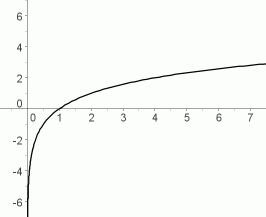
That's a really weird logarithmic function... I'm pretty sure that's some other function that I can't remember then name of. Logarithmic starts (?) at (0, -infinity) and goes from there:

log_base_gt1.gif


Which I think makes more sense as right after you learn F2L (changing your example a little), you slow down (the negative) then you match the time (y=0), then you get faster quickly at first then less over time.

I meant logistic growth. Oops.
 
Last edited:
lolchris. :P

Hes picking on your wording.
You just posted a picture of a different kind of growth.
Logistic =/= logarithmic.
 
Last edited:
lolchris. :P

Hes picking on your wording.
You just posted a picture of a different kind of growth.
Logistic =/= logarithmic.
Lol good, I was thinking, "I don't get this at all..." I'm not good when it comes to exponential stuff...
 
Back
Top