Jim Mittan
Member
Hello! I am Jim Mittan (pronounced M'TAN, the "i" is basically silent).
In May of 1981, I purchased my first cube and solved it a month later. At the time, the puzzle did not come with instructions, and the internet was not yet available. However, there was an article in Scientific American that gave hints to solve the puzzle. In May 1982, I realized that it would be possible to solve a cube blindfolded, and set to work. My first successful blindfold solve (memorizing the scramble, making all the moves blindfolded, taking off the blindfold and seeing a solved cube) was in January 1983. My single-minded dedication to the task may have contributed to my divorce during that period.
Imagine my excitement when they announced a blindfold cubing competition as a part of the 2003 world championships in Toronto. You would think that I would be totally prepared for that first competition ever. But that leaves out the fact that I spent most of my time developing various ways to do assisted blindfold cubing, where the solver is blindfolded before the cube is scrambled, and relies on an assistant for the info needed to solve the puzzle. The assistant does not have any knowledge of cubing, but does have adequate color vision and the ability to choose one or more colors, say "yes" or "no", and count. This may explain why, on qualification day in Toronto, I was one of the eight competitors to fail during the first round of the 3x3x3 event. Only Macky Makisumi and Dror Vomberg succeeded. It was only after that first round was completed that we learned that there would be only one qualification round. The next day in the finals, both Dror and Macky DNFed on their one and only attempts. Dror won by virtue of his quicker time in the qualification round. Their attempts took place in a separate room from the audience who could watch via closed circuit TV.
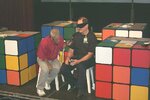
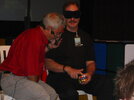
So the only fully public blindfold solve on the day of the finals was a demo of "Seeing Eye" blindfold cubing by yours truly. By today's standards, that solve was no big deal. At the time, the audience was amazed, and someone shouted "That was heinous!" after it was over. My assistant, who was the emcee for the finals, had picked a color. I pointed to squares, and he said yes or no depending on whether the squares were from his color. After one side was completed (not one layer), he chose a second color, and that side was completed withoud messing up the first side. And he chose a third color, and then a fourth color, and a fifth, and then the cube was solved. Turns out, I could have made plenty of mistakes, and still successfully solve the cube. This form of blindfold cubing allows you to correct mistakes, since you are receiving info during the solve. It's relatively foolproof. There are other forms of seeing eye bllindfold cubing. Please get in touch if you are curious.
Anyway, I still haven't solved a cube blindfolded by the official method during a competition. Given enough chances and steady nerves, I am certain I could do it.. But over the years, the cubing community has vastly improved their methods. And that is why I have joined this group.
Please check out the attached photos from Toronto.