

Dan the Beginner
Premium Member
UPDATE. Have a look at this corner piece, after I took it off the cube and then pry open each of the coloured plates. Tiles? They just snap on. I did it to see how I should glue the plates, or where to apply glue, but discovered something interesting inside the corner piece.
The 3 magnets (for attracting other magnets in the edge pieces) are tiny and the adjustment turbine looking disc in the middle of them is interesting. When one of the adjustment lever is pushed, the whole ring turns and moves the other levers. At the same time a lower disc underneath this turbine would rise or lower, changing the distance between the two discs and thereby changing the core magnet distance and magnet strength, i.e. pushing or pulling back the core magnet rod (see Gan's video about their core magnet adjustment, if you are not clear about this). This fancy adjustment system should show why the cube is costly to make. The disc is smaller than a dime, about 14mm. Imagine the delicate assembly work. I suspect there is some sort of leverage linkage design beneath to raise or lower the disc below!
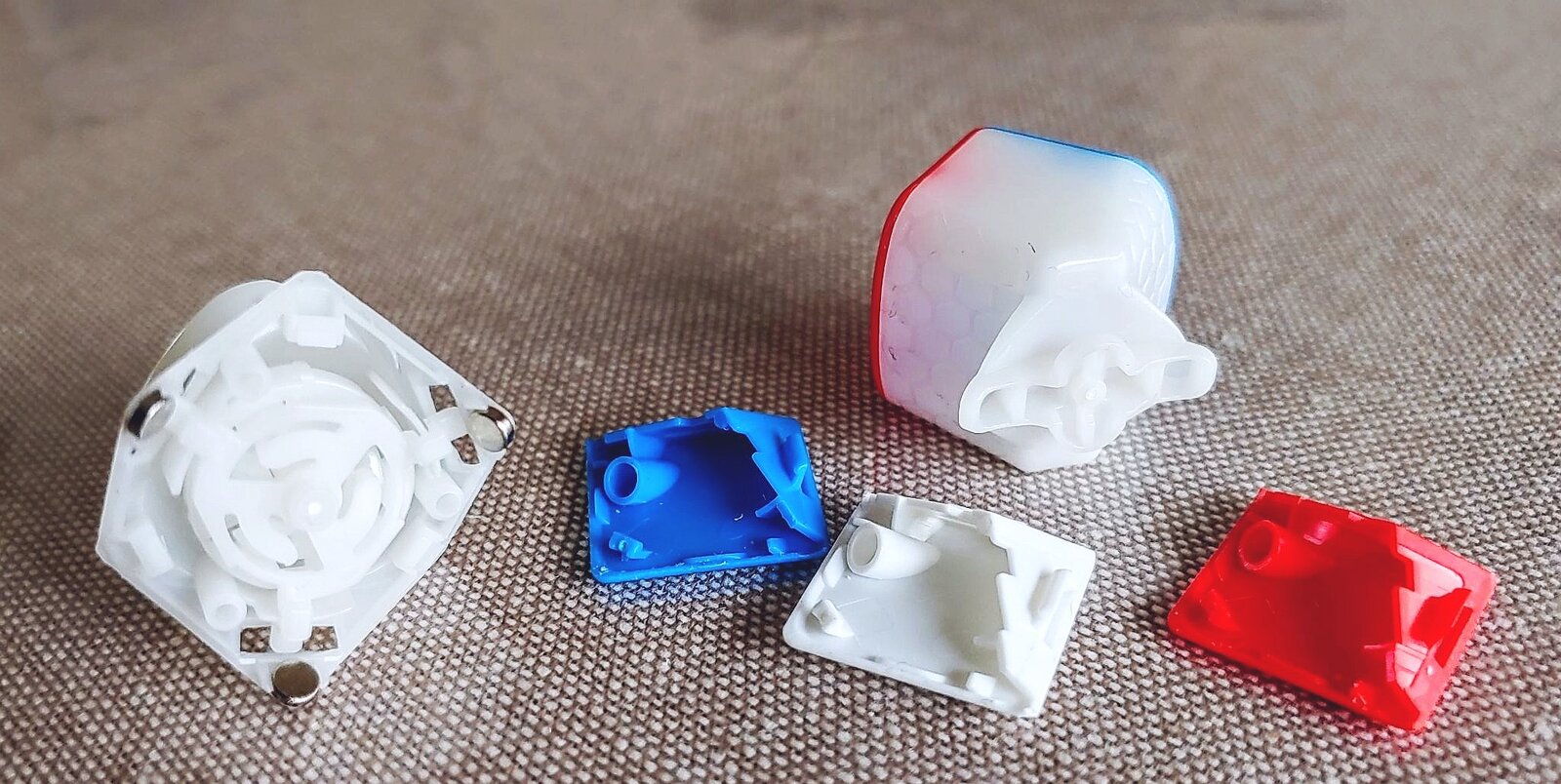
Back to those 3 tiny magnets, they actually provide quite strong attraction forces between the pieces. Since they are positioned right at the corner, i.e. as far away as possible from the centre of the whole cube, they work well in spite of their size. That position means their force is applied at a longer distance from the fulcrum of turning and therefore makes the force stronger. The super lightweight plastic must have also helped, and it's possible those are strong though small magnets.
Minor warning. This cube pops fairly easily if you twist a piece to try to pull it out, to disassamble it. I wanted to investigate the corner piece and take it out. I started by pulling out the edge piece adjacent to the corner piece, twisting and turning it, and two other pieces popped and flew out. Be gentle with this cube. I have no idea whether this indicates any popping problem in solves, as I am a slower turner. I also like my cubes tigher, and have tightened the spring distance of this one to a "1", although the number shown could be anything.
Another warning. Do not take all those plates on all the corners apart at the same time. It will be hard to know which is where when it's time to put them back. Do it one corner piece at a time, and have the cube in a solved state to avoid confusion. Re-assemble each corner piece and put back into the solved cube first, to make sure you have got the right colours in the correction positions, before working on another corner piece.
The 3 magnets (for attracting other magnets in the edge pieces) are tiny and the adjustment turbine looking disc in the middle of them is interesting. When one of the adjustment lever is pushed, the whole ring turns and moves the other levers. At the same time a lower disc underneath this turbine would rise or lower, changing the distance between the two discs and thereby changing the core magnet distance and magnet strength, i.e. pushing or pulling back the core magnet rod (see Gan's video about their core magnet adjustment, if you are not clear about this). This fancy adjustment system should show why the cube is costly to make. The disc is smaller than a dime, about 14mm. Imagine the delicate assembly work. I suspect there is some sort of leverage linkage design beneath to raise or lower the disc below!
Back to those 3 tiny magnets, they actually provide quite strong attraction forces between the pieces. Since they are positioned right at the corner, i.e. as far away as possible from the centre of the whole cube, they work well in spite of their size. That position means their force is applied at a longer distance from the fulcrum of turning and therefore makes the force stronger. The super lightweight plastic must have also helped, and it's possible those are strong though small magnets.
Minor warning. This cube pops fairly easily if you twist a piece to try to pull it out, to disassamble it. I wanted to investigate the corner piece and take it out. I started by pulling out the edge piece adjacent to the corner piece, twisting and turning it, and two other pieces popped and flew out. Be gentle with this cube. I have no idea whether this indicates any popping problem in solves, as I am a slower turner. I also like my cubes tigher, and have tightened the spring distance of this one to a "1", although the number shown could be anything.
Another warning. Do not take all those plates on all the corners apart at the same time. It will be hard to know which is where when it's time to put them back. Do it one corner piece at a time, and have the cube in a solved state to avoid confusion. Re-assemble each corner piece and put back into the solved cube first, to make sure you have got the right colours in the correction positions, before working on another corner piece.
Last edited:




 , making those offending corners more rounded and also more contoured, i.e. sloping towards the gap in between the cube pieces. See photo. This seems to be working and I have not experienced the problem after 3 days. It took me a couple of hours of work though to make it smmoth (there are 24 such corners), and I also had to clean all the pieces and corner due to the fine plastic dust.


