Floppy Cube questions

What program did you use for this? Or did you write one just for this?
I wrote the statistics part just for this, but for generating the solutions I used a program/library that makes solving partial 3x3x3s fairly easy. Deciding what I want to do exactly (formatting etc.) took longer than writing the code to do it.

Do you have a real floppy cube? I hold mine rather vertically so that UDLR are my moves. Because I put my thumbs/fingers on the large faces and for the 3x3x3 my thumbs/fingers are on F/B. I can of course use FBLR, too, I'm just curious whether it comes from theory or practice.
Nope, I don't have one. I chose FBRL because I usually visualize domino in that orientation, and I also use <U,D,F2,B2,R2,L2> in Kociemba's algorithm. Didn't really think about it; when executing the solutions on a 3x3x3, I actually do (half) an x' at the beginning.
 
Last edited:
Wait, if you don't have hands, you get stuck in an infinite loop in the "while b==0" part--once you get a friend with hands, you keep repeating that loop over and over!

No you don't. The first while loop will end. Then you proceed to the next step.

Step 3 is confusing...I don't know which option to choose...

You can do either, or both. It's basic boolean logic.

Was funny, though.

Yay. My aim was mildly amusing at best.
 
For the proof of impossibility of "flipping the centre upside down": That involves permuting edges which we know is impossible, is that good enough?

Do an M-move and you have permuted the edges.

Ok what about... you can't permute edges without flipping the centre therefore flipping the centre alone is impossible?

This is a random question but is it possible to flip the centre on a hexagonal floppy prism?
 
Here is my over elaborate proof that you cannot turn what I like to refer to as the core rather than the center around on it's own:

A turn of any of the four faces of the floppy cube does the following:

- It changes the "orientation" of a center piece (also referred to by some as edge).

- It swaps two "corners", also turning both around.

The action of turning the corner around is irrelevant because the orientation of the corner is dependent on it's position. This is because if we consider one corner we can see that there are four different places it could go.

Two of these places can only be reached by doing an even number of turns, the other two places can only be reached by doing and odd number of turns.

Consider the FR corner. We can turn the right face which moves it to BR. We have now done an odd number of turns. If we continue doing turns that involve this corner and do not reverse our steps, we will find that the next time this corner is in BR we will have done four more turns. As four is an even number, and any even number multiplied by any other natural number is also an even number we find that to get this corner to this position we will always do an odd number (1+any even number) of turns involving this corner.

Because each turn flips the corners it permutes corner around, we can see that the positions reached by an odd number of turns will always have it's corner turned from the identity, and the positions reached by an even number of turns will not have the corner turned from the identity.

We do not need to consider middle layer turns as they are identical to turning the entire prism over and doing two non intersecting moves such as L R.

To flip the core piece (referred to some as center piece), we need to change the orientation of all the edge pieces. That would require an even number of face turns greater than or equal to 4.

The corners need to be at their identity positions. This requires an even number of face turns, and given that an even number of face turns is required to flip the center pieces, this is possible.

Next, the corners need to be flipped around. We have already proven that this is impossible without permuting them. It is therefor impossible to reach the 'dot' state. Q.E.D.
 
I'd say TomZ's proof is somewhat an overly elaborate version of Tim's sketch:
you can do a pons asinorum, but you would then have to basically swap the top and bottom stickers on the corners, which is just physically impossible.
I'm not quite satisfied with either, but admittedly the reason I asked was that I couldn't come up with a nice concise way to explain/prove it myself.

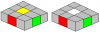
Now I came up with this: Look at the left cube in the image below. Whatever moves you make, the three highlighted stickers will always stay fixed relative to each other. So it's not possible to reach the state shown on the right, which would be required for what I asked for.
 

Attachments

  • floppy_proof.png
    floppy_proof.png
    4.9 KB · Views: 12
OK, I've figured out how to JUST flip the middle piece (the dot). If you want to know, read below (but you're probably not going to be satisfied with the solution).

Paint the yellow center white and the white center yellow.
 
Shoot, I was kinda getting there... :p
Indeed, I think you were. Well, thinking about it some more I'd now go without picture and say this:

The two stickers on the core cubie and the four outside stickers on the edge cubies always stay fixed relative to each other, no matter what moves you make. Just like the six center stickers on a 3x3x3. So having the two core stickers switch places while keeping the outer four stickers where they are is not possible.

Sorry I obsess so much over this, but I really had trouble proving it clearly (and I wasn't alone) and I'm happy I now found something I'm satisfied with. I'm particularly happy I didn't even have to talk about the corners at all.

Well, I do have to use the corners to prove that the double spot pattern isn't possible. Wait, didn't I just prove that above? No. My above proof is for the original request to "just flip the core upside down" and keep the rest of the puzzle exactly the same. But... that doesn't prove I can't build the double spot pattern a different way, by changing the outer ring so it's different but still solved. The way to disprove *that* is to observe that the outer ring can only be built one way, because each piece has forced neighbours.
 
"The two stickers on the core cubie and the four outside stickers on the edge cubies always stay fixed relative to each other, no matter what moves you make. Just like the six center stickers on a 3x3x3. So having the two core stickers switch places while keeping the outer four stickers where they are is not possible."

I'm giving this a thumbs up :)
 
Wait, if you don't have hands, you get stuck in an infinite loop in the "while b==0" part--once you get a friend with hands, you keep repeating that loop over and over!

No you don't. The first while loop will end. Then you proceed to the next step.

Usually the conditions of a while loop just get checked at the end of the loop, not after every step within the loop, and you never reach that end.

Step 3 is confusing...I don't know which option to choose...

You can do either, or both. It's basic boolean logic.
Right, but an algorithm should tell me which to do, since I'm lazy and indecisive.
 
A bit late (only about 6 years), but oh well. I want to tackle the amount of algorithms needed if I were to solve the puzzle at once. It probably wasn't worth it, but I went ahead and memorized the solution for every single floppy cube scramble (oh well).

I have these on my "website" (here). To solve the 3x3 faces of the puzzle in one algorithm (assuming you know how to mirror algorithms and perform x, y, and z rotations), you need about 22 algorithms. Assuming we take a solved Floppy cube and reverse those algorithms, we should arrive at these cases, yes? Now let's perform the algorithm R U M D L to swap around the edges. That's +1 case. Now let's reverse the face-solving algorithms on our new cube. That's 22 more cases. We have now a total of 45 algorithms you'd need to learn (assuming one and two-move solutions are still algorithms). I have a demonstration of the "algorithmic advanced solution" here. Note that the second solve was intuitive. I couldn't recall the algorithm, so in a panic, I simply blindsolved it intuitively. That should explain the definitely not-optimal solution.
 
Last edited:
Back
Top